
Training· 9 min read
An Aquaman-inspired training week: Jason Momoa context
This Aquaman-inspired four-day template combines lifting with optional conditioning and outdoor activity. It is a Zepraug training example, not Jason Momoa’s verified routine or an authenticated AR-7 method.

Certified fitness coach · CQP Instructeur Fitness
Published on
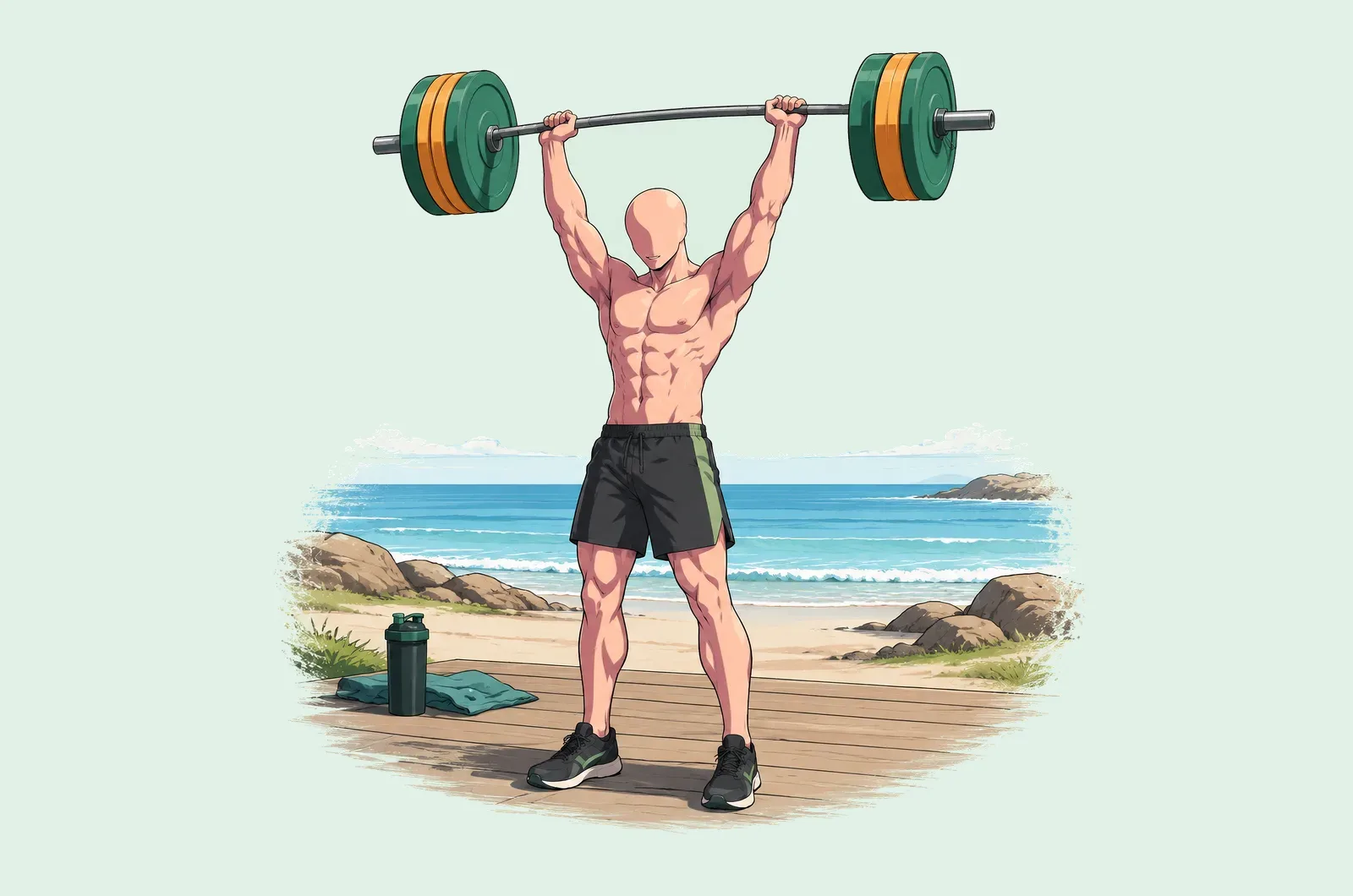
The essentials before you start.
- The tables are a Zepraug proposal, not an authenticated actor training log.
- The complete template has substantial volume; choose fewer exercises or sets when appropriate.
- Load and progression depend on repeatable control, not a weekly deadline.
- A role-inspired theme does not predict a particular body shape or transformation time.
Reported preparation and its limits
The original Men’s Health report describes Momoa’s preference for climbing and other activity. It does not authenticate the four-day lifting template below.
AR-7 routines circulating under his name should not be treated here as a verified actor-published plan. Nor does appearance establish genetics, drug use or a measured current bodyweight. This page does not repeat unverified height or weight estimates.
The proposed training week
The weekday labels are an organisational example. Move sessions and rest days to fit capacity and recovery; there is no promised completion time. Prepare with familiar movements and progressive lighter sets using the warm-up guide.
Use the RPE guide to record effort. Start with manageable loads and avoid treating every set as a failure test. Per-arm or per-leg sets describe work received by each side; three sets per side gives each side three sets.
Monday: upper-body strength
These are extended example amounts. Select rows deliberately, reduce sets or omit optional finishers; rest may exceed the reference. Linked alternatives are choices, not exercises to perform cumulatively.
Each optional round has ten swings, ten burpees and twenty mountain-climber knee drives. Count twenty individual drives as ten per side; five rounds therefore gives 50 swings, 50 burpees and 100 drives.
| Exercise | Sets or rounds | Repetitions or work | Rest reference |
|---|---|---|---|
| Flat dumbbell bench press | 5 | 5 | 2 min 30 |
| Weighted pull-up, or Overhand pull-up with bodyweight | 5 | 5 | 2 min 30 |
| Standing barbell overhead press | 4 | 8 | 2 min |
| One-arm dumbbell row | 4 | 8 per arm | 1 min 30 |
| Parallel-bar dip, or Weighted parallel-bar dip if deliberately selected and manageable | 3 | 8–12 | 1 min 30 |
| Optional circuit: 10 Kettlebell swing, 10 burpees, 20 Mountain climber | 5 rounds | Rest as needed to retain control | 1 min between rounds, or more as needed |
Tuesday: legs and optional speed work
These are extended example amounts. Select rows deliberately, reduce sets or omit optional finishers; rest may exceed the reference. Linked alternatives are choices, not exercises to perform cumulatively.
Four sets of five jumps is twenty jumps; six 30 m sprints is 180 m of sprint distance. These are additional speed tasks, not ordinary strength repetitions or obligatory finishers. Use fewer efforts, more rest or omit them if the movement and landing are not controlled.
| Exercise | Sets or rounds | Repetitions or work | Rest reference |
|---|---|---|---|
| Barbell back squat | 5 | 5 | 3 min |
| Bodyweight jump squats | 4 | 5 | 1 min 30 |
| Romanian deadlift | 4 | 8 | 2 min |
| Walking lunge with dumbbells | 3 | 10 per leg | 1 min 30 |
| Kettlebell swing | 4 | 15 | 1 min |
| 30 m sprints with a walking return | 6 | 1 | Walking return, with more rest as needed |
Thursday: pulling and arms
These are extended example amounts. Select rows deliberately, reduce sets or omit optional finishers; rest may exceed the reference. Linked alternatives are choices, not exercises to perform cumulatively.
| Exercise | Sets or rounds | Repetitions or work | Rest reference |
|---|---|---|---|
| Overhand pull-up, medium grip | 4 | 6–8 | 2 min |
| Barbell bent-over row | 4 | 8 | 2 min |
| Chin-up | 3 | 8–10 | 1 min 30 |
| Inverted row | 3 | 12 | 1 min 30 |
| Hammer curl | 3 | 12 | 1 min |
| Overhead dumbbell triceps extension | 3 | 12 | 1 min |
| Straight-arm bar hang with suitable support | 3 | 30–45 seconds | 1 min |
Friday: optional full-body session
These are extended example amounts. Select rows deliberately, reduce sets or omit optional finishers; rest may exceed the reference. Linked alternatives are choices, not exercises to perform cumulatively.
The clean and press uses one bell for the stated repetitions per arm. Goblet squats use a two-handed single-bell hold. The thruster count means eight complete bilateral squat-and-press repetitions, using a practised two-handed single-bell or two-bell version. A one-arm thruster needs an explicit per-side count and an adjusted amount. Record load per bell and practise the pickup, rack and return separately.
Four optional rounds give 32 thrusters, 32 rows per arm, 40 leg raises and two minutes of planned plank holds. One squat plus press is one thruster here. Shorten or omit a hold and rest between tasks as needed.
| Exercise | Sets or rounds | Repetitions or work | Rest reference |
|---|---|---|---|
| Kettlebell clean and press | 5 | 3 per arm | 1 min 30 |
| Goblet squat | 4 | 10 | 1 min 30 |
| Push-up | 4 | Stop with around two repetitions in reserve | 1 min |
| Optional circuit: 8 Kettlebell thruster, 8 Kettlebell row per arm, 10 Hanging leg raise, 30 seconds of Forearm plank | 4 rounds | Rest as needed to retain control | 1 min 30 between rounds, or more as needed |
Other days: easy activity or rest
Choose easy movement or rest according to the whole week. A walk or another familiar activity can be shortened; no fixed duration is required to earn recovery.
Read the whole workload before choosing it
The first day has 21 straight-set slots plus five rounds of three tasks, adding 15 bouts if fully used. Tuesday lists 20 lifting or jump-set slots plus six sprint efforts. Thursday lists 23 set slots. Friday lists 13 straight-set slots plus four rounds of four tasks, adding 16 bouts. Those give 108 exercise-set or circuit-bout slots plus six sprints across the full template; they are not equivalent loads or direct sets per muscle.
Set slots are bookkeeping, not physiologically identical doses. Compound lifts involve several muscles, while a circuit round contains multiple tasks. Fewer exercises, fewer sets and more recovery can be appropriate even for an experienced trainee.
The split-versus-full-body review does not show that this theme or timetable is superior. Matching volume in research does not validate the size of this proposed week. A beginner plan, full-body plan or half-body plan can provide a simpler starting structure.
Progress when the task is repeatable
Choose a load that fits the complete set, setup and return. When the planned repetitions are repeatable at the intended effort, a small manageable increase may be appropriate. It is also valid to repeat, reduce or skip the increase.
No automatic two-kilogram dumbbell jump, weekly 2.5 kg increase, fixed unloading week or faster circuit time is required. Compare the same range, support and rest first. Change load, repetitions, range and density deliberately rather than all together.
| Stage, whenever reached | Possible choice | Decision reference |
|---|---|---|
| Establish a baseline | Use fewer rows or sets where needed | Repeatable setup, movement, rest and effort |
| Repeat the task | Keep load and amount unchanged | A useful comparison does not require a new best |
| Add a manageable demand | More repetitions or a small load change, if appropriate | Retain control and the intended effort |
| Reduce demand when useful | Fewer sets, omit a circuit or add rest | Consider the whole week rather than a fixed calendar |
Account for conditioning and recovery
Timed work can stop before the interval ends. A technically unfamiliar swing, clean, overhead movement or sprint is not made suitable by a light bell or a celebrity theme. Practise handling separately, and choose familiar alternatives with their own load.
Allow rest between sides and between circuit tasks when needed. Persistent fatigue or declining performance can have several causes; do not diagnose them as simply too little food or a need to train harder. Reduce demand and seek appropriate individual advice for persistent symptoms.
Regular sleep opportunities, food and fluid availability and genuinely easy days support a manageable week. An optional circuit need not be added once or twice weekly on top of an already dense template.
Food and filming practices are separate
The protein review provides general training context, not Momoa’s diet or an individual prescription.
Climbing, sprinting and outdoor sport add their own loading and skill demands. They are not automatically recovery simply because they happen outside a gym. Use activities and conditions you can manage, with appropriate supervision where needed.
Include protein-containing foods, enough energy for the work selected and regular fluids. An actor’s reported calorie intake does not determine yours. The calorie calculator gives an estimate to review over time, not a medical prescription. Seek individual support for a substantial intended weight change or nutrition around a health condition.
Choose a programme for your own constraints
Other role-inspired examples are the Reacher week, Star-Lord week, Superman week and Aquaman week. These are alternatives, not weeks to stack together.
The programme collection includes other splits and simpler arrangements. Judge progress against your own repeatable performance and needs rather than a film still or an actor’s reported mass.
Frequently asked questions
Is this Jason Momoa’s actual programme?
No. The reported preparation provides context; the tables are an independent Zepraug example with adjustable amounts.
Must I complete every row?
No. The full template has substantial volume. Choose fewer tasks, fewer sets or a simpler programme according to the whole week.
Can this guarantee the Aquaman physique?
No. A role-inspired theme does not predict a body shape, time course or individual response.
Must the load rise every week?
No. Increase only when the complete task and intended effort are repeatable. Repeating or reducing demand can be the appropriate choice.
Are the food figures a celebrity diet to copy?
No. Reported preparation is not an individual calorie, protein, fluid or medical prescription.
Sources and limitations
Sources support the passages that cite them. Practical suggestions are coaching choices to adapt to your own situation.
- Men’s Health · 2020 · Report on Momoa’s preferred activities ↗
Syndicated URL retained; original Men’s Health report consulted. It does not authenticate an AR-7 routine.
- Ramos-Campo et al. · 2024 · Split and full-body training comparisons ↗
Volume-matched research does not validate this role-inspired schedule or guarantee a particular physique.
- Morton et al. · 2018 · Protein supplementation during resistance training ↗
Healthy-adult training trials; the estimate concerns total daily protein from food and supplements, not a supplement-only dose or individual prescription.
- Men’s Health · 2020 original report · Momoa’s preferred activities ↗
Interview reporting supplies context only; it does not authenticate the proposed four-day template or an AR-7 method.
This general information does not replace individual advice. Zepraug’s limitations.