Training· 3 min read
Hammer curl: setup, technique and progression
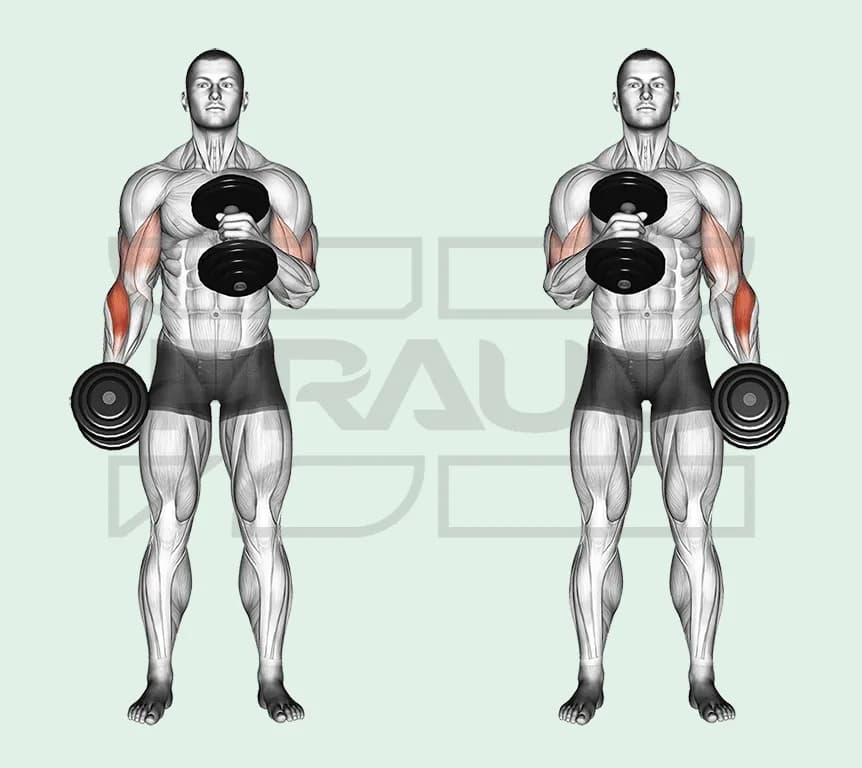
A hammer curl bends the elbows while the palms remain facing each other. The neutral grip changes forearm orientation, while several elbow flexors continue to work. It is an option alongside supinated curls, rather than a compulsory way to obtain thicker arms.

Certified fitness coach · CQP Instructeur Fitness
Published on
The essentials before you start.
- Use secure support and practise the pickup and return.
- Keep the intended arm path and range repeatable.
- Research results apply to specific tasks and measured outcomes.
- Choose the workload within the whole week.
Exercise facts
- Main muscles
- Brachialis, Brachioradialis
- Secondary muscles
- Biceps brachii, Wrist flexors and extensors
- Equipment
- Dumbbells
What the movement trains
The brachialis, brachioradialis and biceps contribute to elbow flexion. Neutral grip does not isolate the brachialis, nor does lower biceps activity mean the whole movement is ineffective.
Set up and perform the movement
- Stand or sit with stable support and a secure dumbbell grip.
- Begin with the arms near the sides, palms facing in and wrists aligned comfortably with the forearms.
- Bend the elbows together or alternately, keeping the chosen upper-arm path repeatable.
- Avoid driving the weights up by extending the hips or shrugging the shoulders.
- Lower smoothly through a manageable elbow range while retaining the neutral grip.
- Return the weights securely and record repetitions for each arm.
Range, support and control
A cross-body path changes the movement and needs its own load and comparison. Do not bend the wrists sideways to create extra height. Alternating and simultaneous repetitions provide different rests and should be logged clearly.
What the cited research supports
The forearm-orientation experiment measured greater brachioradialis activity with pronation than with neutral or supinated positions during its slow, lightly loaded task. It did not establish a neutral-grip growth advantage. The 2026 curl comparison measured biceps activity, not brachialis growth; group averages do not determine an individual best exercise.
Variations and alternatives
A seated supinating curl changes hand orientation. A rope cable curl changes the resistance line and station. Neither is an exact load equivalent or a mandatory extra exercise.
Sets, progression and tracking
An adjustable example is 2–4 sets of 8–15 repetitions per arm. Use enough rest to preserve the grip, range and torso position. Count this alongside other curls, rows and pull-ups instead of adding every variation automatically.
Movement video
The demonstration is one setup, rather than an individual load prescription.
Hammer curl movement demonstration
Frequently asked questions
Does a neutral grip isolate the brachialis?
No. Several elbow flexors contribute. The cited electrical measurements do not establish selective long-term growth.
When should I add demand?
When the chosen setup, range and effort are repeatable and the next increment is manageable. Record changes rather than comparing different tasks as if they were identical.
Sources and limitations
Sources support the passages that cite them. Practical suggestions are coaching choices to adapt to your own situation.
- Croskery et al. · 2026 · Acute comparison of four curl exercises in fifteen adults. ↗
Biceps electrical activity and variable individual rankings; not later growth, brachialis measurement or peak shape.
- Kleiber et al. · 2015 · Forearm-orientation comparison during slow elbow flexion in sixteen healthy adults. ↗
Brachioradialis activity was higher in the pronated condition; no neutral-grip growth superiority was tested.
This general information does not replace individual advice. Zepraug’s limitations.