
how it works
What Zepraug does with your data, feature by feature.
For each of the six features: what you see on screen, what the app computes behind it, and the exact meaning of the words used.
health data
Reading your signals
One number per signal — average night, resting heart rate, steps, weight — and under each number a plain sentence saying whether it is high, low, or in line with your habit.
What the app does- 1It asks Apple Health or Health Connect for the categories you allow, and nothing more.
- 2It computes your median over the chosen window, then places today’s value against it.
- 3It counts the days actually measured. If four nights are missing out of thirty, it says so instead of smoothing the gap.
- 4It picks the matching sentence and shows it behind a sage dot.
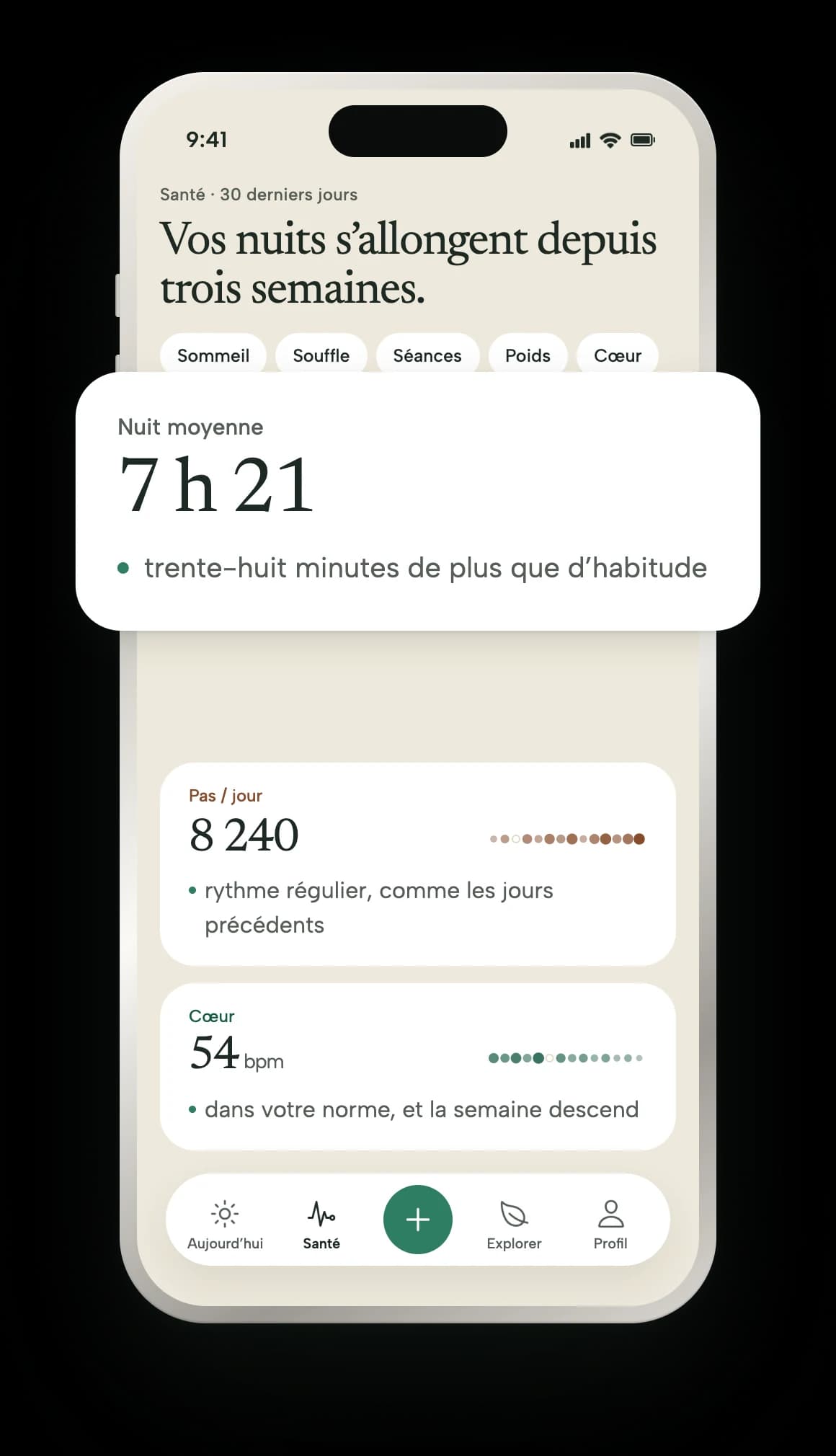
Reading this card
- The sage dot
- announces a reading: a sentence written by the app, not raw data.
- The empty circles
- are nights without a measurement. No value is invented in their place.
- The size of the dots
- carries the value: the bigger the dot, the longer the night.
zepo
Asking a question
A conversation. You type, dictate or photograph; Zepo answers in text and can attach a card — a lighter session, a meal, a programme — that you apply in one gesture.
What the app does- 1It gathers the context the question needs: your recent nights, your resting heart rate, your training log, today’s meals.
- 2It sends the question with that context, without attaching your identity.
- 3It shows the answer and, underneath, the data it leans on — you can check.
- 4If the answer contains an action, that action becomes an applicable card, not an instruction to copy out.
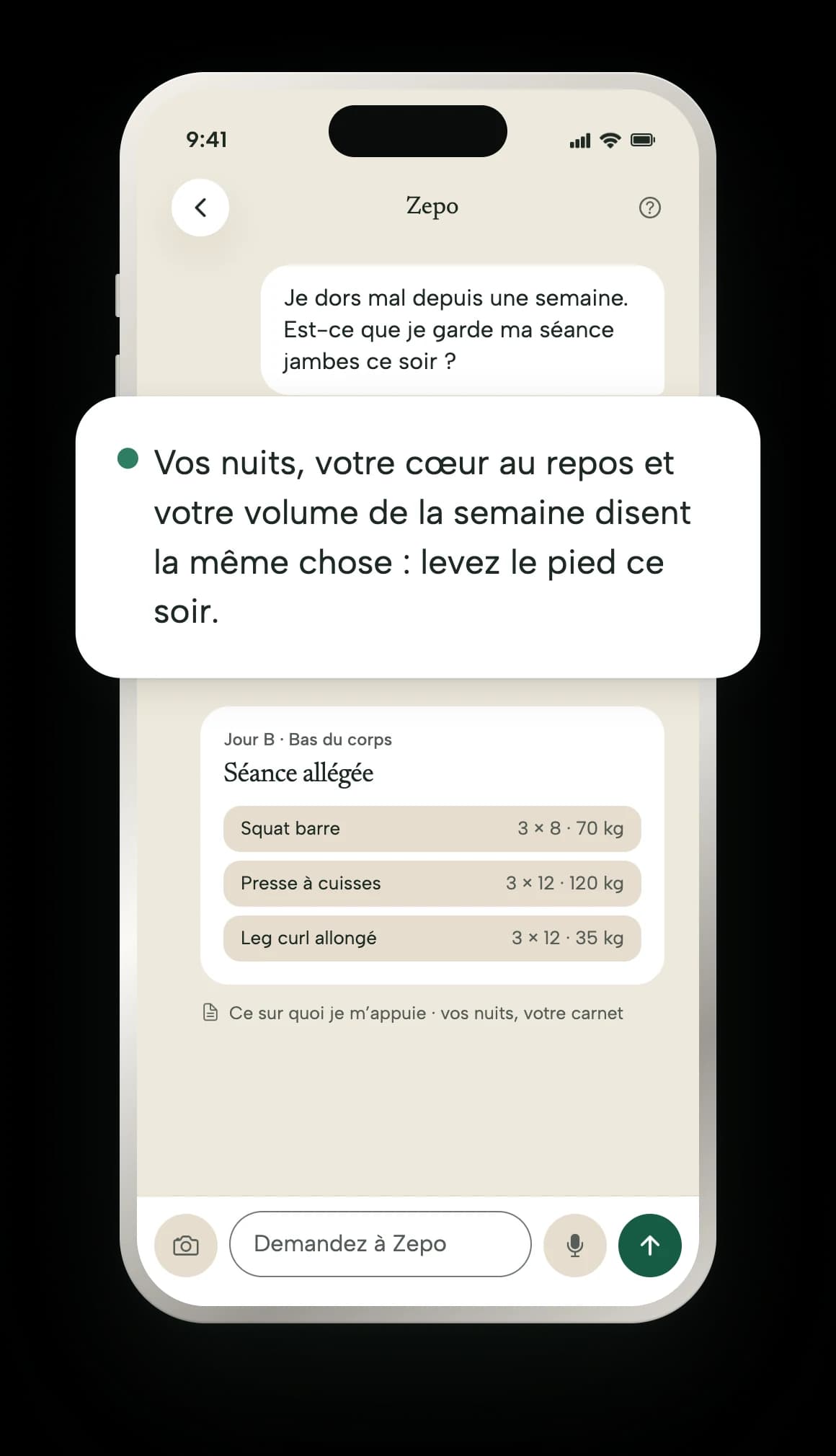
What leaves the device
- The question and the numbers it requires
- and nothing more. Your full history stays on the device.
training
Logging a set
The exercise, its prescription, and the sets already logged. Below them, two dials — reps and load — then an effort notch, and the button that confirms.
What the app does- 1It pre-fills the dials with what you did last time on this exercise.
- 2You confirm; the set is timestamped and joins your history.
- 3The rest timer starts at the duration set for this exercise.
- 4On the next set it applies the programme’s rule: if you held the top of the range at the right effort, it suggests the load above.
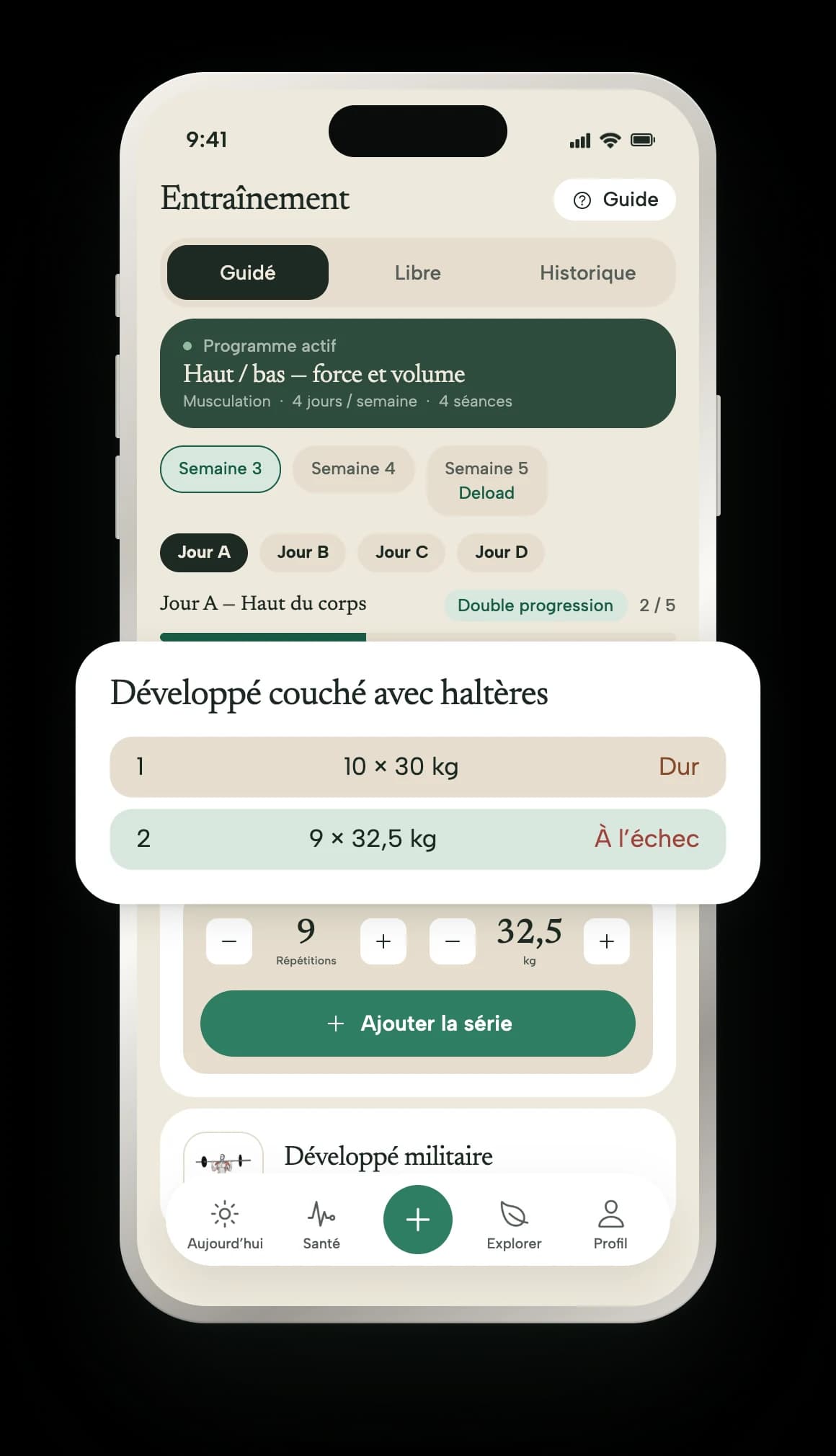
The effort notches
- Easy
- you had several reps left in reserve.
- Moderate
- two or three reps in reserve.
- Hard
- one rep in reserve, the bar slows down.
- To failure
- the last rep did not go up.
nutrition
Filling your plate
A ring for the calories left, three bars for the macros, and the day’s list of meals. At the bottom, a single button to add.
What the app does- 1You choose the input: a photo of the plate, two dictated words, free text, or a barcode.
- 2It recognises the foods and suggests portions, which you correct in one gesture.
- 3It adds up the macros and recomputes what is left of the day.
- 4It compares that with the day’s need, computed from your weight and your sessions, and writes what you are missing.
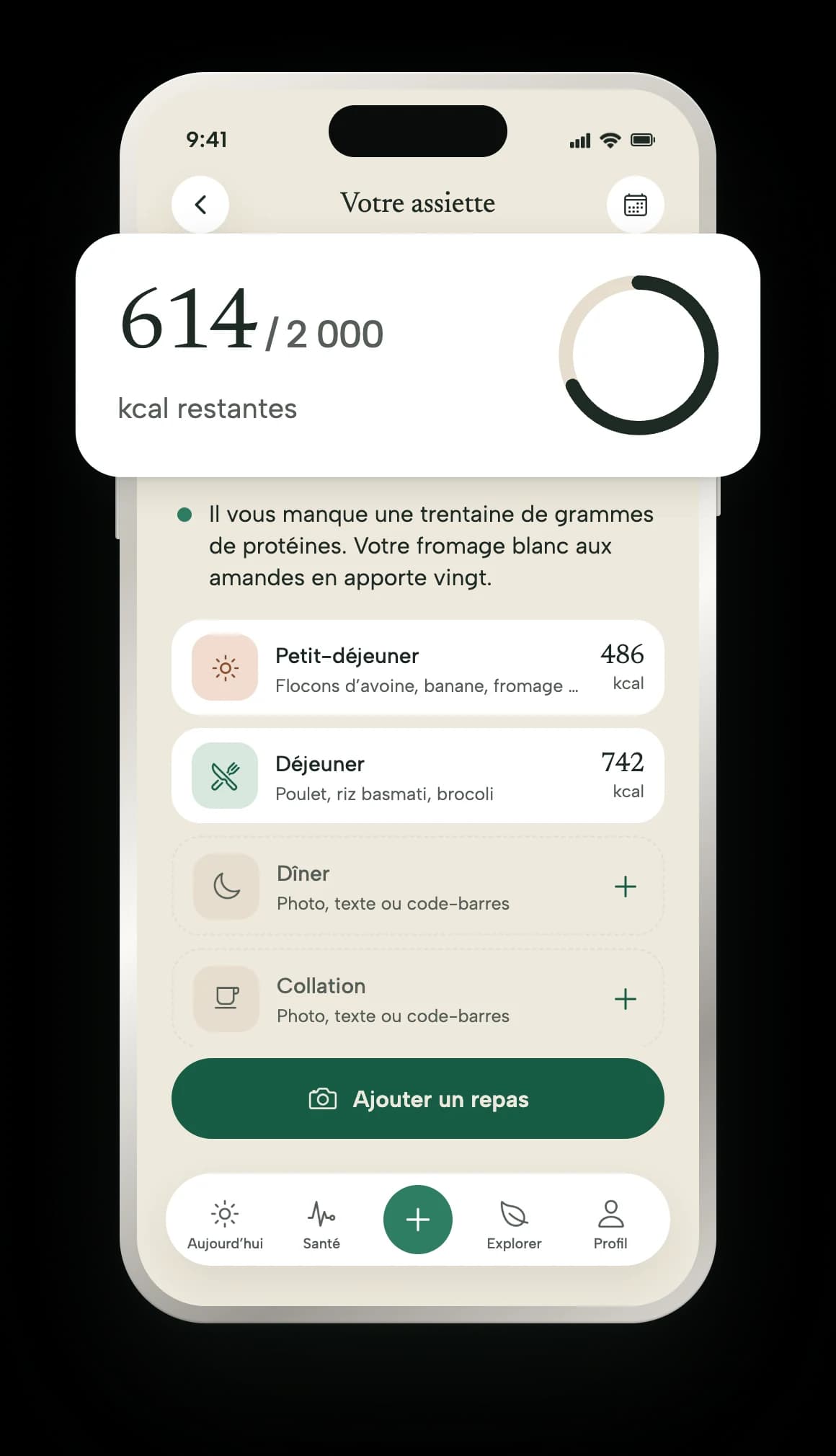
What the estimate is worth
- A photo
- gives an order of magnitude, useful for a weekly trend.
- A barcode
- reads the values off the packet: it is the precise route when it exists.
exercises
Finding a movement
The body areas, each with its number of exercises and a representative plate. Inside an area, the full list, filterable by equipment.
What the app does- 1Every exercise carries a drawn plate: starting position, path, target muscle.
- 2The filing follows the movement, not the name: a pull-up and a lat pulldown live in the same place.
- 3From the sheet you can start a free set or swap the exercise in today’s session.
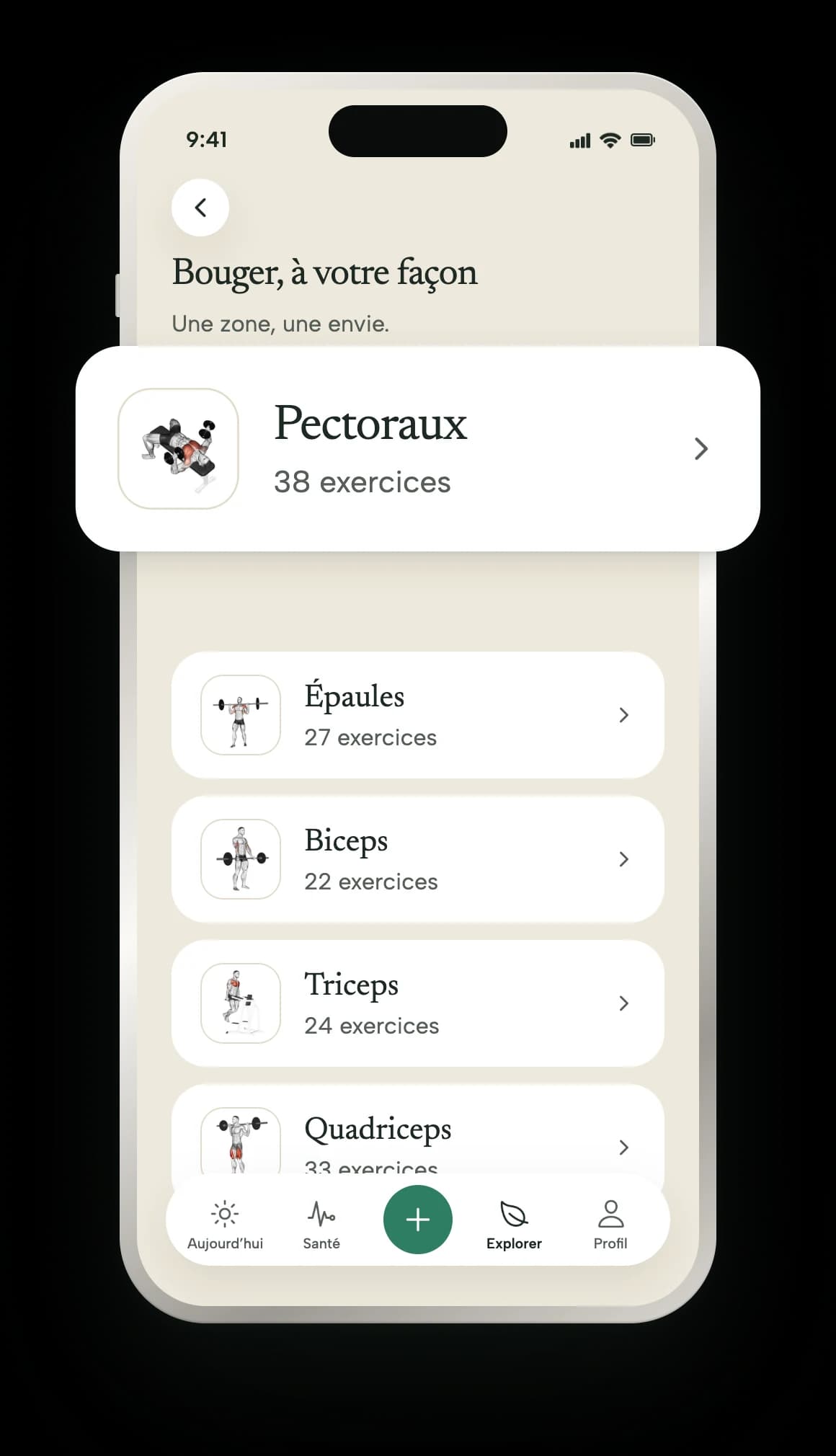
How it is filed
- By movement
- and not by exercise name: the gesture decides the place.
- Filterable by equipment
- so you only see what you have to hand.
programmes
Following a programme
The active programme at the top, its weeks as pills, and the days as tabs. Under the chosen day, the progression rule and the session’s progress.
What the app does- 1You take a programme from the library — gym, home, outdoor — or have Zepo generate one from your constraints.
- 2The weeks are periodised: volume and intensity rise, then a deload week brings them down.
- 3Each day carries its progression rule, and that rule decides when the load goes up.
- 4An archived programme keeps its whole history: reactivating it picks up where you left off.
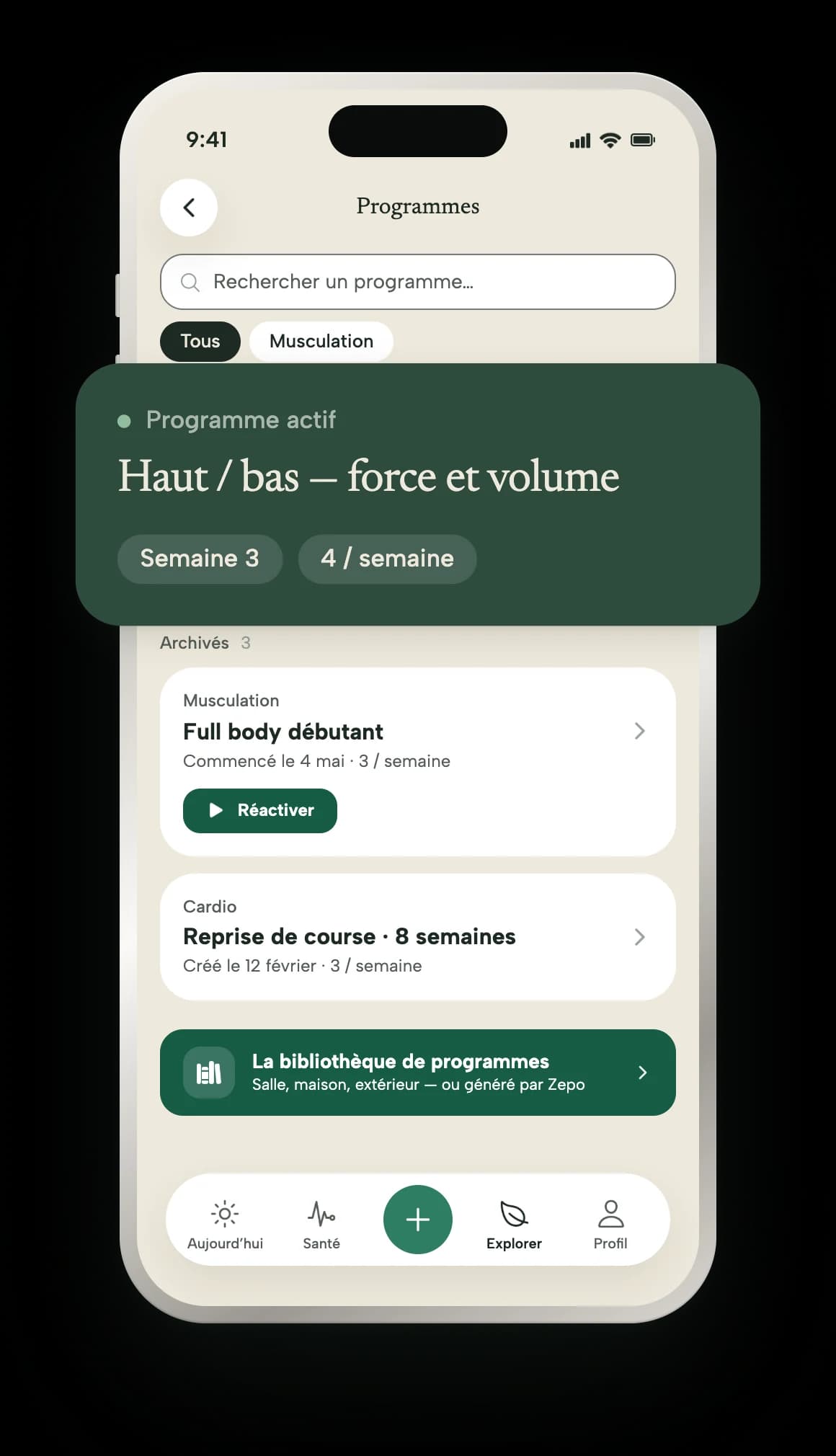
The progression rules
- Double progression
- you first raise the reps within the range, then the load once the top is reached.
- Load progression
- the reps stay fixed; the load goes up as soon as the effort allows.
- Deload week
- reduced volume for a week to let fatigue come down.
glossary
The words used in the app
- Reading
- The sentence the app writes under a number. It places the value against your habit, and nothing else.
- Your norm
- Your own median over the window shown. Never a population average.
- Measured day
- A day where the data actually exists. The others stay empty, and the app says so.
- Perceived effort
- Your reading of the set, in four notches: easy, moderate, hard, to failure.
- Double progression
- Raise the reps to the top of the range, then raise the load.
- Periodisation
- How the weeks are organised: accumulation, then a deload week.
- Deload week
- A week at reduced volume, planned into the programme, to let fatigue come down.
- Guided / free session
- Guided: the app suggests the programme’s order and loads. Free: you log whatever you want.
- Local storage
- Your data lives in the app, on your device. Uninstalling the app erases it.