Training· 6 min read
One-arm dumbbell row: supported and free setups
Other names: Single-arm dumbbell row, Bench-supported dumbbell row
A one-arm dumbbell row brings a dumbbell towards the side of the torso while you hold a hip-hinged position. Supporting one hand and a knee on a bench is a practical starting setup. It changes the support demands, but does not make the exercise a treatment for back pain or remove the need for trunk control.

Certified fitness coach · CQP Instructeur Fitness
Published on
The essentials before you start.
- Use a stable bench and a load that lets you keep the torso position repeatable.
- Move the upper arm and shoulder blade together rather than lifting by twisting the trunk.
- A bench-supported dumbbell row was not directly tested in the cited three-row comparison.
- Record load, range and repetitions for each side without automatically doubling work for one side.
Exercise facts
- Main muscles
- Latissimus dorsi, Rhomboids, Middle and lower trapezius
- Secondary muscles
- Teres major, Rear deltoids, Biceps, Forearms, Obliques, Spinal erectors
- Equipment
- Dumbbell, Stable flat bench
What the one-arm dumbbell row trains
The lats, teres major, rear shoulder and muscles around the shoulder blade contribute as the upper arm moves backwards. The biceps and brachialis bend the elbow, the forearm holds the weight and the trunk resists unwanted rotation.
Support lets you organise the position differently from an unsupported bent-over row. That is a practical setup distinction. The small cited comparison tested an inverted row, a standing bent-over row and a standing one-arm cable row; it did not test this bench-supported dumbbell version.
The cited unilateral-versus-bilateral synthesis was not specific to dumbbell rows or back muscles. It therefore cannot prove identical growth from a dumbbell row and a barbell row. Choose according to the task, support available and ability to progress, rather than a claim of proven equivalence.
How to perform a supported one-arm dumbbell row
Check that the bench does not slide or tip and that there is room for the dumbbell. Set the weight down in a place you can reach without twisting awkwardly.
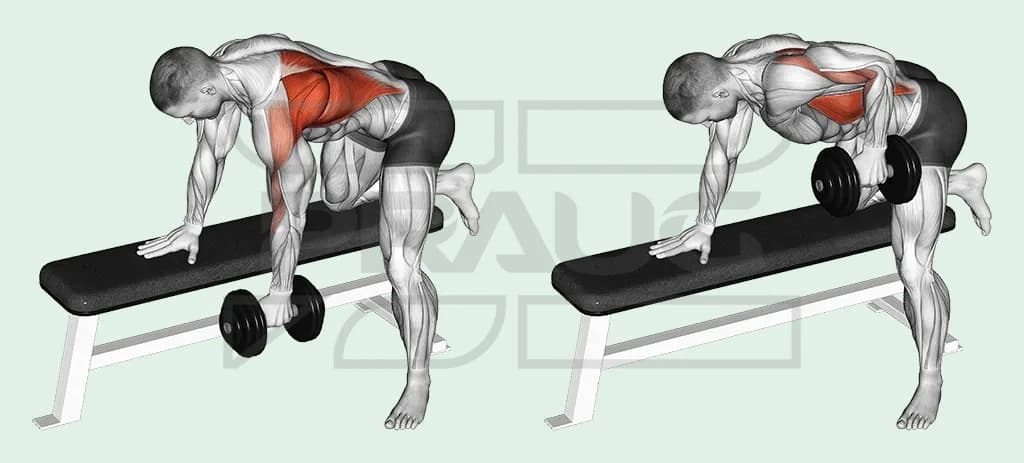
- Place one hand and the same-side knee on the bench, with the other foot supported on the floor. A hand-supported split stance is another option if it suits your proportions.
- Hinge at the hips and find a trunk position you can maintain. Hold the dumbbell with the free hand, palm facing in.
- Begin with the arm reaching down in a controlled shoulder range. Avoid simply hanging into a position you cannot manage.
- Bring the elbow backwards towards the side of the torso while the shoulder blade moves with the arm. Keep the trunk from rotating to lift the weight.
- Lower under control and return to the same starting range. Do not chase extra height by turning the chest upwards.
- Complete the planned repetitions, set the dumbbell down safely and use comparable conditions for the other side.
Elbow path and grip variations
A relatively close elbow path and neutral grip are useful starting cues. Moving the elbow further out changes the shoulder movement and can alter how the upper back and rear shoulder contribute. It is a different variation, not a switch that isolates width or thickness.
An overhand grip often accompanies a more flared elbow. Adjust the load to the changed task. Keep the wrist and shoulder position comfortable instead of forcing the upper arm to match a fixed angle.
A standing version with one hand on a suitable support, or an unsupported bent-over version, places different demands on holding the torso. Choose it deliberately; removing support is not automatically a better progression.
Common errors
If the torso rotates on every pull, the dumbbell may be too demanding for the intended row. Reduce the load or adjust support before trying to pull harder.
Shrugging the shoulder towards the ear, shortening the return or letting the dumbbell drop can also change the exercise as fatigue rises. Pick movement criteria you can repeat and end the set when they are lost.
There is no need to stretch to the deepest possible bottom position or drag the elbow far beyond the torso. Use a range you control. Persistent pain needs individual advice; a different bench position alone does not establish a diagnosis or solution.
Sets, progression and comparing sides
One coaching example is 3–4 sets of 8–12 repetitions per side as a coaching example. Adapt that to experience and the other pulling work in your week. Let movement quality and planned effort guide the load.
Use the same bench position, range and intended effort when comparing sides. If one side needs a lighter load or fewer repetitions, record the observation without treating a single set as proof of a structural imbalance.
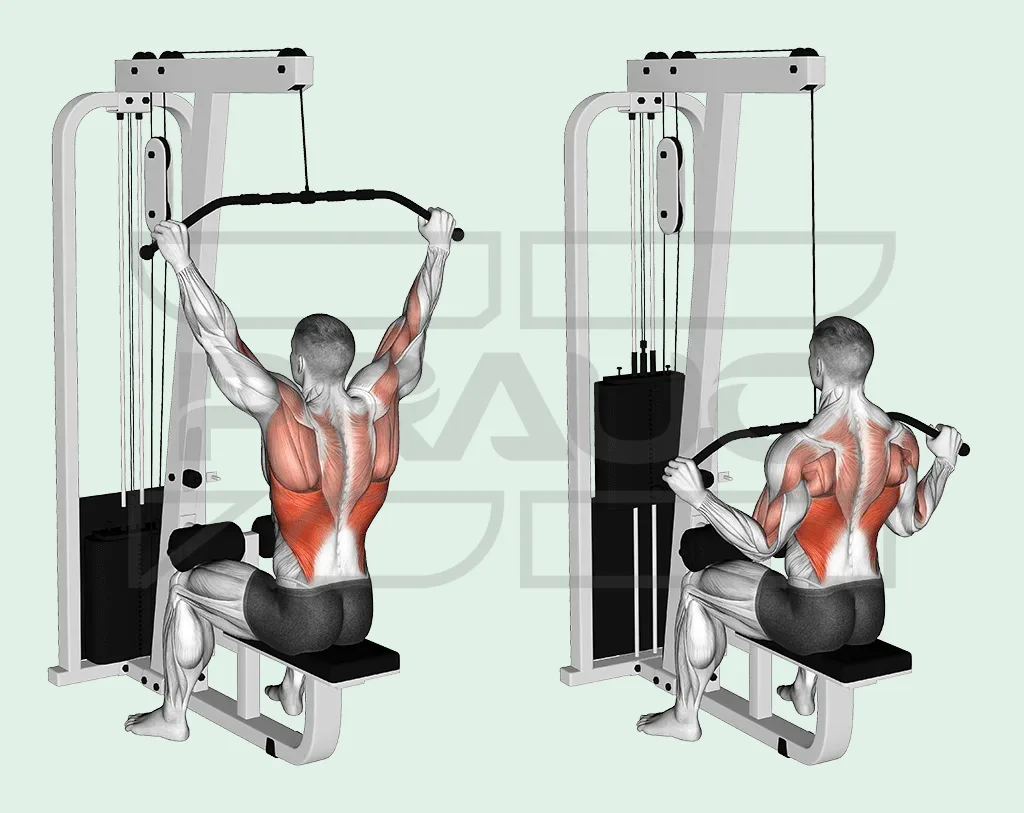
Progress can mean another controlled repetition before a small increase in load. A vertical pull such as the lat pulldown trains a different direction; an inverted row offers a bodyweight horizontal alternative. Neither requires every row variation to appear in the same workout.
Frequently asked questions
Can a beginner use this exercise?
A supported setup can make it easier to focus on the pull. Start with a manageable weight and get help with the setup if needed; the label beginner does not replace individual adaptation.
Should the dumbbell touch my hip?
Think of moving the elbow back towards the torso. The exact dumbbell position depends on proportions and the arm path. Do not twist or force extra range to hit a fixed point.
Can I row without a bench?
A hand-supported split stance or an unsupported hinge is possible when the support and trunk position are controlled. It changes the holding demands rather than simply being a harder version of exactly the same task.
Is it better than a barbell row for back pain?
The cited evidence does not establish that. Support changes the setup, but a painful back needs an appropriate individual assessment rather than a guarantee attached to one exercise.
Should I do more work for the weaker side?
First compare sides under similar conditions over more than one attempt. Do not automatically double the workload based on one performance difference.
Sources and limitations
Sources support the passages that cite them. Practical suggestions are coaching choices to adapt to your own situation.
- Fenwick et al. · 2009 · Comparison of different rowing exercises: trunk muscle activation and lumbar spine motion, load, and stiffness. ↗
Very small sample. It tested standing one-arm cable rowing, not the bench-supported dumbbell row; it does not establish treatment effects for back pain.
- Kassiano et al. · 2025 · Systematic review and meta-analysis comparing unilateral and bilateral resistance training. ↗
Few trials with methodological limitations, none specific to dumbbell rows or back muscles. No clear average difference is not proof of individual equivalence.
- Di Fonza et al. · 2026 · Narrative review of latissimus dorsi electrical activity during pulling exercises. ↗
Acute electrical-activity evidence, not long-term hypertrophy evidence or a direct test of this bench-supported dumbbell setup.
This general information does not replace individual advice. Zepraug’s limitations.