Training· 6 min read
Lat pulldown: setup, grip and pulling technique
Other names: Cable lat pulldown
The lat pulldown is a seated vertical pull: your body stays supported while you bring the bar from overhead towards the upper chest. It trains the back and elbow flexors with an adjustable load, which makes it useful alongside or before unassisted pull-ups.

Certified fitness coach · CQP Instructeur Fitness
Published on
The essentials before you start.
- Set the thigh pad before choosing a load you can control without swinging.
- Start with a comfortable overhand grip around shoulder width or slightly wider; a wider grip is not automatically better.
- Muscle-activity measurements cannot rank grips for long-term growth or establish injury risk.
- Use the same machine, grip and range when comparing loads and repetitions.
Exercise facts
- Main muscles
- Latissimus dorsi, Teres major, Rhomboids, Middle and lower trapezius
- Secondary muscles
- Biceps, Brachialis, Rear deltoids, Forearm muscles
- Equipment
- High cable pulley, Lat pulldown bar
What the lat pulldown trains
The shoulder and elbow move together as you bring the upper arms towards your sides. The latissimus dorsi and teres major contribute to that movement; the muscles around the shoulder blades help control their position. The biceps and brachialis bend the elbows, and the forearms maintain the grip.
It is not possible to remove the arms from a pulling exercise. Feeling the biceps work does not show that the back has stopped working. A load that makes you swing backwards changes the movement and makes progress harder to compare.
Unlike a pull-up, the resistance can be lower than bodyweight. The machine setting is specific to that machine: pulley arrangements and stack markings make kilograms on different machines imperfect comparisons.
How to set up and perform a lat pulldown
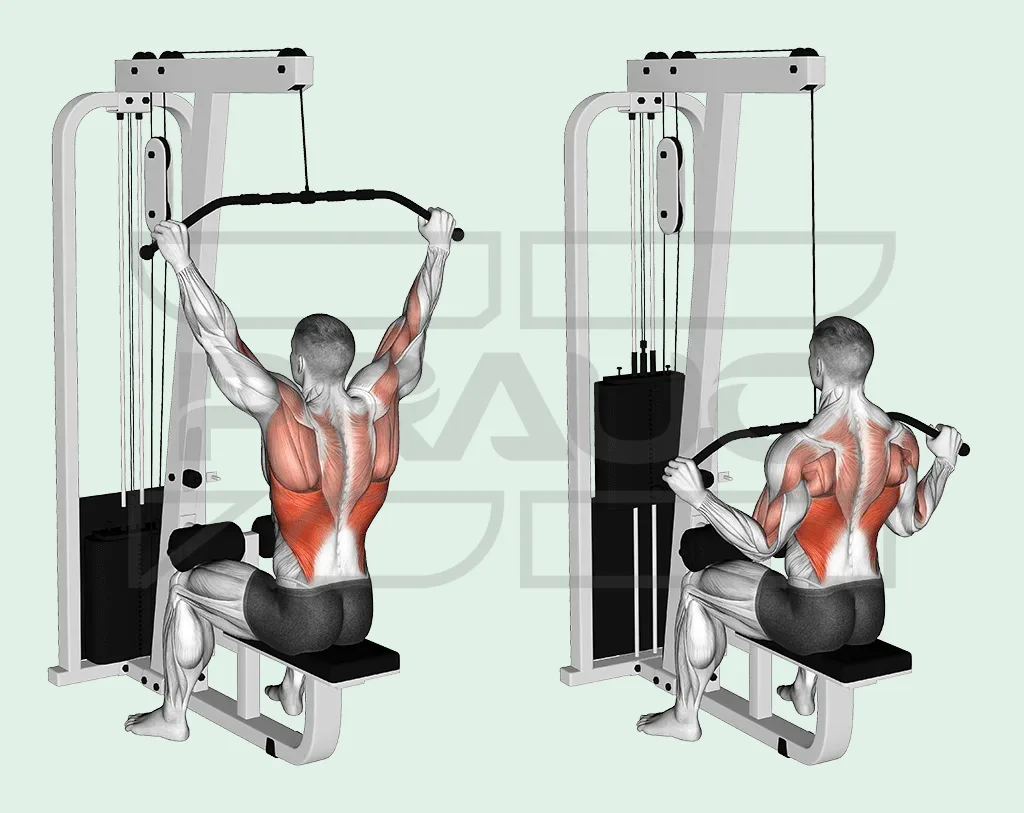
Adjust the seat and thigh pad so your feet have stable support and your thighs stay in position without being painfully compressed. Take the attachment with a full grip and sit down under control. Use assistance to reach the bar if necessary rather than jumping with a load you cannot manage.
- Begin with the arms overhead in a range you can control, the chest comfortably lifted and a small, steady backward lean if needed.
- Bring the upper arms down towards your sides as you bend the elbows. Let the shoulder blades move with the pull rather than forcing them into one fixed position.
- Guide the bar towards the upper chest without throwing your torso back or pushing the head forward to meet it. You do not need to force contact if the attachment or your comfortable range does not allow it.
- Return the weight under control, allowing the arms to reach overhead without letting the stack jerk you upwards.
- Keep the grip, torso angle and finishing point consistent across the set. Choose a breathing rhythm you can maintain.
Overhand, underhand or neutral grip?
An overhand grip has the palms facing away; an underhand grip turns them towards you. Parallel handles allow a neutral grip. These options change joint positions and can feel different at the shoulders, elbows and wrists. Choose a usable setup rather than treating one grip as mandatory.
The cited grip-width study tested narrow, medium and wide overhand grips in a small group of trained men. Lat muscle activity was broadly similar, while the very wide grip allowed a lower six-repetition load. Another small study found a difference between overhand and underhand grips at the tested load. These are acute findings, not a comparison of months of muscle growth.
Our coaching choice here is a pull in front of the face towards the upper chest. The study comparing front, behind-the-neck and V-bar pulldowns did not establish injury rates. Its electrical-activity measurements do not prove that any version is safe or unsafe for every shoulder.
What to change when the movement drifts
If each repetition begins with a large backward swing, lower the load and restore a steady torso angle. If the bar stops much higher on later repetitions, decide whether to end the set instead of counting a different movement as the same repetition.
Do not force the elbows behind the body to reach an arbitrary depth. Equally, cutting the return short changes the overhead range. Find a controlled range you can repeat. Persistent pain needs an individual assessment rather than a search for the supposedly perfect grip.
Sets, repetitions and progression
The source programme uses 3–4 sets of 8–12 repetitions, with roughly 90 seconds to 2 minutes between sets. Treat that as a coaching example to adapt to your experience and the rest of the week, not a dose established by the grip studies.
Choose a load that lets you finish the planned work with consistent movement and some repetitions still possible. When every set reaches the top of the chosen range under similar conditions, try the next manageable increment and rebuild the repetitions.
A vertical pull and a horizontal row can complement each other. For a supported one-sided row, see the one-arm dumbbell row. The distinction is direction and setup, not an ability to build width or thickness in complete isolation.
Variations and alternatives
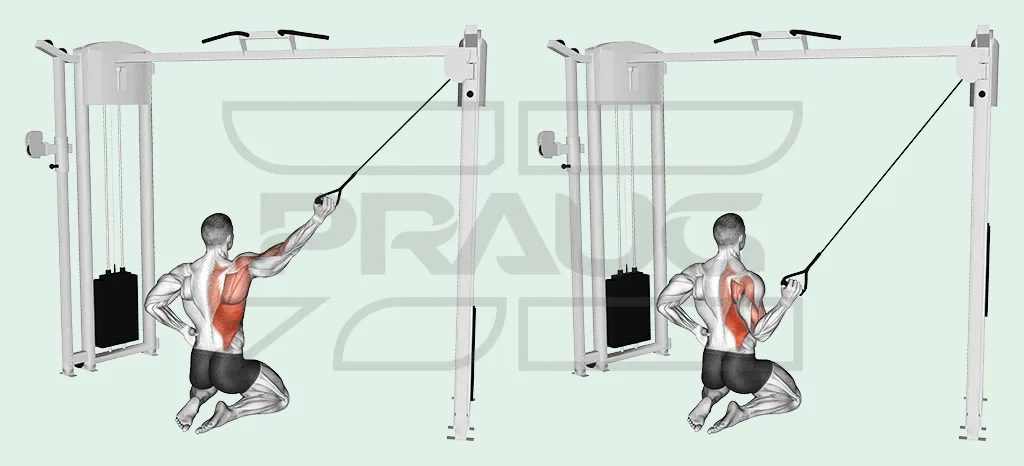
A single-arm cable pulldown lets you practise one side at a time and choose an individual arm path. A neutral-grip attachment changes the hand position without making the exercise automatically superior.
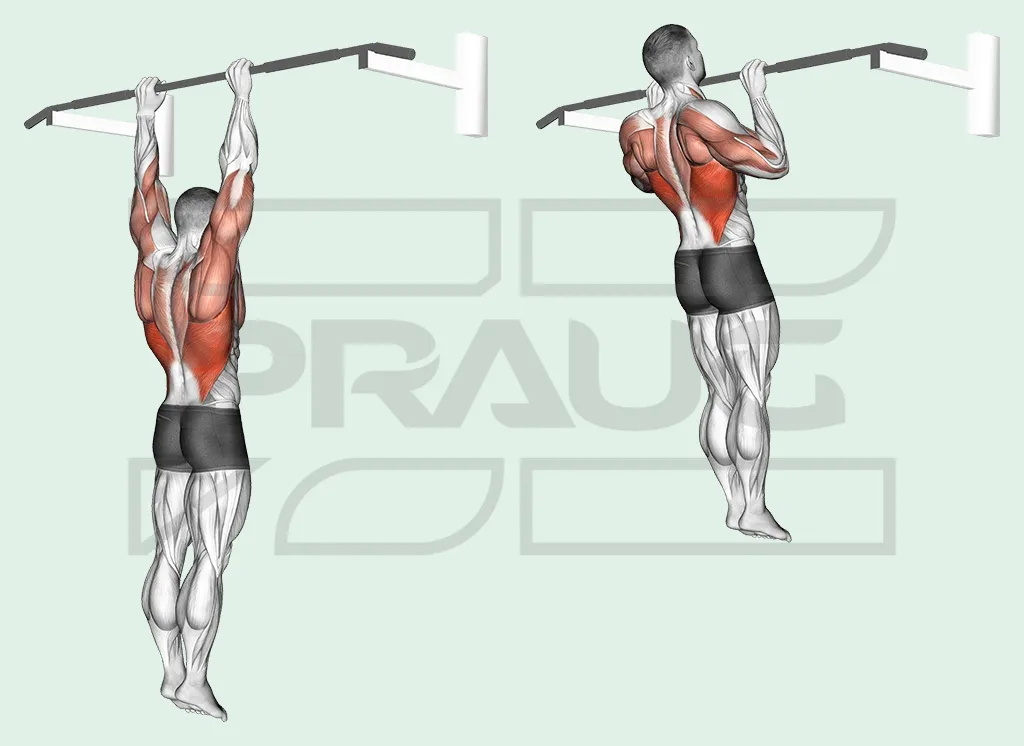
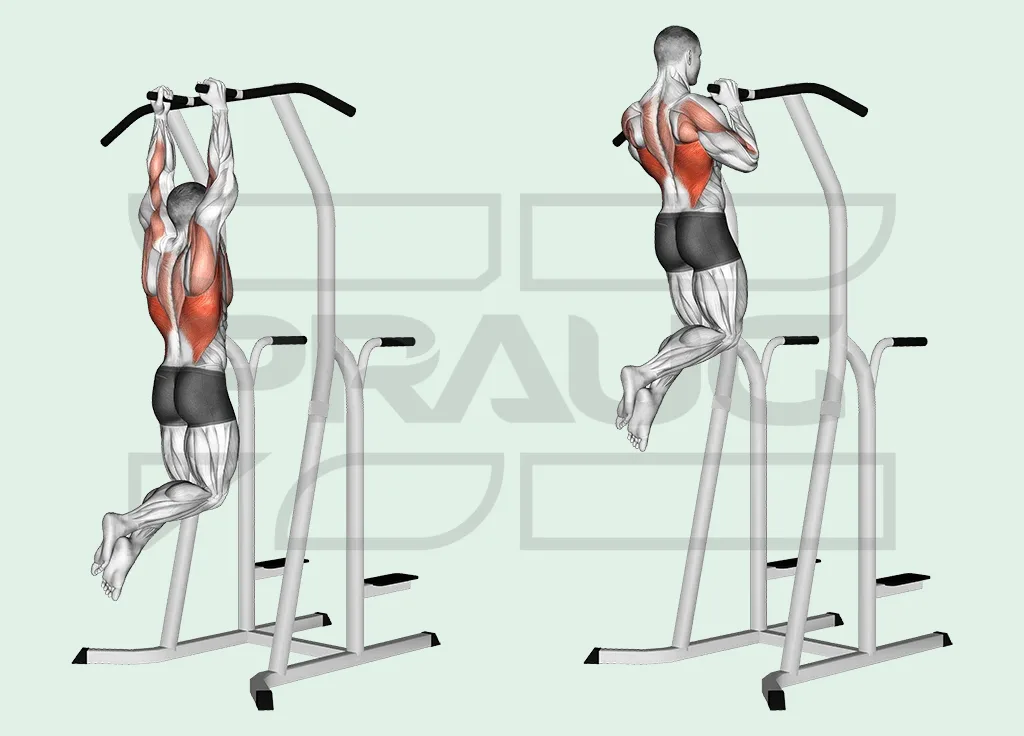
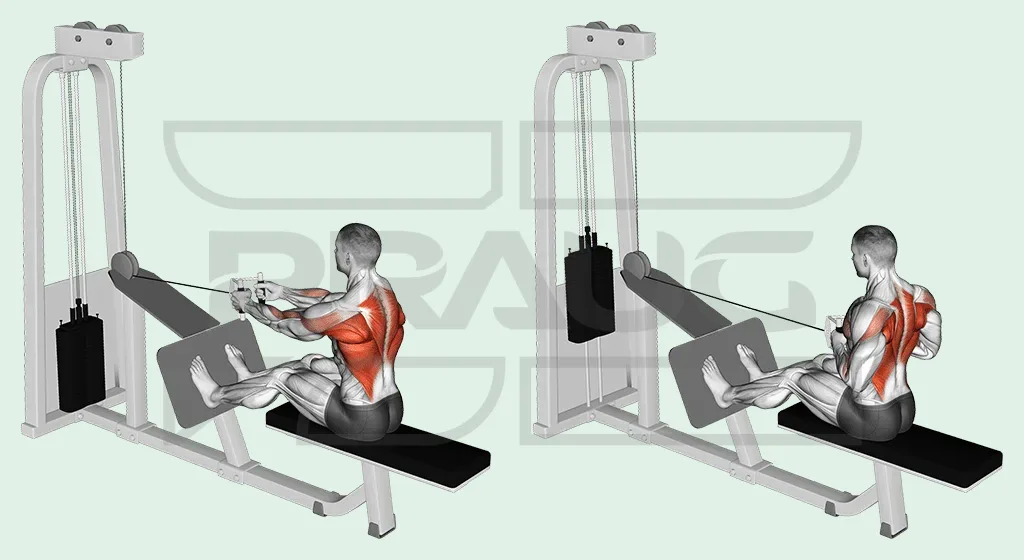
Pull-ups and chin-ups move the body towards the bar. Chin-ups use an underhand grip, while pull-ups commonly mean an overhand grip. Assisted versions can make either movement accessible. A seated cable row is a horizontal pulling option; it complements a pulldown rather than being the same exercise. The illustrations of these options are retained below.
Illustrated setup and variations
The illustrations show example setups and variations. Use a difficulty you can control; the drawings do not prescribe an individual load.
Lat pulldown setup
 Start and finish
Single-arm cable variation
Chin-up and pull-up
 Underhand
 Overhand
Neutral-grip pull-up
Horizontal cable row
Frequently asked questions
Which muscles does a lat pulldown work?
The lats, teres major and muscles controlling the shoulder blades work with the elbow flexors and forearms. Their relative contributions vary with the task; an electrical-activity result is not a long-term muscle-growth ranking.
How wide should I hold the bar?
Start around shoulder width or a little wider, then choose a grip that allows a controlled, comfortable movement. A very wide grip is not a requirement for a wider back.
Should I pull behind my neck?
This guide uses a pull in front towards the upper chest. That is a coaching choice. The cited comparison does not measure injury risk, so it cannot guarantee which variation suits an individual shoulder.
Is a pulldown useful before my first pull-up?
It lets you practise a vertical pull with adjustable resistance. Combine it with practice specific to the pull-up if that is your goal; matching a stack number to bodyweight does not guarantee a first repetition.
What is the difference between a pulldown and a row?
A pulldown brings the arms down from overhead. A row pulls towards the torso more horizontally. Both can train overlapping back muscles through different setups.
Sources and limitations
Sources support the passages that cite them. Practical suggestions are coaching choices to adapt to your own situation.
- Andersen et al. · 2014 · Effects of grip width on muscle strength and activation in the lat pull-down. ↗
Small sample of trained men and acute testing. Muscle activity and a six-repetition load do not establish long-term hypertrophy or injury risk.
- Lusk et al. · 2010 · The effect of grip width and forearm orientation on muscle activity during the lat pull-down. ↗
Small male sample at a single relative load. An acute electrical-activity difference does not establish greater muscle growth over time.
- Sperandei et al. · 2009 · Electromyographic analysis of three different types of lat pull-down. ↗
Acute electrical-activity comparison of three variations. It did not measure injuries or long-term muscle growth.
This general information does not replace individual advice. Zepraug’s limitations.