Training· 3 min read
Mountain climber: setup, technique and progression
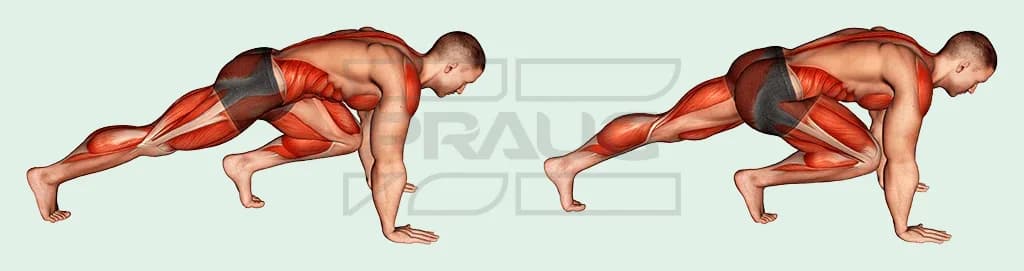
A mountain climber alternately brings the knees forwards from a high-plank support. Speed, hand height and step length change the task. Starting slowly can help retain support, but slow and fast versions do not form a proven universal progression.

Certified fitness coach · CQP Instructeur Fitness
Published on
The essentials before you start.
- Choose secure support and a manageable starting demand.
- Describe the intended trunk, hip and pelvic movement.
- Record lever, range and counting method consistently.
- Research measurements do not establish every variation or a local-fat-loss promise.
Exercise facts
- Main muscles
- Rectus abdominis, Internal and external obliques, Transversus abdominis, Hip flexors
- Secondary muscles
- Deltoids, Pectorals, Triceps, Serratus anterior, Quadriceps, Gluteals
- Equipment
- Bodyweight
What the movement trains
The trunk helps maintain the intended position while the hips move the legs and the shoulders and arms support the upper body. A faster cadence can add conditioning demand without giving a fixed calorie expenditure.
Set up and perform the movement
- Use a clear non-slip surface and secure hand support. A raised support must be intended and stable for exercise.
- Begin in a manageable high-plank position with the hands and feet securely placed.
- Bring one knee forwards through a controlled range without collapsing onto the arms or forcing it to the chest.
- Return the foot to secure support, then change sides.
- Keep breathing and maintain the intended torso height at the chosen cadence.
- Return the knees or feet to secure support when the set ends.
Range, support and control
Body proportions and step length affect the shape. A cross-body knee path, outside-elbow variation, unstable support or band changes the task; none is required merely because a faster version is possible.
What the cited research supports
The six-week trial combined mountain climbers with jumping jacks, burpees and squat jumps. It found no significant measured body-composition or thickness changes and did not isolate mountain climbers or measure a fixed calorie cost. The separate abdominal-training trial does not prove this task selectively removes belly fat.
Variations and alternatives
Hand elevation and a slower step can change support and pace. A front plank removes the alternating knee action. Choose the workload within the whole session.
Sets, progression and tracking
An example is 2–4 bouts of 15–30 seconds with enough rest to retain support. A circuit repeats that work each round. Define whether one repetition means one knee drive or a left-and-right pair, and keep the definition consistent.
Illustrated positions and options
The images show example positions rather than an individual range, loading or breathing prescription. Use suitable equipment and a controlled return.
Illustrated option 1
Frequently asked questions
Can I calculate calories from the repetition count alone?
The cited study did not measure a fixed expenditure for this exercise. Cadence, body mass, duration, support and the rest of the session change the task.
When should I add demand?
When the intended support, range and effort remain repeatable and the next change is manageable. Record changes rather than comparing different levers as if they were identical.
Sources and limitations
Sources support the passages that cite them. Practical suggestions are coaching choices to adapt to your own situation.
- Evangelista et al. · 2019 · Six-week mixed bodyweight intervals versus moderate continuous running in twenty-five adults. ↗
Four exercises combined; no isolated mountain-climber effect, fixed calorie measurement or significant measured composition/thickness change.
- Vispute et al. · 2011 · Six-week abdominal-exercise trial in twenty-four sedentary adults. ↗
Curl-up endurance improved without significant changes in the measured abdominal-fat outcomes; not every exercise or combined lifestyle intervention.
This general information does not replace individual advice. Zepraug’s limitations.