Training· 5 min read
Dead bug: trunk control, breathing and progressions
A dead bug moves an arm and the opposite leg while you lie on your back and keep a controlled trunk and pelvic position. It practises resisting unwanted extension as the limbs move. Start with a range that lets you breathe and maintain the position rather than forcing the hand and heel to the floor.

Certified fitness coach · CQP Instructeur Fitness
Published on
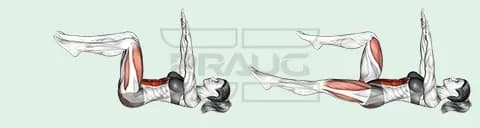
The essentials before you start.
- Use a manageable arm and leg reach rather than chasing maximum range.
- A changing gap under the lower back is a cue to review the task, not an injury diagnosis.
- Keep breathing as you move; a strong abdominal squeeze is not a reason for a long breath-hold.
- Acute ultrasound thickness and electrical activity do not establish long-term strength or treatment effects.
Exercise facts
- Main muscles
- Abdominal wall, Rectus abdominis
- Secondary muscles
- Internal and external obliques, Hip flexors, Deltoids
- Equipment
- Bodyweight, Mat
What a dead bug trains
The abdominal wall and other trunk muscles help control the relationship between ribs, pelvis and spine while the arms and legs move. The hip flexors and shoulders also contribute to holding and moving the limbs. The exercise does not isolate only the transverse abdominis.
The cited studies measured acute ultrasound thickness or electrical activity during exercise. Thickness while a muscle contracts is not the same outcome as growth after weeks of training. The studies do not establish that this exercise treats back pain, repairs a diastasis or is suitable for every postpartum situation.
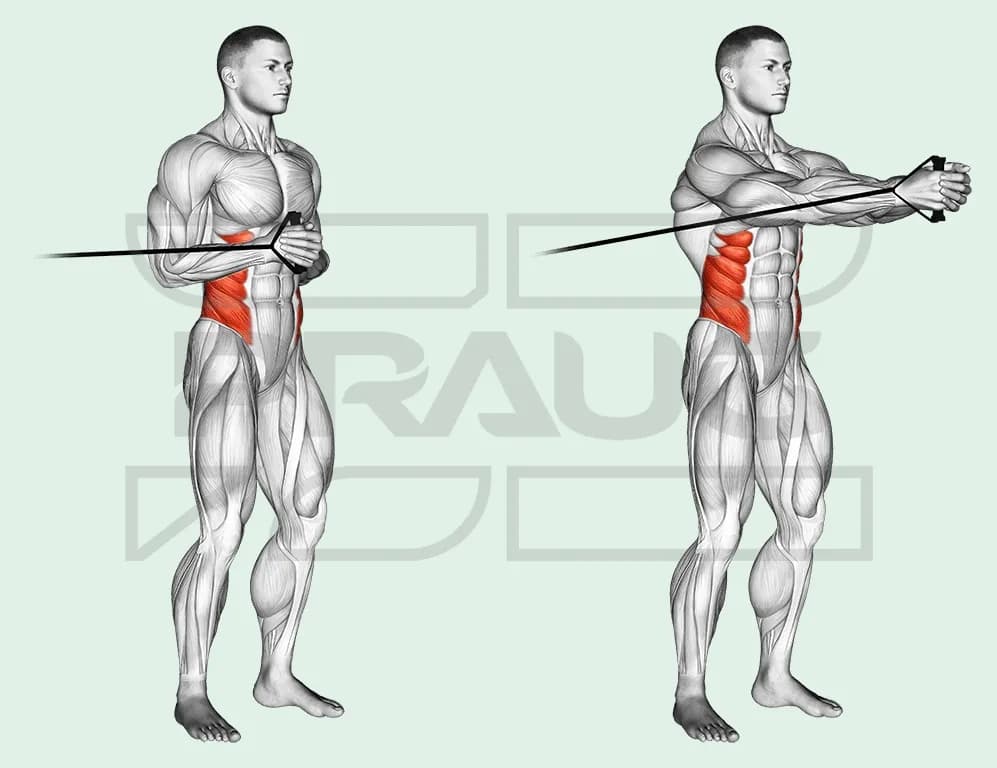
The front plank offers another anti-extension task with different support; the Pallof press practises resisting rotation.
How to perform a dead bug
Use a comfortable floor or mat. Begin with a small movement and adapt the limb positions to your current control.
- Lie on the back and raise the arms towards the ceiling. Bring the hips and knees into a manageable bent position, often around right angles.
- Establish a comfortable rib and pelvic position. A light lower-back contact cue may help, but do not force maximal flattening or painful pressure.
- Exhale as you reach one arm backwards and the opposite leg away from you, moving slowly.
- Stop the reach before the trunk position changes more than intended or you need to hold the breath.
- Return with control, then repeat on the other side under similar conditions.
- Set the feet down and rest when the chosen movement is no longer repeatable.
Range, breathing and common errors
If extending the leg pulls the ribs upwards or creates a large uncontrolled arch, shorten the reach, keep the knee more bent or move only one limb. Reaching the floor is not the goal in itself.
Avoid rushing through alternating sides, moving both legs away unexpectedly or pressing so hard into the floor that breathing stops. Maintaining a useful position and rhythm is more informative than an arbitrary repetition total.
For sharp pain, dizziness or symptoms that persist, stop and seek appropriate individual advice. A general trunk-control drill is not an individual rehabilitation prescription.
Heel taps, longer levers, bands and weights
A heel tap with the knee bent or moving only the arms reduces some demands. Extending the leg further, slowing the movement or adding a brief pause changes the task. Choose one adjustment at a time.
A ball pressed between opposite limbs adds a contact task. A band anchored securely or a small weight changes the resistance and start and finish requirements. Do not introduce a load you cannot control above the body or an unverified band anchor.
More difficulty is not automatically more useful. You can keep a simpler dead bug for practice while progressing a separate task. Compare the side plank for lateral support work, rather than expecting one exercise to cover every trunk function.
Sets, repetitions and progression
One coaching example is 3 sets of 8–12 repetitions per side, or a short continuous period. Choose fewer repetitions, rest or a shorter reach if that better preserves control. The studies did not establish this as a required dose.
The exercise can be light preparation or direct training. Avoid fatiguing the trunk before a demanding lift if that undermines the main task. Frequency depends on the rest of the week rather than the assumption that a floor exercise can always be repeated daily.
Record the limb version, reach, tempo, resistance and repetitions. Progress when the existing task is repeatable, including breathing. The abdominal exercise collection explains how the available tasks differ.
Illustrated positions and variations
These original illustrations show example setups. Choose a range, support and difficulty you can control.
Opposite-limb movement
Frequently asked questions
Must my lower back be pressed flat?
Light contact can be a useful cue, but avoid forcing a painful position or maximal flattening. Keep the chosen trunk position controlled while breathing.
Why does my back arch as the leg extends?
The lever may exceed the task you can currently control. Shorten the reach or bend the knee; that observation alone is not a diagnosis.
Does ultrasound prove it is the best abdominal exercise?
No. Acute thickness measurements are not a comparison of long-term strength, growth or treatment effects.
How can I make it easier?
Use heel taps, a shorter reach or one moving limb at a time, keeping a manageable breathing rhythm.
Sources and limitations
Sources support the passages that cite them. Practical suggestions are coaching choices to adapt to your own situation.
- Tsartsapakis et al. · 2023 · Ultrasound thickness during five trunk-Pilates exercises. ↗
Acute contraction measurements in women, not long-term hypertrophy, strength or treatment outcomes.
- Bini et al. · 2021 · Ultrasound comparison of abdominal muscles during six support exercises. ↗
Thirteen participants in one session. No training adaptation or treatment effect was established.
- Kim et al. · 2016 · Trunk-muscle electrical activity during graded support exercises. ↗
Ten healthy men without low back pain; an acute comparison, not a back-pain treatment trial.
This general information does not replace individual advice. Zepraug’s limitations.