Training· 5 min read
Pallof press: cable or band anti-rotation technique
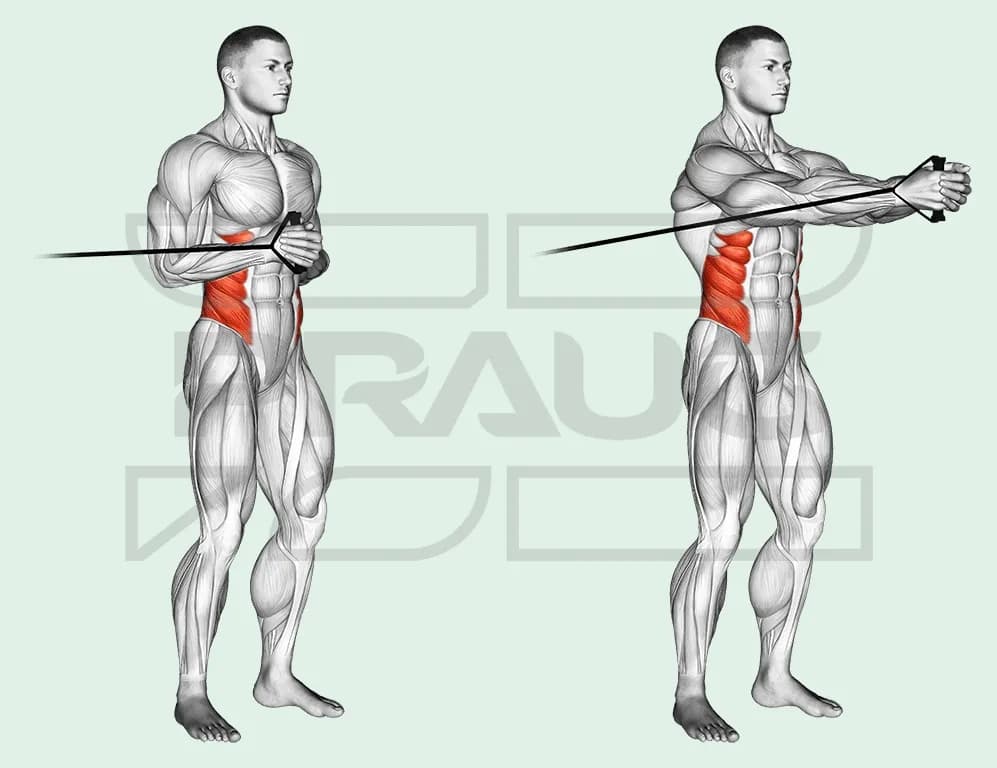
A Pallof press extends the arms in front while a cable or band pulls from the side and you resist unwanted trunk rotation. The shoulders hold the handle and the trunk and lower body maintain the chosen position. Use a demand that lets you reach, return and breathe without being pulled around.

Certified fitness coach · CQP Instructeur Fitness
Published on
The essentials before you start.
- Set the attachment around chest height and use stable foot support.
- Extend the arms only as far as the intended position remains controlled.
- Band stretch and cable geometry change the task; their resistance is not identical.
- Studies of pelvic motion or test reliability do not prove back-pain treatment or long-term strength effects.
Exercise facts
- Main muscles
- Internal and external obliques, Abdominal wall
- Secondary muscles
- Rectus abdominis, Spinal erectors, Deltoids, Pectorals, Glutes
- Equipment
- Cable pulley or resistance band, Suitable handle and anchor
What anti-rotation means here
The obliques and other trunk muscles contribute to resisting the turning demand. The shoulders and arms hold the handle, while the hips and legs provide support. The exercise is not a test that isolates one deep abdominal muscle.
One small study ranked variations using pelvic acceleration, rather than directly measuring muscle activity or training adaptation. Another examined the repeatability of resistance-band tests in people with and without chronic low back pain. A reliable test is not evidence that practising it treats that pain.
Compare the forearm plank for anti-extension and the side plank for lateral support. These are related but different tasks.
How to perform a cable Pallof press
Use an adjustable pulley and suitable handle with room to stand side-on.
- Set the handle around chest height and choose a light initial load.
- Take the handle with both hands and step to a position where the cable is under control, with the pulley to one side.
- Use stable feet around shoulder width as a starting stance, knees comfortable and the handle near the chest.
- Establish a steady rib and pelvic position, then extend the arms forwards without letting the trunk rotate unexpectedly.
- Pause briefly if useful and keep breathing. Avoid forcing an extended-arm position you cannot control.
- Return the handle towards the chest smoothly, then use comparable conditions with the other side facing the pulley.
Using a resistance band
Use an intact band and an anchor designed for the direction and load. Check attachment security and the space around you; an improvised door anchor is not automatically suitable.
Moving further from the anchor increases initial stretch. Arm position and band stretch both change the turning demand. A cable also changes its line of pull as you move, so neither setup supplies a perfectly constant trunk torque.
Record the band, distance, anchor height and stance. Band colours are not standardised loads across brands. Start with a manageable version rather than assuming holding for ten seconds means the next band is compulsory.
Stance, kneeling and common errors
If the shoulders or pelvis rotate more than intended, reduce demand or shorten the reach. A large backward lean or a continually changing foot position makes the work harder to compare. Do not claim the abdominal muscles stop working when the task changes.
Narrow, split, kneeling and half-kneeling positions alter support. A ranking in a small pelvic-motion study is not an individual progression ladder. Unstable surfaces are not required for useful trunk work.
A deliberate rotational version becomes a different movement. An overhead reach adds a different lever and extension-control demand. Introduce either for a clear goal rather than as a compulsory next stage.
Stop for sharp pain and seek appropriate advice for persistent symptoms. Neither a cable nor a band makes a generic exercise an individual rehabilitation plan.
Sets, repetitions and progression
Coaching examples include 3 sets of 8–12 repetitions per side with a short pause, or holds around 20–30 seconds. Adapt the amount to the whole week. The cited studies did not establish these as an optimal dose.
It can be light practice before lifting or direct work later, depending on the goal. Preparation should not create unwanted fatigue before the main task. There is no requirement to do it at every workout.
Track attachment, anchor height, stance, distance, load, reach and duration or repetitions. Change one variable when the existing task remains repeatable. Browse the abdominal collection for other trunk tasks.
Illustrated positions and variations
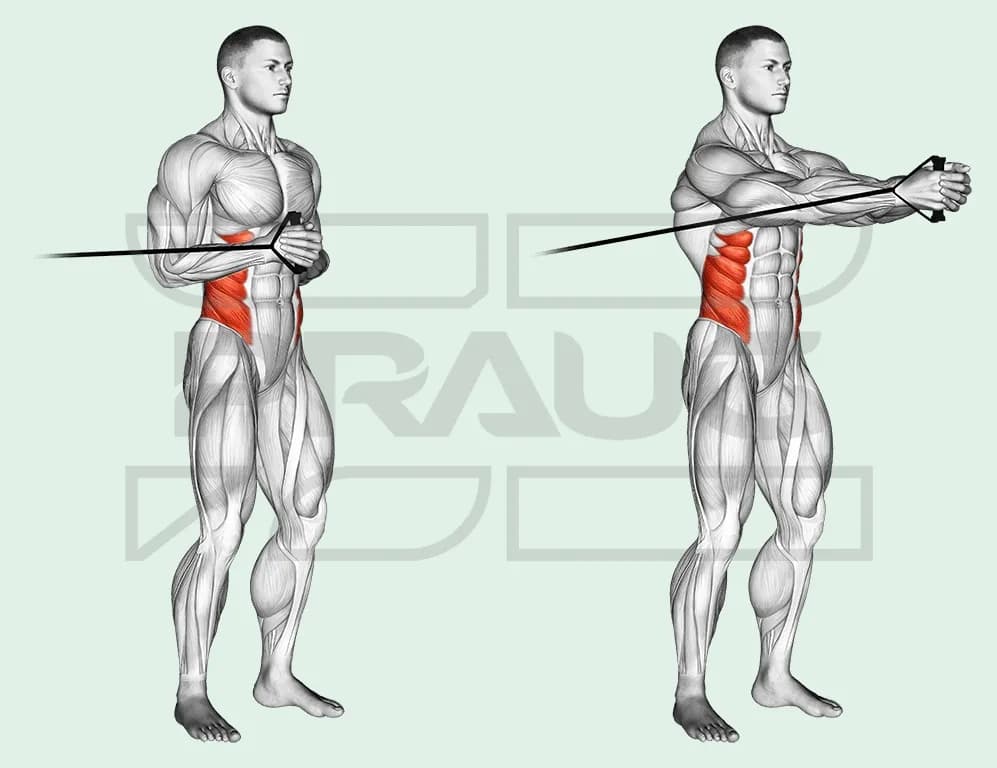
These original illustrations show example setups. Choose a range, support and difficulty you can control.
Pallof press movement
Frequently asked questions
Cable or band?
Both can create a side-pulling demand. Their geometry and resistance profiles differ, so record the exact setup.
Should my trunk stay completely motionless?
Aim to control the movement you intend to resist. A small movement is not a diagnostic failure; reduce demand if rotation becomes uncontrolled.
Are feet together always the next progression?
No. Stance changes support and can be chosen for a purpose. The study ranking is not a universal progression ladder.
Does it treat low back pain?
The cited reliability study did not establish treatment effects. Persistent symptoms need individual assessment.
Sources and limitations
Sources support the passages that cite them. Practical suggestions are coaching choices to adapt to your own situation.
- Juan-Recio et al. · 2025 · Pelvic acceleration during five Pallof-press support variations. ↗
Small acute study of postural challenge, not direct muscle activity, long-term adaptation or treatment effects.
- Franco-López et al. · 2024 · Test-retest reliability of resistance-band trunk-strength tests. ↗
A reliability study, including people with and without chronic low back pain; it does not demonstrate treatment efficacy.
This general information does not replace individual advice. Zepraug’s limitations.