Training· 5 min read
Forearm plank: position, breathing and variations
Other names: Front plank, Prone plank
A forearm plank supports the body through the forearms and feet while the trunk resists unwanted extension. Choose a manageable body line and keep breathing. A shorter controlled hold or a knee-supported version is useful when the full version exceeds your current capacity.

Certified fitness coach · CQP Instructeur Fitness
Published on

The essentials before you start.
- Begin with elbows around shoulder level and stable forearm and foot support.
- Keep the intended trunk position without forcing a maximal pelvic tuck.
- End or adapt the hold when the task changes substantially.
- There is no universal one-minute limit or required weighted-plank starting load.
Exercise facts
- Main muscles
- Rectus abdominis, Abdominal wall, Internal and external obliques
- Secondary muscles
- Glutes, Quadriceps, Deltoids, Serratus anterior
- Equipment
- Bodyweight, Mat
What the plank trains
The abdominal wall contributes to resisting extension while the shoulder, hip and leg muscles help maintain support. The lower back does not take over all the work simply because you feel it, and a visible change does not identify one weak muscle.
Small acute studies compared electrical activity in plank variations, including longer levers and different pelvic positions. They do not establish which variation produces greater long-term strength, growth or lower injury risk. The abdominal-training fat-loss trial was not a plank-specific trial.
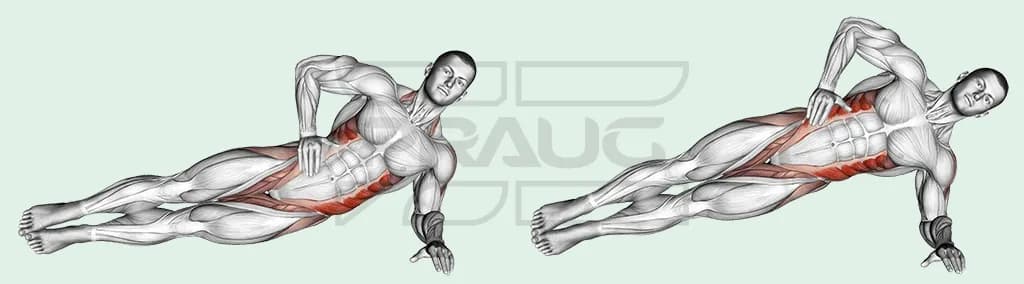
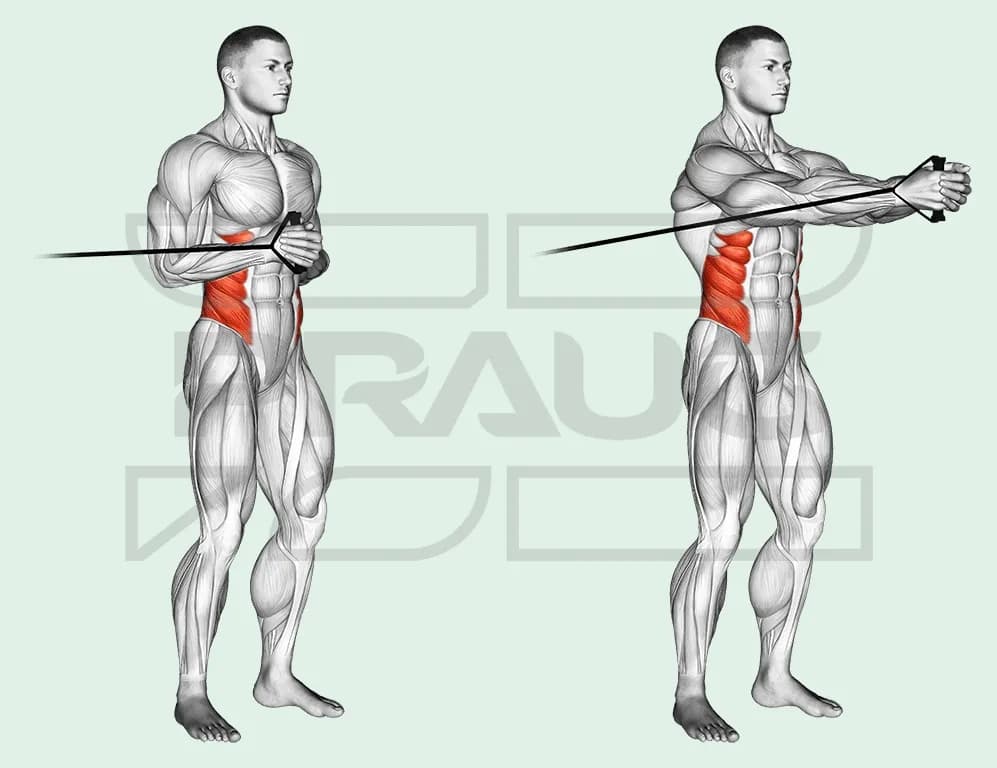
A side plank resists lateral bending and a Pallof press resists rotation. These labels describe tasks rather than an obligation to do every exercise in each session.
How to set up a forearm plank
Use a comfortable, non-slip surface and choose knee support or full-length support according to current control.
- Place the forearms on the floor with the elbows around shoulder level and a comfortable spacing.
- Use the knees or feet for the lower-body support and organise a steady trunk position.
- Lift into the chosen body line, keeping the head in a comfortable continuation of the trunk.
- Press into the forearms without collapsing into the shoulders. Maintain enough abdominal and hip effort to hold the position.
- Breathe throughout rather than using a prolonged breath-hold to reach a target time.
- Lower under control and rest before fatigue changes the task substantially.
Position and common errors
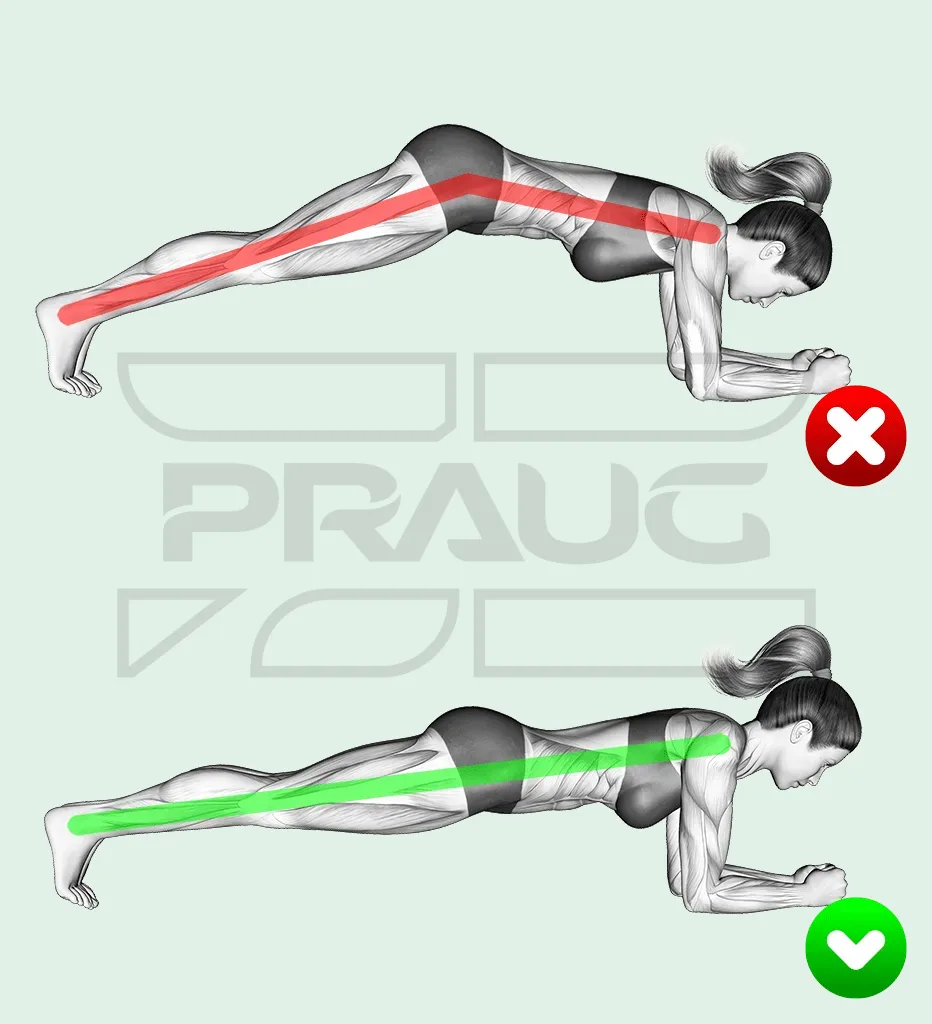
Watch for progressively sagging hips, a large rise of the pelvis, repeated neck reaching or shoulders that can no longer support the position comfortably. Shorten the hold or change leverage rather than chasing the timer.
A slight pelvic tuck may help you organise the position, but it is not a requirement to flatten the spine maximally. A comparison of electrical activity under a specific cue does not prove that cue is always superior.
Stop for sharp pain and seek individual advice for persistent symptoms. This guide does not prescribe a plank as treatment for a particular back or shoulder condition.
Knees, longer levers, limb lifts and load
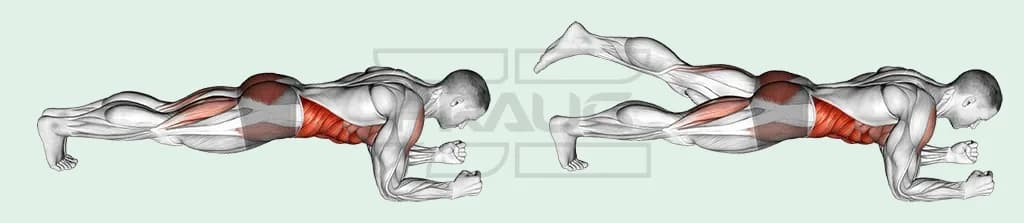
Knee support shortens the lever. Raising a limb adds an asymmetric support demand; moving the elbows further forwards lengthens the lever. Choose a manageable adjustment and avoid sudden loss of support.
A high-tension or RKC-style plank deliberately increases voluntary effort. It is a separate way of defining the task, not proof that a more relaxed controlled hold has no value. Roll-out and suspension versions add equipment and require secure anchors and an appropriate progression.
Added resistance needs a secure method and a controlled way to enter and exit. Do not begin with a prescribed 5–10 kg or balance a loose plate on the back because a generic example suggests it. You can progress without adding external load.
A dead bug changes support and adds limb movement. It is a related option, not a compulsory stage before planking.
How long to hold and how to progress
One coaching example uses 3 holds of 20–45 seconds with rest as one example. Adapt the time to current ability and the intended version. Longer holds can train the chosen task; they do not become useless at exactly one minute.
If a harder lever serves the goal, introduce it gradually instead of adding time indefinitely. There is no requirement to progress at thirty or forty-five seconds, and an acute activity ranking is not a mandatory training sequence.
Record support, elbow position, body line, duration, rest and effort. Choose frequency in the context of other trunk and lifting work. See abdominal exercises for related tasks.
Illustrated positions and variations
These original illustrations show example setups. Choose a range, support and difficulty you can control.
Body-line examples
One-leg plank
Frequently asked questions
How long should a beginner hold?
Use a duration and support you can control while breathing, even if shorter than the example. Stop when the intended task changes.
Are three-minute planks useless?
No. Duration is one way to train and track a task. A different lever may suit another goal, but there is no universal time cutoff.
Should I add a weight plate?
It is optional and requires a secure loading method. There is no required starting weight or need to balance a loose plate on the back.
Does a plank remove abdominal fat?
It trains a trunk-support task. It is not a method for reliably choosing where the body loses fat.
Sources and limitations
Sources support the passages that cite them. Practical suggestions are coaching choices to adapt to your own situation.
- Schoenfeld et al. · 2014 · Electrical activity in traditional and modified forearm planks. ↗
Nineteen participants and acute holds. No long-term strength, hypertrophy or injury outcome was established.
- Calatayud et al. · 2017 · Electrical activity during eight plank variations. ↗
Twenty students in one session. Activity rankings do not establish a mandatory progression or individual spinal loading.
- Vispute et al. · 2011 · Six weeks of abdominal exercise and abdominal-fat measurements. ↗
Small sedentary sample and not a plank-specific trial; it does not establish targeted fat loss from this exercise.
This general information does not replace individual advice. Zepraug’s limitations.