
Training· 6 min read
Strength-training warm-up: prepare without tiring out
A practical strength-training warm-up combines manageable general movement with lighter practice of the exercise you are about to train. Increase demand in steps while checking the setup and how the movement feels. The aim is preparation without unnecessary fatigue; the examples here are adaptable coaching choices, not a guarantee against injury.

Certified fitness coach · CQP Instructeur Fitness
Published on
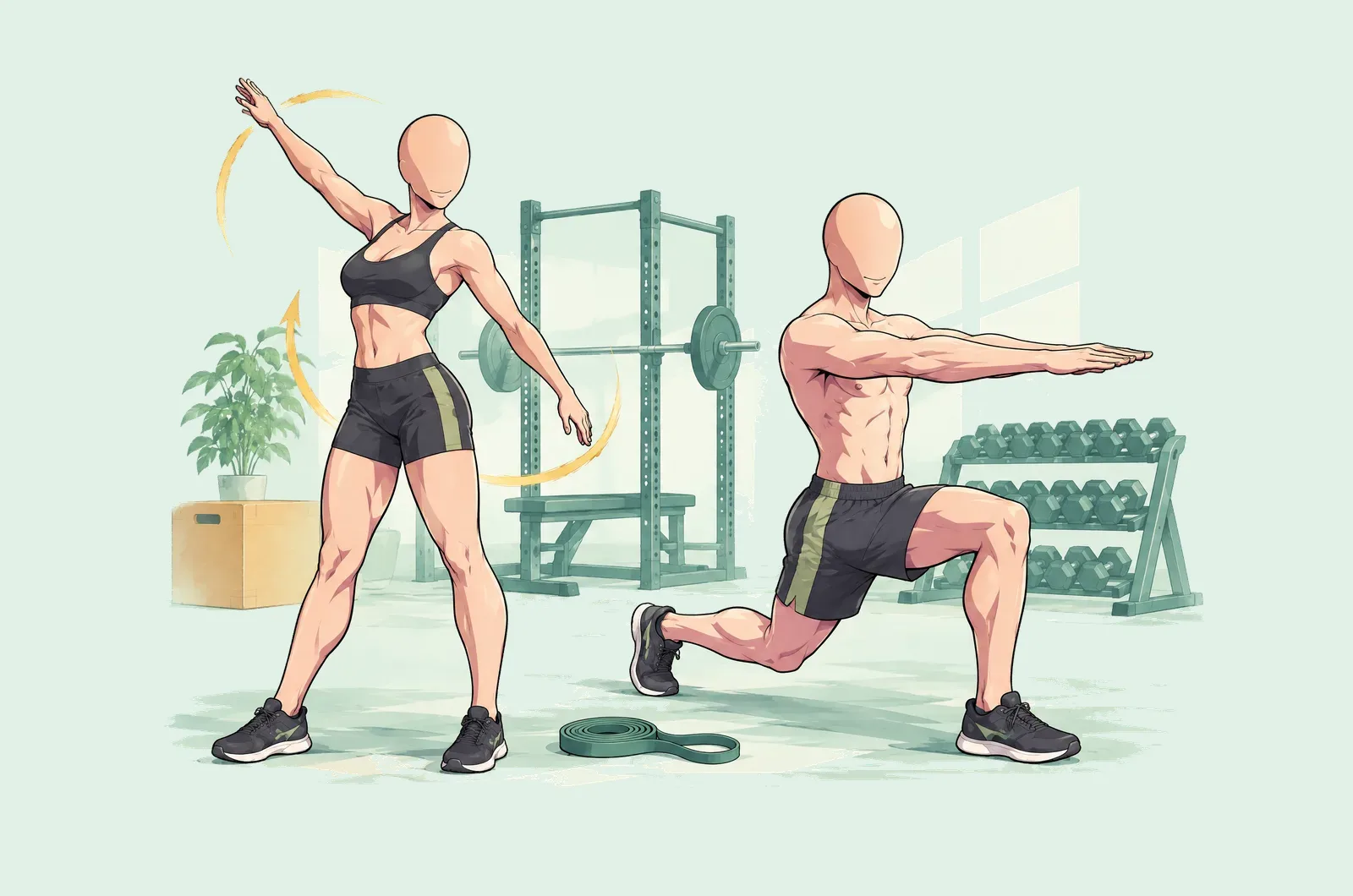
The essentials before you start.
- Use light general movement when useful, then relevant practice and ramp-up sets.
- A percentage of working weight is different from a percentage of one-repetition maximum.
- The cited warm-up experiment measured performance in one session, not long-term gains or injury prevention.
- Static-stretching findings depend on duration and context; forty-five seconds is not a universal safe-or-unsafe boundary.
What preparation can and cannot establish
A warm-up provides a chance to move gradually, practise the planned task, check equipment and decide whether the intended load fits the day. The amount needed varies with the session, environment and current readiness; a fixed routine is not mandatory for every exercise.
The older injury paper cited here used experimentally preconditioned rabbit muscles. It does not show how much injury risk changes in human strength training. Do not turn that laboratory mechanism into a prevention guarantee.
The human squat-and-bench experiment compared specific warm-up arrangements before one session’s work and measured performance variables. It did not test an exact ten-minute routine for everyone or establish long-term training outcomes.
General movement: enough to prepare
A practical starting option is roughly 5–10 minutes of easy cycling, rowing or walking as a starting example. Choose an activity and duration suited to the planned task and your current capacity. You should not need to recover from an exhausting warm-up before starting the workout.
Comfortable dynamic movements can provide additional practice of the ranges you will use. They do not have to become a large circuit of every muscle group. Burpees, hard skipping or a demanding circuit can create fatigue rather than simply prepare you.
Cold conditions or a longer gap since moving may call for more gradual preparation. A warmer room does not remove the value of practising the actual lift. Let the session and your response guide the amount.
Relevant practice and ramp-up sets
After general movement, practise the main exercise with a manageable resistance. Increase the load in steps while reducing repetitions as useful, with enough rest to assess the next set. A demanding warm-up set can count towards fatigue even if it is labelled preparation.
Check the bar, machine settings, supports, range and planned finish. The warm-up is an opportunity to notice a setup problem before a heavy set; it is not proof that every symptom has been resolved.
If a later exercise uses a new pattern or substantially different range, some lighter practice may still be useful. You do not always need to repeat the entire general warm-up before every exercise.
Working weight and maximum: avoid mixing the percentages
In the cited experiment, the working sets used 80% of one-repetition maximum. Warm-up loads were described as percentages of that working load. Thus 80% of the working load was 64% of the tested maximum, not the full working weight. The tested arrangements and effects differed between squat and bench press.
The practical ramp below illustrates planned 100 kg squat working sets. It is a coaching illustration, not the experiment’s protocol or a prescription for a reader’s first squat.
| Stage | Example weight | Example repetitions | Meaning |
|---|---|---|---|
| Initial practice | An appropriate empty or light bar | A manageable short set | Check setup and movement first. |
| Ramp 1 | 40 kg | 10 | 40% of a planned 100 kg working weight. |
| Ramp 2 | 60 kg | 8 | 60% of that working weight. |
| Ramp 3 | 80 kg | 5 | 80% of that working weight. |
| Working sets | 100 kg | As planned | Not necessarily 100% of one-repetition maximum. |
Examples for different sessions
For a lower-body session, begin with manageable general movement if useful, then an air squat or lighter relevant practice before ramping the barbell squat or chosen machine. Reduce the example repetitions if they create fatigue.
For upper-body pressing, easy movement and a manageable incline push-up or light press can provide practice before ramping the bench press. You do not need a fatiguing set of every shoulder exercise first.
For pulling or hinges, use lighter practice of the chosen pulldown, row or Romanian deadlift. General cardio alone is not the same movement practice.
The demonstration below is one warm-up example. It is not the exact research protocol and should not be treated as a compulsory routine.
Static stretching and dynamic movement
The cited meta-analysis examined immediate performance after static stretching. Average effects varied with duration and test conditions, and the smallest negative effects were seen with shorter durations. It did not establish a universal forty-five-second boundary or directly compare every complete dynamic warm-up routine.
If sustained static stretching is part of your preparation, consider why you are using it, the amount and how you follow it with task-specific movement. Do not claim that all stretching before lifting is harmful or that a short hold guarantees unchanged performance.
Dynamic movements rehearse motion rather than holding one position. Choose manageable movements relevant to the session without treating them as injury-proofing. These sources do not determine a personalised mobility or rehabilitation plan.
Use the warm-up to adjust the session
If a usual light load feels unusually demanding, check rest, setup and movement and consider adjusting the planned work. The RPE guide explains effort estimates without treating them as exact measurements.
Do not push through sharp pain because a routine says the muscles should now be warm. Persistent or concerning symptoms need individual advice. Fatigue, pain and breathlessness are different observations; no single warm-up set diagnoses their cause.
Keep a useful routine repeatable, then adapt it when conditions change. A warm-up that takes more time or uses more exercises is not automatically better.
Original warm-up demonstration
One demonstration; adapt the routine to your task and current capacity.
Strength-training warm-up demonstration
Frequently asked questions
How long should a strength warm-up take?
The source gives 5–10 minutes of general movement plus relevant ramp-up work as one starting example. Adapt to the session and your response rather than a compulsory duration.
Does 80% warm-up mean 80% of maximum?
Only if that is the stated reference. In the cited experiment, warm-up percentages referred to the working load, which itself was 80% of maximum.
Is static stretching forbidden before lifting?
No. Duration, purpose and the rest of the routine matter. The cited synthesis does not create a universal forty-five-second rule.
Does warming up guarantee fewer injuries?
No. The cited rabbit-muscle experiment does not establish human injury-prevention effects, and the human study measured acute performance.
Must I warm up every exercise from the beginning?
Use relevant lighter practice for a new task as needed. Repeating a full general routine before every movement is not automatically useful.
Sources and limitations
Sources support the passages that cite them. Practical suggestions are coaching choices to adapt to your own situation.
- Safran et al. · 1988 · Failure mechanics of preconditioned and control rabbit muscles. ↗
Animal laboratory model. It does not quantify injury prevention in human strength training.
- Ribeiro et al. · 2020 · Specific warm-up arrangements before squat and bench-press work. ↗
Forty trained men and acute performance outcomes. Warm-up percentages refer to working load, not directly to maximum; no injury or long-term outcome was tested.
- Simic et al. · 2013 · Meta-analysis of immediate performance after static stretching. ↗
Duration and test context varied. It does not establish a universal 45-second boundary or compare every complete dynamic warm-up.
This general information does not replace individual advice. Zepraug’s limitations.