Training· 5 min read
Cable back exercises: five pulling options
A cable station offers vertical pulling, horizontal rowing, straight-arm shoulder work and rear-shoulder options. Choose by the task and a manageable weekly amount. These five movements are choices within a programme, not a ranked list that everyone must perform in one session.

Certified fitness coach · CQP Instructeur Fitness
Published on
The essentials before you start.
- Choose by movement task, not an exclusive width/thickness label.
- One cable station can support different arm paths and support arrangements.
- The example menus are choices, not work to add together.
- Acute electrical activity does not validate a universal best workout.
Five movements, different tasks
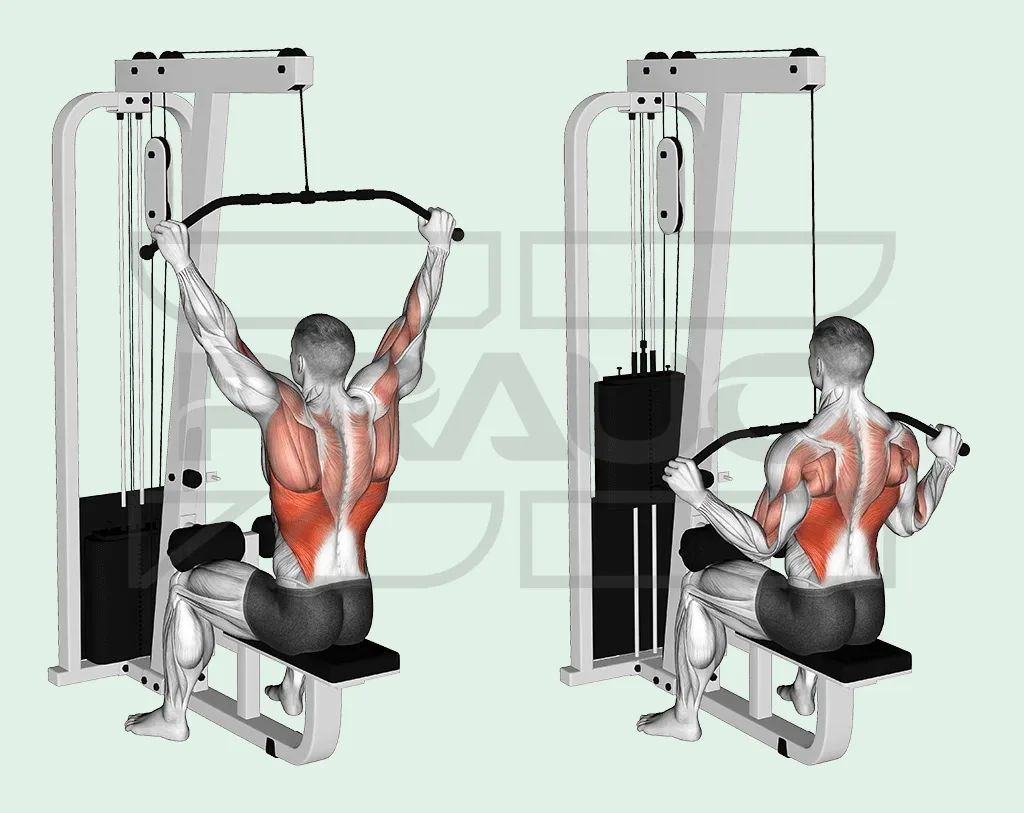
A lat pulldown and single-arm cable pulldown move the upper arms from overhead while the elbows bend. A seated cable row uses a more horizontal direction. Neither direction exclusively creates width or thickness.
A straight-arm pulldown keeps a nearly fixed elbow angle. A face pull combines rear-shoulder pulling with controlled rotation. It is a different task, not a guaranteed shoulder-protection exercise.
| Option | Pulley and setup | Main task |
|---|---|---|
| Lat pulldown | High; seated with thigh support | Vertical pull with elbow flexion |
| Single-arm pulldown | High; stable kneeling, standing or seated support | One-sided vertical pull |
| Straight-arm pulldown | High; controlled standing or kneeling setup | Shoulder movement with little elbow-angle change |
| Seated row | Low; supported feet and repeatable trunk angle | Horizontal pull |
| Face pull | Around face height as a starting reference | Rear-shoulder pull and rotation |
Set the station before adding demand
Check attachments, cable travel, adjustments and the path of the stack. A cable does not create identical muscle torque through every angle; pulley position, arm position and machine geometry matter. Stack labels from different stations do not represent directly interchangeable loads.
- Choose a station and attachment appropriate to the task and check the locks.
- Set stable feet, seat or kneeling support and a shoulder range you can control.
- Coordinate the arm and shoulder-blade movement instead of clamping the shoulder blades down throughout.
- Pull and return smoothly without throwing the torso or letting the stack jerk you.
- Record the setup before adding repetitions or load.
What the cited research can establish
The review summarises electrical activity during particular pulling setups. Within the seated-row evidence, narrower grip and lower shoulder-abduction angle were studied separately, not as one validated combined setup. The small grip-width study examined pulldowns, not all five tasks. These sources do not rank long-term growth or validate the complete workouts below.
Smaller cable workout example
Choose this example or reduce it; do not add it to a complete back workout automatically. These nine listed sets are per occurrence, not nine weekly sets if repeated twice.
| Exercise | Sets | Repetitions |
|---|---|---|
| Lat pulldown | 3 | 12–15 |
| Seated cable row | 3 | 12–15 |
| Face pull | 3 | 15–20 |
Larger cable workout example
The two pulldown rows overlap. Choose whether both add useful work for your goal. Fourteen listed sets form a larger menu; they are not the next compulsory stage after a fixed training age.
| Exercise | Sets | Repetitions |
|---|---|---|
| Lat pulldown | 4 | 10–12 |
| Close or neutral-grip pulldown | 3 | 12–15 |
| Seated cable row | 4 | 12–15 |
| Face pull | 3 | 15–20 |
Extended cable menu
This example contains twenty-one listed sets using the per-side count for unilateral work. It is substantial; selecting fewer tasks or dividing the amount across sessions is a valid choice. Three sets per side gives each side three, not six.
| Exercise | Sets | Repetitions |
|---|---|---|
| Lat pulldown | 4 | 8–10 |
| Close-grip pulldown | 4 | 10–12 |
| Seated cable row | 4 | 10–12 |
| Straight-arm pulldown | 3 | 12–15 |
| Single-arm pulldown | 3 per side | 12–15 per side |
| Face pull | 3 | 15–20 |
Use a manageable amount and compare the same task
Use lighter practice and enough rest to repeat the intended motion. Leaving roughly one to three valid repetitions possible is one coaching option while learning; the research cited here did not prescribe these table doses. Stop for sharp pain and seek individual advice for persistent symptoms.
Use the back programme to choose a workload rather than adding every table to it. Change repetitions or a manageable load increment while keeping attachment, range and effort comparable.
Illustrated positions and options
These show example positions and equipment. An illustration is not a required range, individual loading instruction or validation of a particular support.
Illustrated option 1
Movement exampleIllustrated option 2
 Movement example
Illustrated option 3
 Movement example
Illustrated option 4
 Movement example
Illustrated option 5
 Movement example
Frequently asked questions
Do I need all five exercises?
No. Choose tasks and an amount that fit the whole programme.
Does a wide grip always train the lats better?
The cited acute evidence does not establish that or a long-term growth ranking.
Are rows only for thickness?
No. Direction changes the task, but the muscles overlap.
Can the station’s stack number be compared with another machine?
Not directly. Pulley arrangements, labels and setup can change the actual demand.
Sources and limitations
Sources support the passages that cite them. Practical suggestions are coaching choices to adapt to your own situation.
- Di Fonza and al. · 2026 · Narrative review of pulling-exercise electrical activity. ↗
Acute findings with varied setups; not a growth ranking or validation of every cable variation.
- Andersen and al. · 2014 · Acute comparison of overhand pulldown grip widths. ↗
Fifteen men; not a trial of long-term growth or all cable exercises.
This general information does not replace individual advice. Zepraug’s limitations.