
Training· 6 min read
Back training at home: floor work and pulling options
At home, floor exercises can train trunk extension and shoulder-blade movement. Useful back pulling usually needs a suitable bar, suspension system or other resistance. This menu distinguishes those tasks rather than presenting floor drills as an equivalent replacement for rows or pull-ups, or household furniture as exercise equipment.

Certified fitness coach · CQP Instructeur Fitness
Published on
The essentials before you start.
- Floor work does not reproduce every pulling task.
- A bar, band or suspension system needs an appropriate load-bearing setup.
- The twelve options form a menu, not a compulsory session.
- Furniture and door-towel improvisations have been replaced by different supported tasks.
What equipment-free work can and cannot reproduce
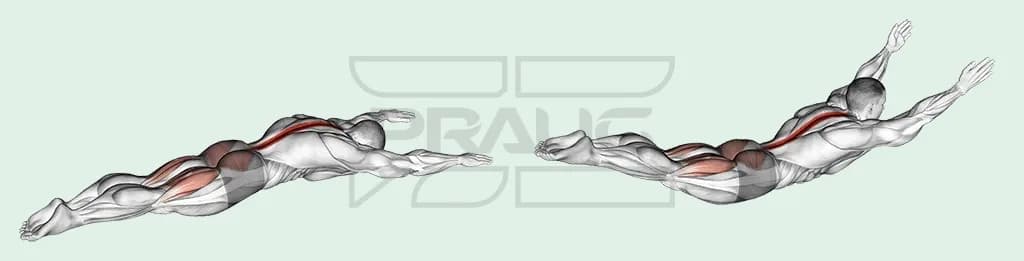
A superman, bird dog or prone W–Y–T task can be useful practice with different demands. None supplies the same adjustable pulling resistance as a row or pulldown simply because it is performed near the back muscles.
The cited load-comparison synthesis did not test this home menu or validate furniture setups. Its failure-based protocols do not mean every floor set should be taken to failure, or that any easy movement produces identical growth to a heavier pull.
How to practise the floor options
Use a small range and a manageable lever. These cues describe different tasks; they do not establish equivalent resistance or a complete pulling workout.
- Bird dog: from hands and knees, reach one arm and the opposite leg only as far as the trunk stays steady, then return and change sides.
- Prone swimmer: lying face down, make small alternating opposite-arm/leg lifts without throwing the head back.
- Prone W–Y–T: lying face down, use bent arms for W, diagonal arms for Y and arms out to the sides for T. Lift slightly through a controlled shoulder range; one round contains all three shapes.
- Short-lever prone extension: keep the arms near the sides or bent, lift the upper torso slightly and lower smoothly. It overlaps with superman work, so choosing one is reasonable.
- Self-resisted row hold: use the other hand to apply light opposing pressure to the working forearm while it attempts a small row. Keep the torso steady and release smoothly. This is an optional low-load task, not a towel or door anchor, a maximum strength test or a substitute for every resisted pull.
Floor practice example
This is a trunk-and-shoulder practice menu, not a complete lat-pulling workout. Choose fewer tasks or sets when starting; W–Y–T counts three shapes, so eight of each is more than eight total repetitions. The short-lever floor extension replaces the bed-edge example.
| Task | Example amount |
|---|---|
| Superman | Up to 3 × 12 controlled repetitions |
| Prone W–Y–T | Up to 3 rounds of 8 for each shape |
| Bird dog | Up to 3 × 10 per side |
| Short-lever prone extension | Up to 3 × 15; omit if duplicating too much extension |
| Prone swimmer | Up to 3 short blocks; 30 seconds is an example, not a requirement |
Supported row example
Use purpose-built equipment rather than a table or door-towel arrangement. The substitutions below change resistance and balance. Choose a manageable band and keep it out of a path that could strike the face if it releases.
| Task | Example amount |
|---|---|
| Inverted row | Up to 4 × 10–15 |
| Band row with suitable anchor | Up to 3 × 15 |
| Superman | Up to 3 × 12 |
| Prone W–Y–T | Up to 2 rounds of 8 per shape |
Bar and pulling example
A bar alone does not supply every support below. Use a separate appropriate row setup or choose fewer tasks. Replace maximum-set instructions with repetitions you can repeat under control.
| Task | Example amount |
|---|---|
| Overhand pull-up | Up to 4 controlled sets; assistance as needed |
| Inverted row on suitable equipment | Up to 3 × 12 |
| Assisted one-arm suspension row | Up to 3 × 8 per arm; optional |
| Short-lever floor extension | Up to 3 × 15; optional |
Progress without making the support the weak point
For a row, change body angle, assistance or resistance gradually. For a floor drill, change the lever, control or duration deliberately; more discomfort or a longer hold is not a complete strength test. Keep enough rest to repeat the chosen movement.
Do not improvise an under-table one-arm row, a towel looped around a door, or an unsupported bed extension on the assumption that an object will hold. An intact band still needs a suitable anchor; a purpose-built system still needs correct installation and use.
Two or three weekly occurrences are coaching examples, not mandatory frequencies. Repeating a whole menu multiplies its work. The home programme and first pull-up guide help choose a structure rather than adding all three menus together. Stop for sharp pain and seek individual advice for persistent symptoms.
Frequently asked questions
Can I train the back with no equipment?
You can practise floor-based trunk and shoulder tasks. They do not reproduce every loaded pulling task.
Is a solid-looking table enough for rows?
Appearance does not establish load capacity or stability. Use equipment intended for the exercise.
Do all twelve options belong in one session?
No. It is a menu, and several entries require specific equipment.
Does light-load research prove this menu builds the same muscle as a gym plan?
No. The cited synthesis did not test these tasks or this complete plan.
Sources and limitations
Sources support the passages that cite them. Practical suggestions are coaching choices to adapt to your own situation.
- Schoenfeld and al. · 2017 · Synthesis comparing lower- and higher-load resistance training. ↗
Failure-based protocols; not a test of this home menu or furniture supports.
This general information does not replace individual advice. Zepraug’s limitations.