Training· 6 min read
Face pull: cable setup, technique and evidence limits
Other names: Cable face pull, Rope face pull
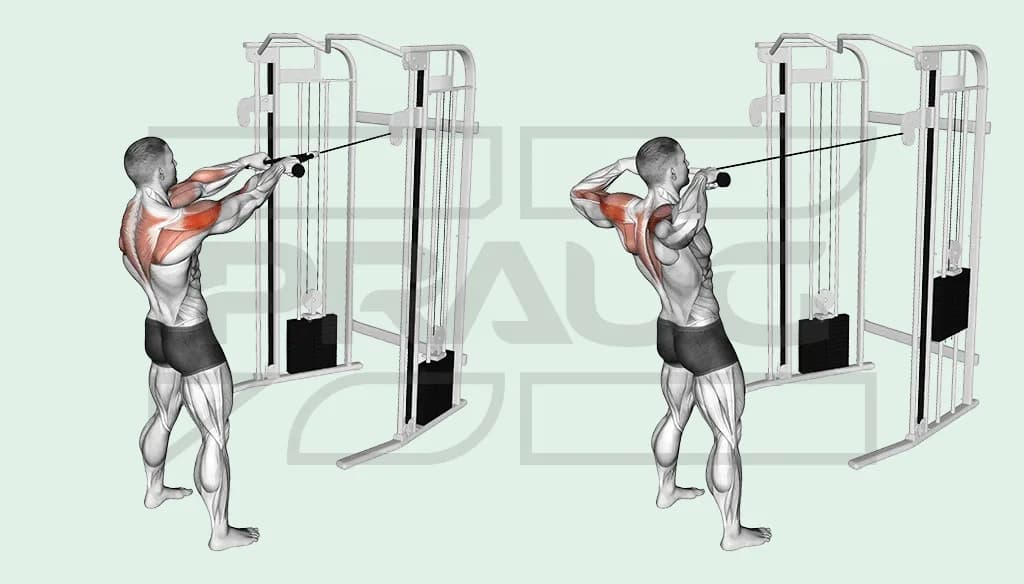
A face pull brings a rope attachment towards the face with the elbows raised, then includes a controlled external-rotation component as the hands separate. It combines a rear-shoulder and upper-back pull with a different arm position from a low row. Use a manageable load and a range you can control.

Certified fitness coach · CQP Instructeur Fitness
Published on
The essentials before you start.
- Start with the pulley around eye height and a suitable rope or attachment that allows the hands to separate.
- Keep the trunk steady and use a load that permits the intended pulling and turning movement.
- The cited shoulder studies did not test the face pull itself.
- This exercise is an option for training, not a proven way to correct posture, prevent injury or treat shoulder pain.
Exercise facts
- Main muscles
- Posterior deltoids, Middle and lower trapezius, Rhomboids
- Secondary muscles
- Infraspinatus, Teres minor, Lateral deltoids
- Equipment
- Adjustable cable pulley, Rope attachment
What the face pull is intended to train
The rear deltoids contribute to bringing the upper arms backwards, the muscles around the shoulder blades control their movement and the external rotators contribute to the turning component. The exact demand changes with pulley height, elbow path, load and the chosen finish position.
The infraspinatus and teres minor are external rotators. The cited Reinold study recorded activity during seven other shoulder exercises in ten healthy participants; the Cools study compared other scapular exercises. Neither directly measured a face pull, and neither established face-pull injury prevention, postural correction or long-term muscle growth.
It can provide a different task alongside a seated shoulder press or chest work. That does not imply a fixed push-to-pull ratio is necessary or that one movement cancels out the effects of another.
Set up and perform a cable face pull
Use a cable station, attachment and working space suitable for the movement. A rope allows separation of the hands; other appropriate independent attachments can do so too. A rigid straight bar changes the task.
- Begin with the pulley around eye height or slightly above and a light setting. Check the attachment and cable before moving away.
- Stand facing the pulley with stable feet or a split stance. Step back far enough to begin with the arms reaching forwards and the cable under control.
- Keep the trunk steady and take a comfortable grip on the rope ends. Avoid positioning the attachment so it can strike the face.
- Pull towards the face with the elbows raised in a range you can control. Let the shoulder blades move with the arms.
- Separate the hands and add controlled external rotation towards a comfortable finish near either side of the head. Do not force vertical forearms or a painful end position.
- Return smoothly with the arms reaching forwards. Avoid letting the stack jerk you or throwing the torso backwards to begin the next repetition.
When the task changes
If the set becomes a heavy leaning row without the intended turning component, lower the load and restore the movement you meant to practise. That change does not mean the shoulder muscles stopped working; it means the task is different.
If elbow height, finishing position or trunk angle changes on every repetition, record or reduce the difficulty instead of counting all the repetitions as equivalent. An exact elbow angle is not an individual safety test.
There is no need to force the hands far behind the head or squeeze the shoulder blades as hard as possible. Stop for sharp pain and seek individual advice for persistent symptoms, especially if you are trying to rehabilitate an injury.
Warm-up or training sets?
Coaching options include light warm-up examples of 2–3 sets of 15–20, and training examples of 3–4 sets of 12–15. These are coaching options, not protocols established by the cited studies. Choose less or more according to current ability, the session and recovery.
If using it before presses, keep it light enough that it does not become a fatiguing workout before the main task. Performing face pulls before pressing has not been shown by these sources to prevent an injury.
For training, record the pulley height, attachment, load, range and repetitions. Increase demand only when you can retain the intended movement. A low stack number does not mean unlimited frequency is automatically appropriate.
Bands, kneeling and one-arm face pulls
A band version needs an intact band and a secure anchor intended for the task. Check the anchor, wear and attachment and keep the band away from a path that could strike the face if it releases. Band resistance rises with stretch, so its end-range demand differs from a cable.
Kneeling or sitting changes the body height and support demand; reset the pulley height accordingly. It may reduce some ways of leaning, but it does not make trunk momentum impossible. A low pulley may still be unsuitable for the intended angle even after changing position.
A single-handle one-arm version allows a different hand path and requires its own setup. It is not automatically a correction for a side-to-side difference.
A rear-delt fly involves a different shoulder task without the same deliberate external-rotation finish. A lateral raise trains abduction. Use the shoulder collection to choose among them according to your goal.
Frequently asked questions
How high should the cable be?
Around eye height or a little higher is a starting example. Adjust for body position and a controlled pulling angle.
Does a face pull prevent shoulder injuries?
The cited studies did not test that outcome or the face pull itself. Do not treat it as a guarantee or as a substitute for individual rehabilitation advice.
Do I need a rope?
A suitable rope allows the hands to separate. Appropriate independent handles may also allow that movement; a rigid bar changes the task.
Is it the same as a rear-delt fly?
No. Both involve rear-shoulder work, but this version adds a deliberate external-rotation component and a cable pull towards the face.
Should I do it in every workout?
There is no requirement to do so. Choose frequency and amount in the context of the whole programme and your response.
Sources and limitations
Sources support the passages that cite them. Practical suggestions are coaching choices to adapt to your own situation.
- Reinold et al. · 2004 · Rotator-cuff and deltoid activity during seven external-rotation exercises. ↗
Ten healthy adults; the face pull was not tested. No face-pull injury prevention, posture correction or training adaptation was established.
- Cools et al. · 2007 · Scapular-muscle activity during twelve other shoulder exercises. ↗
Forty-five healthy adults and acute measurements; no face pull or injury-prevention trial. Findings cannot establish face-pull treatment effects.
This general information does not replace individual advice. Zepraug’s limitations.