Training· 6 min read
Dumbbell lateral raise: technique, range and progression
Other names: Lateral raise, Dumbbell side raise
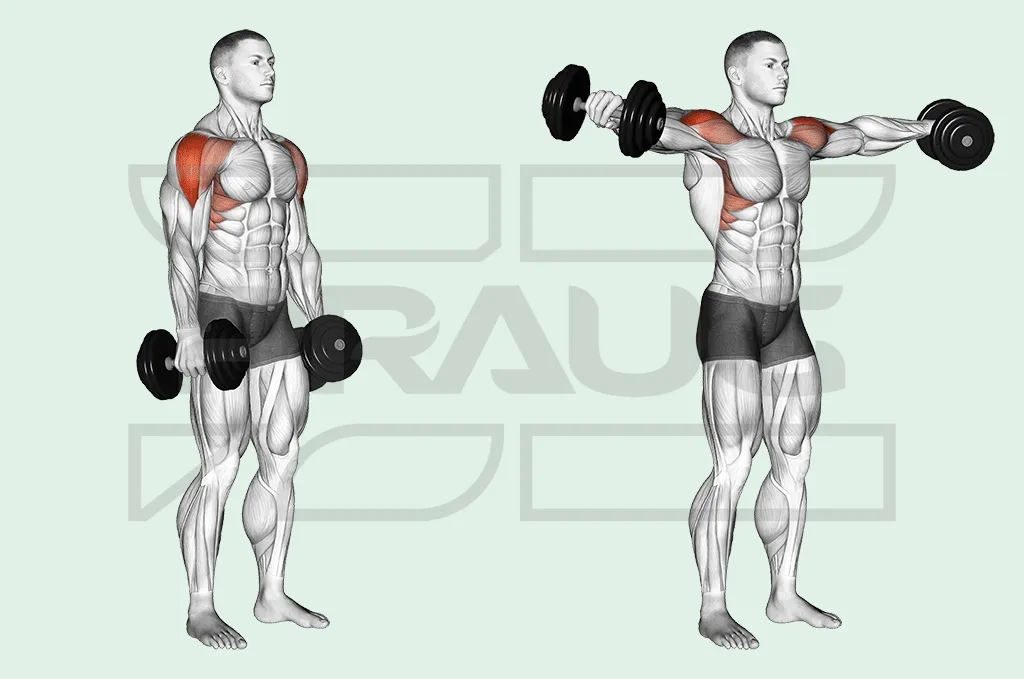
In a dumbbell lateral raise, you lift the arms out to the sides with a small, steady elbow bend, then lower under control. It directly trains shoulder abduction, with the lateral deltoid contributing alongside the muscles that move and stabilise the shoulder blades.

Certified fitness coach · CQP Instructeur Fitness
Published on
The essentials before you start.
- Use a load that allows a repeatable arm path without throwing the torso to start each repetition.
- Around shoulder height is the range used in this example; it is not a universal safety ceiling.
- The shoulder blades move with arm elevation. Do not force them permanently down.
- A short trial found similar lateral-deltoid thickness changes with dumbbells and cables under matched conditions.
Exercise facts
- Main muscles
- Lateral deltoids
- Secondary muscles
- Trapezius, Anterior deltoids, Posterior deltoids, Supraspinatus
- Equipment
- Dumbbells
What the lateral raise adds
The lateral deltoid contributes to lifting the upper arm out to the side. Other deltoid portions, the rotator cuff and the muscles controlling the shoulder blade also contribute. The upper trapezius is part of normal arm-elevation mechanics, not a muscle that must be prevented from working.
A small acute experiment compared several shoulder exercises. That helps describe the tested electrical activity, but it does not establish each reader’s growth response. A seated dumbbell press and a lateral raise remain different movement tasks even though their muscles overlap.
Lateral raises offer direct abduction work alongside pressing. No exercise can guarantee a particular shoulder width, which also depends on body structure and other factors.
How to perform a dumbbell lateral raise
Start with lighter dumbbells than you would use for a press. The long lever can make a modest weight demanding near the top.
- Stand with stable foot support, knees comfortable and a dumbbell beside each thigh. Keep a steady trunk rather than leaning back.
- Choose a small elbow bend and retain it through the set. Find a comfortable hand orientation without forcing a thumbs-down position.
- Lift the arms outwards in a path you can control, often slightly in front of a straight line to the sides.
- For this example, finish around shoulder height. Allow coordinated shoulder-blade movement rather than clamping the shoulders down.
- Lower smoothly to the starting position without dropping the dumbbells or bouncing them off the thighs.
- Repeat with the same arm path and range. Stop or reduce the demand when torso momentum becomes the main way to raise the weights.
Useful cues and limits
Leading with the elbows can help maintain the arm path. It is a cue, not a rule that the hands must always sit below the elbows. Avoid changing elbow bend progressively simply to move a heavier weight.
Around shoulder height provides a clear reference in this guide. The cited training study did not compare different upper limits, so it cannot show that lifting higher is harmful or useless. Adapt the task to your goal and a range you can control.
Do not label every shoulder-blade movement a shrugging error. Look for an uncontrolled change in the intended task, such as repeatedly bouncing the legs or throwing the trunk. If a movement causes sharp or persistent pain, adjust and seek appropriate individual advice.
Dumbbells, cables, machines and support
Dumbbell shoulder torque is relatively low with the arm near the side and increases as the weight moves further horizontally from the shoulder. A cable changes that profile according to pulley position and body angle; it does not provide identical shoulder torque everywhere.
An eight-week study in 24 trained participants assigned one arm to cables and the other to dumbbells with a matched range. Both conditions increased measured lateral-deltoid thickness, without a clear between-condition difference. It does not prove every cable setup, machine or range is equivalent.
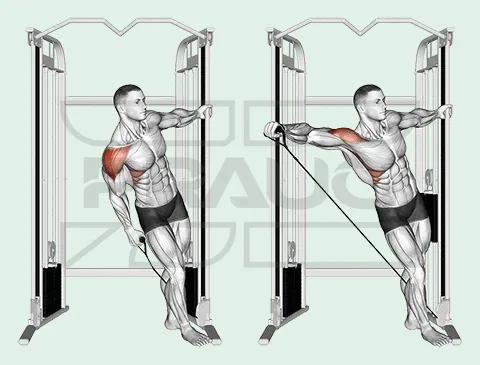
A one-arm cable raise uses a suitable handle and pulley setting, with the free hand on stable support if needed. A machine uses pads and a fixed movement arrangement: adjust it to your proportions rather than forcing an uncomfortable fit.
A seated raise, supported standing version or one-arm dumbbell raise changes the balance demands. These options can help you practise a repeatable task, but support does not remove every way to use momentum or automatically correct side-to-side differences.
Sets, repetitions and place in the week
One coaching example uses 3–4 sets of 12–20 repetitions as one example, sometimes spread over two or three sessions. Adapt that to your experience and total shoulder work rather than assuming a small muscle always recovers quickly. It is not necessary to copy the study’s sets to failure.
Lateral raises can follow pressing or appear earlier when direct abduction work is a priority. A face pull provides a different rear-shoulder and upper-back task; neither exercise makes the other compulsory.
Record the weight per hand, range, support method and repetitions. Add a small increment when useful while keeping those references stable. If the next available dumbbell is a large jump, progress repetitions or use another suitable loading option rather than forcing it. Browse the shoulder collection for related tasks.
Illustrated positions and variations
These illustrations show example positions and options. Choose a setup and difficulty you can control.
One-arm cable lateral raise
Frequently asked questions
How heavy should the dumbbells be?
Light enough to repeat the chosen arm path and range without a large torso swing. There is no useful universal starting weight.
Should I stop at shoulder height?
That is this guide’s starting example. The cited study does not establish a universal upper limit or compare injury risk above it.
Are cables better than dumbbells?
They change the resistance profile. The short matched-range trial found similar thickness changes, without establishing equivalence for every setup.
Do I need to keep my shoulders pulled down?
Avoid an exaggerated uncontrolled shrug, but allow normal shoulder-blade movement with arm elevation.
How many weekly sets should I do?
Choose a manageable amount in the context of pressing and other shoulder work. The source’s example is a starting option, not a requirement.
Sources and limitations
Sources support the passages that cite them. Practical suggestions are coaching choices to adapt to your own situation.
- Larsen et al. · 2025 · Eight-week within-participant comparison of cable and dumbbell lateral raises. ↗
Twenty-four trained participants, matched range and a specific protocol. It does not compare every cable arrangement, machine, support position or upper range limit.
- Campos et al. · 2020 · Deltoid electrical activity during four shoulder and chest exercises. ↗
Thirteen trained men and a single exercise set. It does not measure hypertrophy over time or establish a universal programme.
This general information does not replace individual advice. Zepraug’s limitations.