Training· 5 min read
Seated dumbbell shoulder press: setup and technique
Other names: Seated dumbbell overhead press
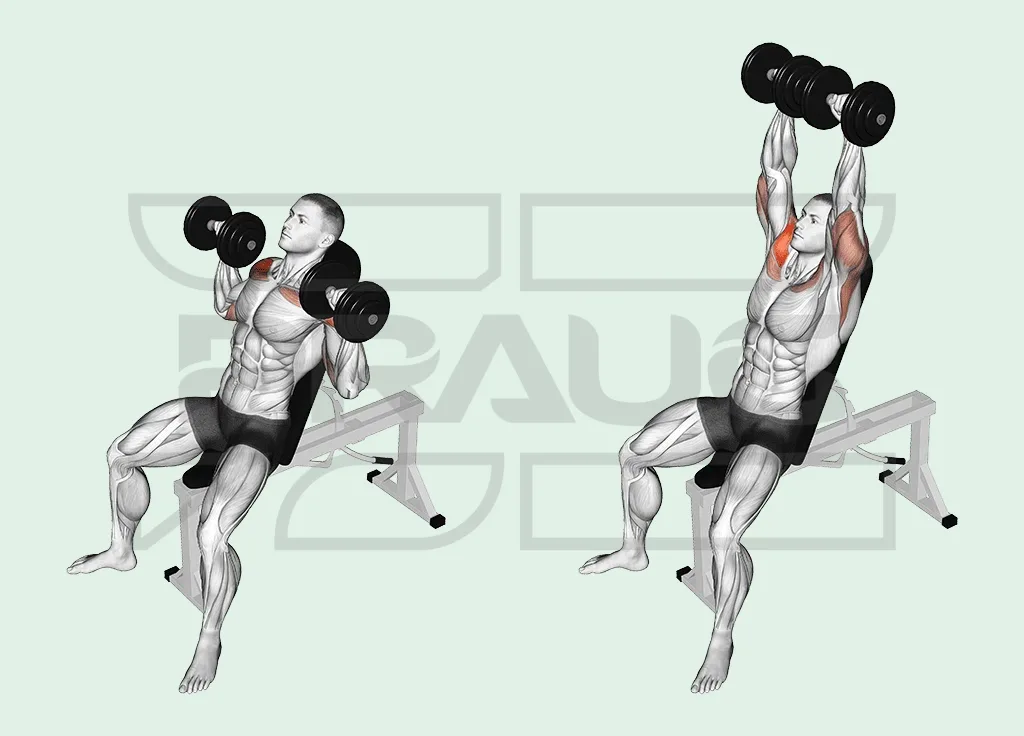
A seated dumbbell shoulder press starts with the weights beside the shoulders and presses them overhead. A near-upright backrest provides support while the shoulders and triceps work. Choose weights you can bring into position and put down with control, as well as press for the planned repetitions.

Certified fitness coach · CQP Instructeur Fitness
Published on
The essentials before you start.
- Set a stable bench near upright and give the feet firm support.
- A backrest changes support demands but does not remove all trunk control or prevent every compensation.
- Use a repeatable overhead range; elbow height is a coaching reference, not a universal anatomical limit.
- Seated-versus-standing electrical-activity findings do not prove which option produces more muscle growth.
Exercise facts
- Main muscles
- Anterior deltoids
- Secondary muscles
- Lateral deltoids, Triceps, Trapezius, Serratus anterior
- Equipment
- Dumbbells, Adjustable bench
What the seated dumbbell press trains
The anterior and lateral deltoids contribute to raising the upper arms, and the triceps extend the elbows. The trapezius and serratus anterior contribute to shoulder-blade movement as the arms rise. Supporting the back does not make the trunk irrelevant or mean the shoulder blades should be held down throughout.
The cited experiment compared seated and standing presses using barbells and dumbbells in 15 healthy men. It measured one-repetition strength and electrical activity, not training adaptations over months. A higher maximum load or activity value in one setup is not a universal growth ranking.
Dumbbells allow independent hand paths. They do not guarantee that discomfort with a barbell will disappear, or automatically correct a strength difference between sides.
Set up before pressing
This example uses a backrest roughly 75–90 degrees from horizontal. Treat this as a practical starting range, adapting the bench and body position to a controlled task rather than assuming one angle is best for every back.
- Check the bench is stable and locked, with room to move the weights safely. Choose manageable dumbbells before sitting down.
- Place the feet on firm support and establish a steady trunk against the backrest. Avoid sliding forwards to create an exaggerated arch.
- Bring the dumbbells beside the shoulders using a controlled method you have practised, or appropriate assistance. Do not improvise a difficult kick-up with unfamiliar weights.
- Position the wrists over the forearms and choose a comfortable hand angle. Start from a shoulder range you can control.
- Press smoothly overhead, allowing the shoulder blades to rotate with the arms. Keep the weights clear of the head and avoid banging them together.
- Lower under control to the same starting depth, then finish the set using a planned method of returning the weights.
Depth, hand path and common errors
This example uses elbows around shoulder height as a depth cue. This is a coaching reference, not evidence that going lower provides no benefit or is harmful for everyone. Choose a usable range and keep it consistent when comparing sessions.
If the back lifts progressively from the support, the torso slides or one arm changes path to finish, reduce the load or end the set. A backrest does not remove every opportunity to use momentum.
There is no need to make the dumbbells touch at the top. Avoid an uncontrolled collision, a dropped lowering phase or forcing a wrist position that hurts. A neutral or partly turned grip can change the task but is not a treatment guarantee.
Use a sustainable breathing rhythm rather than deliberately holding your breath through a long difficult set. Stop for sharp pain and seek individual advice about persistent symptoms.
Standing, barbell, machine and one-arm versions
A standing press requires a different support task. A seated barbell press constrains the hands to one bar; a machine constrains the path further. These changes can suit different equipment and practice goals without making one version compulsory.
An Arnold press adds a turning hand and arm path. A behind-the-neck barbell press changes the shoulder position again; neither is a required progression from this exercise. Choose variants for a clear reason rather than to accumulate every press in one session.
A one-arm press changes the balance demand. Use an appropriate load and compare sides under similar conditions rather than assuming a visible difference needs an automatic corrective programme.
Fit the press into the week
One coaching example is 3–4 sets of 8–12 repetitions with around 90 seconds to 2 minutes of rest. Adapt the amount to ability, recovery and overlapping chest or triceps work. The cited experiment did not test this weekly prescription.
Place it early if overhead pressing is the main task to improve. Lateral raises and a face pull offer different shoulder tasks; they are not extra work that must be added regardless of recovery.
Record bench angle, weight per dumbbell, range, sets and repetitions. Consider a manageable increase only when the existing work is repeatable, including the setup and return of the weights. See the shoulder collection for how these movements differ.
Frequently asked questions
What backrest angle should I use?
A near-upright backrest, around 75–90 degrees, is the guide’s starting example. Adjust for the equipment and a repeatable position rather than claiming an exact angle prevents pain.
How low should the weights go?
Use a controlled, comfortable range. Elbows near shoulder height are a starting cue, not a universal lower limit.
Do the dumbbells need to touch overhead?
No. Press with control and keep the weights clear of the head without colliding them.
Is seated better than standing?
They have different support demands. A small acute comparison does not establish which one provides greater long-term muscle growth.
Can this replace every other shoulder exercise?
It trains an overhead press. Lateral raises and rear-shoulder pulling involve different tasks; choose the whole programme around your goals rather than one exercise name.
Sources and limitations
Sources support the passages that cite them. Practical suggestions are coaching choices to adapt to your own situation.
- Saeterbakken et Fimland · 2013 · Strength and muscle activity in seated and standing barbell and dumbbell shoulder presses. ↗
Fifteen healthy men and acute measurements. The experiment did not compare long-term muscle growth or prove an individual safety advantage.
This general information does not replace individual advice. Zepraug’s limitations.