Training· 4 min read
Seated cable row: setup, technique and progression
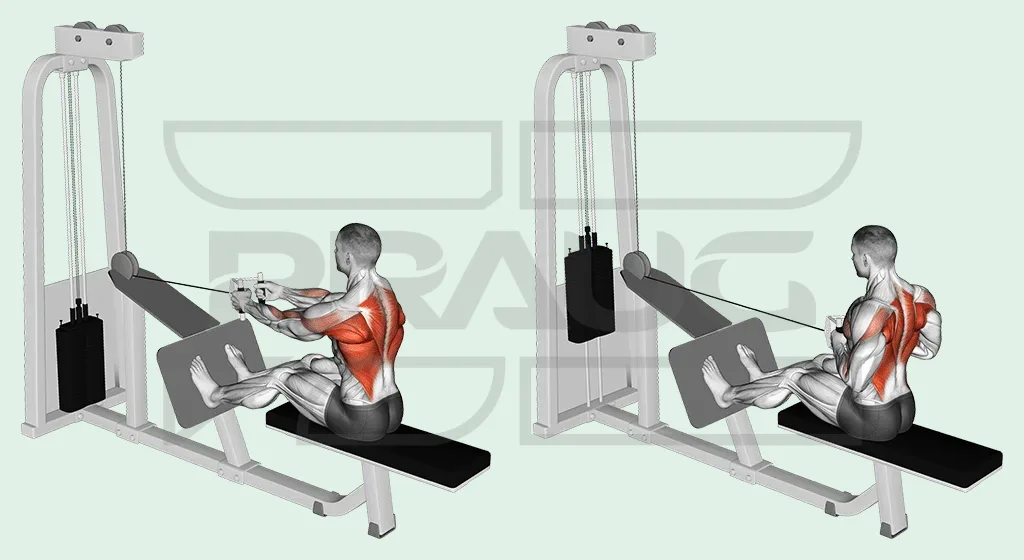
A seated cable row brings a low-cable handle towards the torso while the feet support you on the station. The lats, muscles around the shoulder blades and elbow flexors contribute together. It is a horizontal pulling option, rather than an exercise that exclusively creates back thickness.

Certified fitness coach · CQP Instructeur Fitness
Published on
The essentials before you start.
- Use a secure setup and a load or assistance you can control.
- Keep the intended support, range and effort comparable between sessions.
- Variations change the task; acute activity does not rank long-term growth.
- Adapt the example workload to other training and recovery.
Exercise facts
- Main muscles
- Latissimus dorsi, Middle and lower trapezius, Rhomboids
- Secondary muscles
- Teres major, Biceps, Brachialis, Rear deltoids, Spinal erectors
- Equipment
- Low cable pulley, Triangle handle
What the movement trains
The shoulder extends as the elbows travel back, the elbow flexors bend the arms and the shoulder blades move around the rib cage. The trunk helps hold the chosen position. A close elbow path and a wider path change the movement without cleanly dividing the back into width and thickness muscles.
Set up and perform the movement
- Check the cable, attachment, foot supports and available seat travel. Choose a load you can reach, pull and return without being dragged forwards.
- Sit with supported feet and comfortable knee bend. Take a full grip, using a suitable triangle or other handle.
- Establish a trunk angle you can repeat, with the arms reaching forwards through a controlled shoulder range.
- Pull the handle towards the lower ribs or abdomen as the elbows bend and travel back. Coordinate the shoulder blades and arms rather than forcing a separate maximal pinch first.
- Finish before the shoulder must be forced far behind the torso or the body rocks backwards to gain distance.
- Return smoothly, allowing the arms and shoulder blades to move forwards while retaining the intended trunk position. Set the weight down under control.
What the cited research does and does not show
The grip and elbow-angle findings were investigated separately, rather than as one validated narrow-grip/low-elbow combination. The three-row spine comparison did not test bilateral seated cable rowing. The eight-person biofeedback study did not establish better shoulder comfort, injury prevention or growth from suppressing upper-trapezius activity.
Variations and alternatives
A neutral handle, wider overhand bar or underhand grip changes the arm path. One-arm rowing changes the rotational demand; use comparable conditions on both sides. A chest-supported machine row and a barbell row offer different support tasks. No handle requires the torso to move through an extreme reach.
Sets, progression and tracking
One example is 3–4 sets of 8–15 repetitions, with enough rest to repeat the task. Adapt this to other pulling work. Keep the same station, handle, seat, torso angle and range when comparing performance; different pulley systems make identical stack labels imperfect comparisons.
When to reduce the demand or change the setup
A change in range, support, body angle or assistance changes the comparison. Reduce the demand or finish the set when you cannot retain the movement you intended. An equipment label or a beginner/advanced category does not establish individual suitability.
Stop for sharp pain and seek appropriate individual advice for persistent symptoms. A new handle, support or variation does not diagnose or treat the cause.
Browse the back collection for other pulling and trunk tasks, or the back programme to choose work within a whole week rather than adding every guide together.
Illustrated positions and options
These show example positions and equipment. An illustration is not a required range, individual loading instruction or validation of a particular support.
Illustrated option 1
 Movement example
Frequently asked questions
Must the handle touch my abdomen?
Use a repeatable finish suited to the attachment and your proportions. Do not force contact by rocking or driving the shoulder far behind the torso.
Does a narrow grip prove better lat growth?
The cited acute findings do not establish that, and grip width and elbow angle were studied separately.
When should I progress?
When the chosen movement and effort are repeatable. Change one demand deliberately and log any setup change.
Can this treat back or shoulder pain?
The guide and its cited activity studies do not establish an individual treatment. Persistent symptoms need suitable assessment.
Sources and limitations
Sources support the passages that cite them. Practical suggestions are coaching choices to adapt to your own situation.
- Di Fonza and al. · 2026 · Narrative review of pulling-exercise electrical activity. ↗
Acute findings with varied setups; not a growth ranking or validation of every cable variation.
- Fenwick and al. · 2009 · Small biomechanical comparison of three rowing tasks. ↗
Seven men; standing one-arm cable, bent-over and inverted rows, not every seated or supported variation.
- Dos Anjos and al. · 2024 · Feasibility study of activity feedback during a wide-grip row. ↗
Eight men, non-randomised; no established training, comfort or injury-prevention benefit.
This general information does not replace individual advice. Zepraug’s limitations.