Training· 3 min read
Forward and reverse lunge: setup, technique and progression
Other names: Lunge
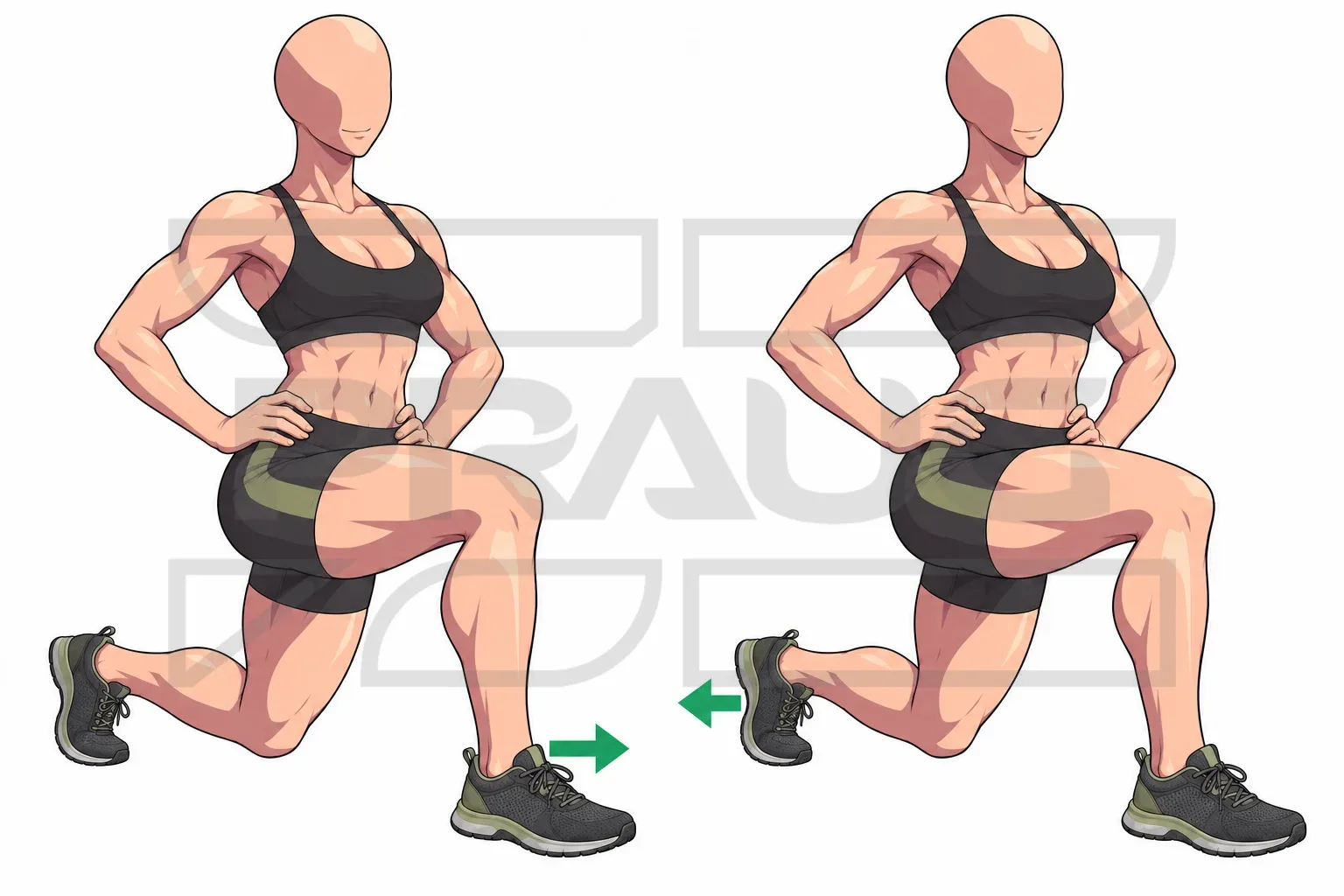
A lunge steps forwards or backwards, lowers the body through the hips and knees, then returns. Choose a step and depth that permit balance. A reverse lunge is not automatically a treatment for knee pain.

Certified fitness coach · CQP Instructeur Fitness
Published on
The essentials before you start.
- Practise the setup, support and return before adding demand.
- Keep the intended range and movement repeatable.
- The cited outcomes apply to particular tasks and populations.
- Choose the workload within the whole week.
Exercise facts
- Main muscles
- Quadriceps, Gluteus maximus
- Secondary muscles
- Hamstrings, Hip adductors, Calf muscles, Trunk muscles
- Equipment
- Bodyweight, Dumbbells, Barbell
What the movement trains
The quadriceps and gluteals contribute with other lower-body and trunk muscles. Step direction, length, torso position and hand support change the task; a universal ninety-degree knee target is unnecessary.
Set up and perform the movement
- Choose a clear non-slip area and start with bodyweight or suitable hand support.
- Stand with enough lateral foot spacing for balance rather than on a tightrope.
- Step forwards or backwards to a position you can control. Bend both knees without forcing the rear knee to the floor.
- Keep the front foot secure and use a comfortable knee path; passing the toes is not automatically an error.
- Push through the intended support and return without launching the torso.
- Settle before changing sides or repeating, using comparable conditions for each leg.
Range, support and control
The rear leg still contributes to support. A fixed two-centimetre floor clearance, perfectly vertical torso or long step is not required. Dumbbells and a bar change handling and need a separate manageable load.
What the cited research supports
The twenty-woman comparison found greater modelled patellofemoral loading in its forward condition. The nine-man study compared joint mechanics during bodyweight tasks. Neither measured later growth or symptom improvement in people with knee pain, nor validated a compulsory progression order.
Variations and alternatives
A walking lunge continues forwards, while a Bulgarian split squat uses a different foot support. Re-establish the range and load for each.
Sets, progression and tracking
One example is 2–4 sets of 6–12 controlled repetitions per side, with sufficient rest for balance. Define repetitions per leg explicitly. More training experience does not require shorter rest or a heavier bar.
The table gives alternative workload examples. Choose one row or fewer sets; they are not minimums tied to experience or doses established by the cited mechanics studies. Rest can exceed the listed reference.
| Possible option | Sets | Repetitions per leg | Load example | Rest reference |
|---|---|---|---|---|
| Lower external demand | 3 | 10–12 | Bodyweight or suitable assistance | 90 s or more as needed |
| Moderate repeated work | 4 | 10–15 | Manageable dumbbells | 75 s or more as needed |
| Optional extended heavier work | 4–5 | 8–12 | Separately manageable bar or dumbbells | 60 s or more; extend to retain control |
Frequently asked questions
Is a reverse lunge guaranteed to be easier on a painful knee?
The cited comparisons used people without pain and measured mechanics. They do not establish individual symptom relief or a diagnosis.
When should I add demand?
When the setup, range and effort are repeatable and the next change is manageable. Log changed support or assistance rather than comparing different tasks as if they were identical.
Sources and limitations
Sources support the passages that cite them. Practical suggestions are coaching choices to adapt to your own situation.
- Goulette et al. · 2021 · Forward versus backward lunge mechanics in twenty women without symptoms. ↗
Modelled joint loading during bodyweight tasks; no demonstrated symptom relief or later growth.
- Comfort et al. · 2015 · Bodyweight single-leg squat and forward/reverse lunge joint mechanics in nine men. ↗
Brief force and motion measurements, not muscle growth or a universal readiness ladder.
This general information does not replace individual advice. Zepraug’s limitations.