Training· 5 min read
Bulgarian split squat: setup, support and technique
Other names: Rear-foot-elevated split squat, RFESS
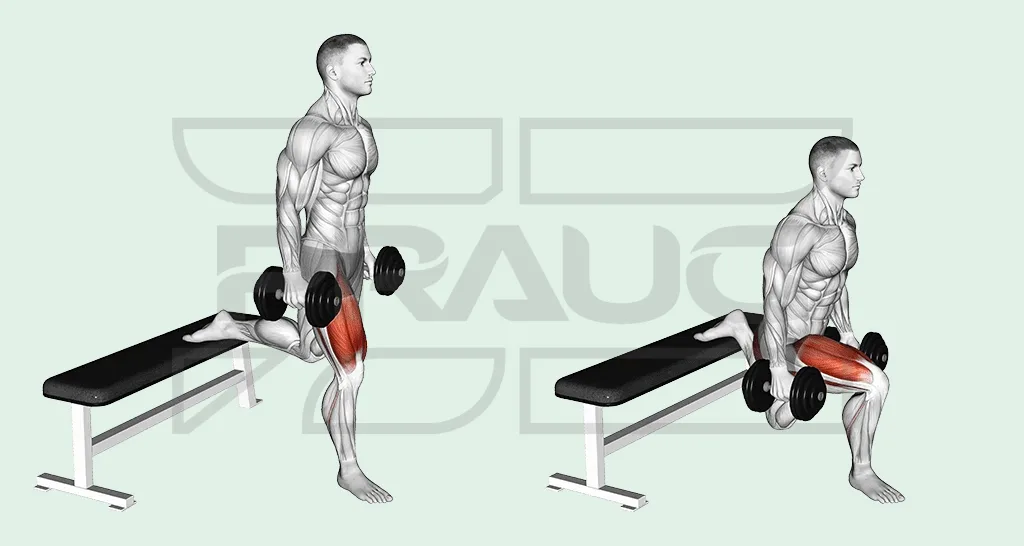
A Bulgarian split squat is a split squat with the rear foot raised on a suitable support. The front leg supplies much of the work while both contacts help organise the movement. The quadriceps and glutes contribute as the front knee and hip bend and extend. Begin with bodyweight and a support height you can control.

Certified fitness coach · CQP Instructeur Fitness
Published on
The essentials before you start.
- Use a rear-foot support that will not slide or tip.
- Leave enough side-to-side space for balance rather than placing the feet on a tightrope.
- Stance and torso angle change demands without neatly isolating glutes or quadriceps.
- A smaller acute knee-demand measure is not proof of injury prevention or suitability for knee pain.
Exercise facts
- Main muscles
- Quadriceps, Gluteus maximus
- Secondary muscles
- Hamstrings, Gluteus medius, Adductors, Obliques
- Equipment
- Stable rear-foot support, Optional dumbbells or suitable rack setup
What this split squat trains
The front-leg quadriceps and glutes contribute to standing, with other hip, trunk and lower-leg muscles helping control support and balance. The rear leg is not completely unloaded, and the movement is not a true single-contact squat.
The cited studies compare joint demands or electrical activity under particular loads. A modelling paper tested a split squat with the rear foot on the floor, not this elevated version. None proves a universal growth advantage or makes one stance an injury treatment.
A back squat loads a bilateral task. You can choose either or both for a purpose; the studies do not require them to appear together in every programme.
How to set up and perform the movement
Choose a low, stable support before adding load. A bench-height setup that works for someone else may pull your rear hip into an uncomfortable position.
- Stand facing away from the support, then place the rear foot on it in a comfortable position. Practise entering and leaving without weight first.
- Position the front foot far enough forwards for the intended range, with some lateral width between the feet for balance.
- Keep the front foot supported and establish a trunk position you can repeat. Use suitable hand support if needed.
- Bend the front knee and hip to lower smoothly. Let the knee travel broadly with the foot.
- Choose a depth you can control without striking the rear knee on the floor or losing the rear-foot support.
- Press through the front foot to stand while retaining balance, then repeat. Finish and change sides with control.
Stance, torso angle and common errors
A longer stance and different torso inclination alter joint demands, but they do not switch the quadriceps off or isolate the glutes. Try manageable setups and record the one used rather than forcing an exact distance or upright torso.
If balance is the main limit, use a lower support, a supported version or an ordinary split squat with the rear foot on the floor. You do not have to master a bodyweight-repetition threshold before using support.
Avoid bouncing the rear knee, letting the support move or repeatedly shifting the front heel as fatigue rises. Stop for sharp pain and seek individual advice for persistent symptoms; the label hip dominant does not establish suitability for a painful knee.
Dumbbells, barbells and alternatives
Dumbbells held at the sides change the loading and exit method. A barbell adds rack, shoulder-support and balance requirements; it is not a compulsory progression from dumbbells. Plan how to end the set instead of assuming a heavy weight can always be dropped safely.
A pause or slower lowering phase changes demand without extra load. A support-assisted version is a valid choice when the goal is leg work rather than a balance test.
An air squat, a floor-rear-foot split squat and a walking lunge have different stance and coordination demands. They can be alternatives without being prerequisites. The illustrations include a walking lunge as another task with its own setup and support demands.
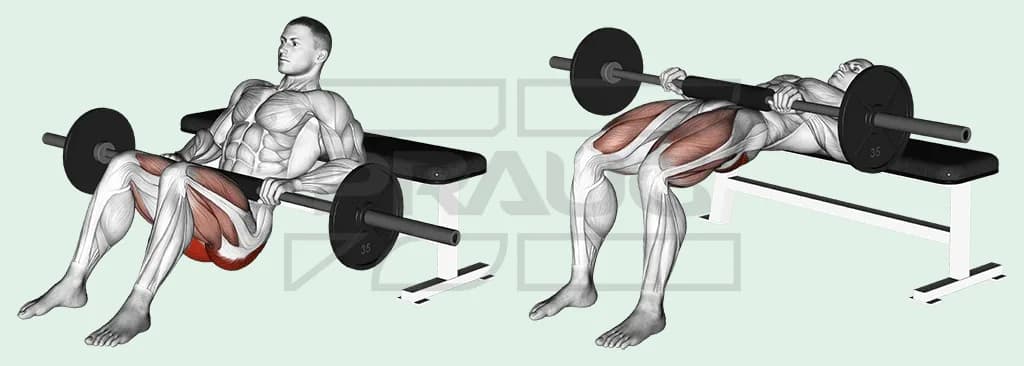
A glute bridge or hip thrust trains a different hip-extension setup. None automatically corrects an observed side-to-side difference.
Sets, repetitions and progression
One coaching example uses 3–4 sets of 8–12 repetitions per side, with some examples extending to 15. Adapt that to the whole week and current control. The cited experiments did not test this as a universal training dose.
Use comparable conditions on each side and record actual performance. Rest between sides if needed; there is no requirement to rush from one to the other. A persistent marked difference or symptoms deserves individual assessment rather than automatic extra sets.
Track support height, stance, hand support, load, range and repetitions. Progress one demand when the existing task is repeatable. Browse glute exercises and quadriceps exercises to choose related movements.
Illustrated positions and variations
These original illustrations show example setups. Choose a range, support and difficulty you can control.
Dumbbell and barbell options
 Dumbbell and barbell options
 Dumbbell and barbell options
Other leg movements
 Other leg movements
 Other leg movements
Frequently asked questions
Is the rear leg only for balance?
It provides support and is not completely unloaded. The distribution depends on the setup and movement.
Can I hold a support?
Yes, if it is stable and intended for the task. That changes the balance demand and can help keep the leg work repeatable.
Does a longer stance isolate the glutes?
No. Stance and torso angle change mechanics, but the muscles continue to work together.
Must I progress to a barbell?
No. Choose equipment for a clear goal and a controlled start and finish, not a fixed equipment ladder.
Sources and limitations
Sources support the passages that cite them. Practical suggestions are coaching choices to adapt to your own situation.
- Mackey et al. · 2021 · Joint mechanics of Bulgarian split squats and back squats. ↗
Acute measurements in trained men at specified loads. Lower measured knee demand does not prove injury prevention or suitability for knee pain.
- Andersen et al. · 2014 · Squat and Bulgarian-squat activity on stable and unstable support. ↗
Acute activity in trained men, without a glute-growth outcome; instability is not established as a better programme.
- Kipp et al. · 2022 · Modelled muscle forces during squat, split squat and step-up tasks. ↗
Very small sample. The split squat used rear-foot floor support, not the elevated Bulgarian version; forces were modelled, not training outcomes.
This general information does not replace individual advice. Zepraug’s limitations.