
Training· 5 min read
Dumbbell biceps exercises: eight options and three workloads
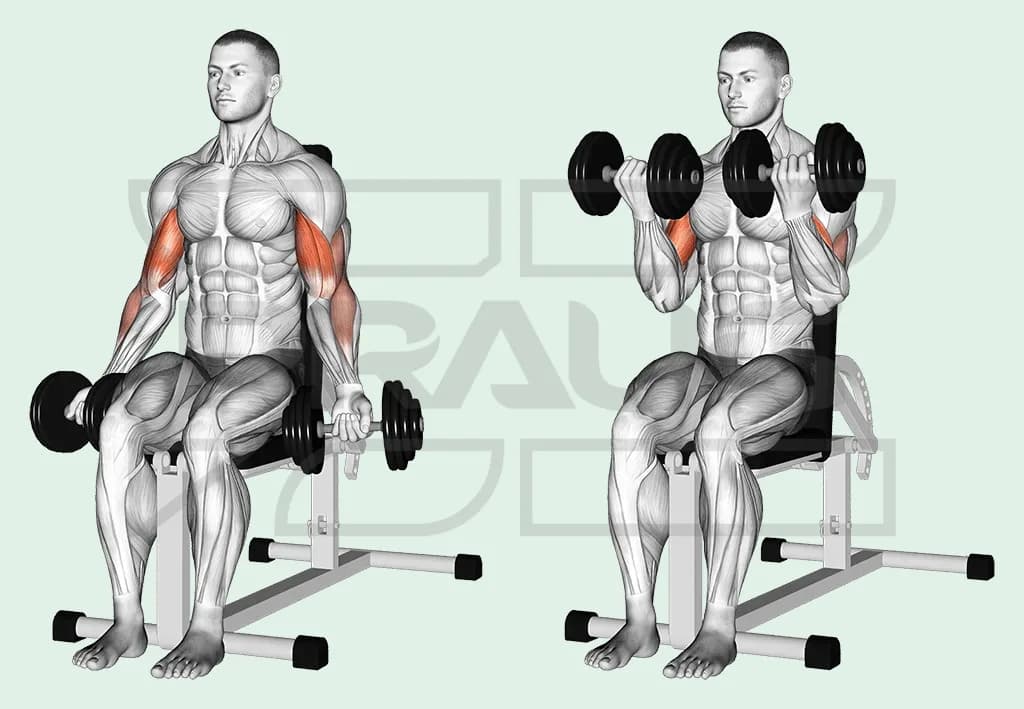
Dumbbell curls can change forearm orientation, shoulder position and support. These eight options describe different tasks, not eight exercises to perform together or ways to isolate a biceps head. Choose an amount within your week and account for rows and pull-ups.

Certified fitness coach · CQP Instructeur Fitness
Published on
The essentials before you start.
- Choose a repeatable grip, shoulder position and elbow range.
- Independent weights still need secure pickup and return.
- The three workload examples are alternatives and can be reduced.
- Direct curls overlap with pulling; count both before adding work.
Practise the three standing options
For the alternating supinating curl, stand securely with the arms near the sides. Bend one elbow while gradually turning the palm upwards if comfortable, then lower smoothly before changing sides. Avoid twisting the torso to finish. Eight repetitions per arm means eight on each side.
For the Zottman curl, raise manageable weights with palms upwards, turn the forearms smoothly near the top and lower with palms down. Return to the intended start without a forceful wrist twist. Use a lighter load if the pronated lowering cannot be controlled.
For the drag curl, begin with the arms near the sides and palms upwards. Let the elbows travel backwards deliberately while the dumbbells move near the torso, without leaning back to launch them. Return smoothly. This moving-shoulder task is different from holding the upper arms still.
The linked five guides explain their individual supports and handling. Use stable equipment intended for the task; a pair of dumbbells alone does not supply the bench needed for incline or spider curls.
What the cited comparison supports
The twelve-week MRI study compared incline and preacher curls in twenty-one untrained adults, not all eight options. It found different changes in individual elbow-flexor muscles without a clear difference in total growth. It did not separately measure the two biceps heads, peak shape or a superior combination of exercises.
Grip and shoulder position help describe a curl, but resistance profile, range, effort and equipment also matter. Choose a task you can repeat rather than a table label claiming long-head or short-head isolation.
Three adjustable workload examples
Choose one starting format or reduce it; these are not minimums to add after an existing programme. The first two retain extended examples so that their arithmetic is visible. They may be more direct work than needed. Repeating a full table repeats all its sets.
For unilateral movements, the set number is received by each arm: three sets per side gives each arm three sets. Count repetitions separately. Rest as needed, often around 60–120 seconds or more, to retain the intended task.
| Format | Example work per occurrence | If repeated as described |
|---|---|---|
| Gym, with a suitable bench | Seated curl 4 × 8–10; incline curl 3 × 10–12; hammer curl 3 × 10–12; concentration curl 2 × 15 per arm | 12 direct sets per arm each occurrence; twice weekly gives 24. Reduce or split this extended example when appropriate. |
| At home, with dumbbells and suitable seated support | Alternating supinating curl 4 × 10 per arm; hammer curl 3 × 12; Zottman curl 3 × 10; concentration curl 3 × 15 per arm | 13 direct sets per arm each occurrence; two or three occurrences gives 26 or 39. This is not a recommended minimum; select fewer tasks or sets. |
| After a back session, shorter option | Incline curl 3 × 10; hammer curl 3 × 12, using a suitable bench | 6 direct sets per arm, in addition to the pulling already done. Fewer sets or one curl can be enough; fifteen minutes is an estimate, not a deadline. |
Make comparisons useful
Start with relevant lighter practice. A controllable range with repetitions still possible is useful while learning; not every set needs to reach failure. Change one feature deliberately and record it rather than treating reduced range, a different bench or torso swing as the same improvement.
Log weight per hand, support, arm position, grip, sets, repetitions per side and effort. The biceps programme offers a broader structure, while the biceps collection includes barbell and supported alternatives. Stop for sharp pain and seek individual advice for persistent symptoms.
Frequently asked questions
Do I need all eight exercises?
No. They are options, not a required session. Select work within the whole week.
Can one pair of dumbbells cover every setup?
Some tasks also require suitable bench support. A fixed pair may not provide a manageable load for every variation.
Does an arm-forward curl isolate the short head?
The cited trial did not separately measure the two biceps heads. Support and shoulder position do not prove selective growth.
How do I count alternating repetitions?
State the number performed by each arm. Ten per arm means ten on the left and ten on the right, not ten split between them.
Sources and limitations
Sources support the passages that cite them. Practical suggestions are coaching choices to adapt to your own situation.
- Kobayashi et al. · 2026 · Twelve-week incline versus preacher dumbbell-curl comparison with MRI in twenty-one untrained adults. ↗
Different individual muscle changes, without a clear total elbow-flexor difference; no separate biceps-head or spider-curl measurement.
This general information does not replace individual advice. Zepraug’s limitations.