Training· 3 min read
Sumo deadlift: setup, technique and progression
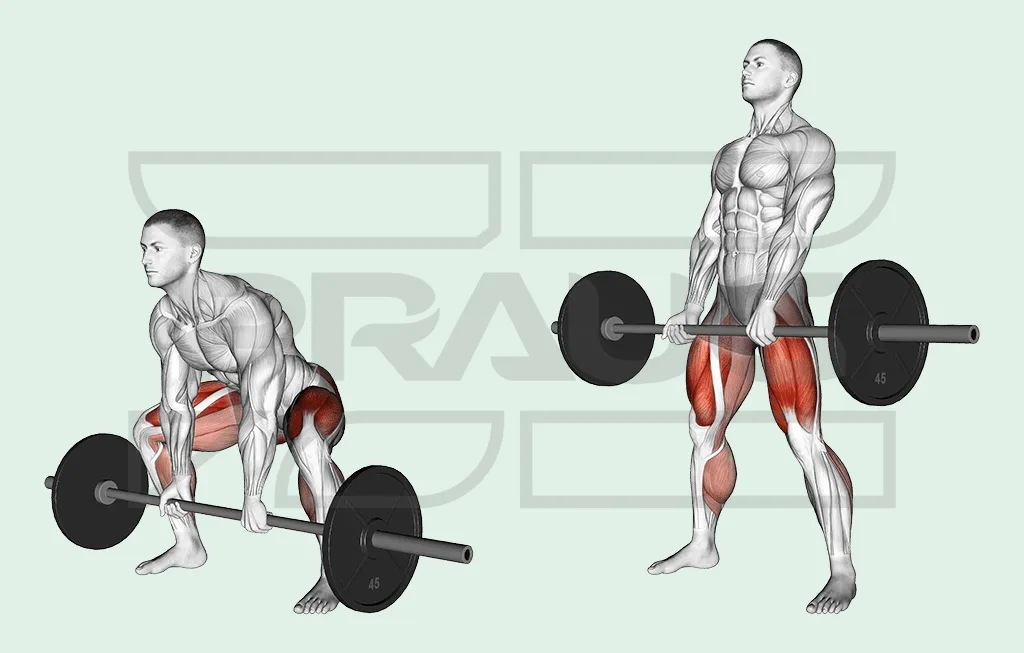
A sumo deadlift lifts a bar with a wider stance and the hands inside the legs. Stance width and foot angle should permit a controlled start and return. A more upright torso is not an individual back-safety guarantee.

Certified fitness coach · CQP Instructeur Fitness
Published on
The essentials before you start.
- Practise the setup, support and return before adding demand.
- Keep the intended range and movement repeatable.
- The cited outcomes apply to particular tasks and populations.
- Choose the workload within the whole week.
Exercise facts
- Main muscles
- Gluteus maximus, Quadriceps, Hip adductors
- Secondary muscles
- Hamstrings, Spinal erectors, Trapezius, Latissimus dorsi, Forearm muscles
- Equipment
- Barbell
What the movement trains
The gluteals, quadriceps, adductors and other posterior-chain muscles contribute while the trunk and grip support the bar. Proportions and stance change the movement; wider is not automatically better.
Set up and perform the movement
- Use a suitable bar, secure plates and a clear lifting area. Check a controlled pickup and return with a light load.
- Choose a comfortable stance wide enough for the hands inside the legs, without forcing the feet towards the plates.
- Take a secure grip and bend the hips and knees to a start that retains foot contact and a manageable torso position.
- Build tension smoothly and lift by extending the hips and knees without jerking the bar from the floor.
- Stand in a controlled position without leaning back to finish.
- Lower with a coordinated hip and knee bend, keeping the bar clear of the knees, then reset before another repetition.
Range, support and control
Foot angle is not universally thirty to forty-five degrees. A raised start changes range and can be used deliberately. Mixed grip, straps and belts change handling and do not establish readiness for a heavier load.
What the cited research supports
The thirteen-player experiment measured electrical activity during sumo and conventional lifts. The fifty-seven-competitor study estimated joint loading during maximal competition lifts. Neither measured long-term growth, individual injury rates or guaranteed back protection from one style.
Variations and alternatives
A conventional deadlift changes stance and hand placement. A stiff-leg deadlift changes knee movement and starting task. Compare each with its own load and range.
Sets, progression and tracking
An adjustable example is 2–4 sets of 3–8 controlled repetitions with enough rest to retain the start and return. More repetitions can use a different manageable load. Log stance, grip, start height, range and effort rather than a universal sumo-to-conventional ratio.
Frequently asked questions
Does sumo guarantee less back trouble?
The cited mechanical model and acute activity comparison do not establish an individual pain or injury outcome. Choose and adapt the actual task rather than a universal protection claim.
When should I add demand?
When the setup, range and effort are repeatable and the next change is manageable. Log changed support or assistance rather than comparing different tasks as if they were identical.
Sources and limitations
Sources support the passages that cite them. Practical suggestions are coaching choices to adapt to your own situation.
- Escamilla et al. · 2002 · Sumo versus conventional deadlift activity, with and without a belt, in thirteen football players. ↗
Brief activity at specified load; not later growth, injury rates or universal technique ratios.
- Cholewicki et al. · 1991 · Modelled joint loads during maximal competition deadlifts in fifty-seven powerlifters. ↗
High-load mechanical estimates, not individual pain, injury or guaranteed back protection from one style.
This general information does not replace individual advice. Zepraug’s limitations.