
Training· 7 min read
Conventional deadlift: setup, muscles and bar path
Other names: Barbell deadlift
The conventional deadlift lifts a barbell from the floor to standing, using hip and knee extension while the trunk and grip hold the position. The feet are usually around hip width and the hands outside the legs. Learn the setup with manageable resistance before trying to increase the load.

Certified fitness coach · CQP Instructeur Fitness
Published on
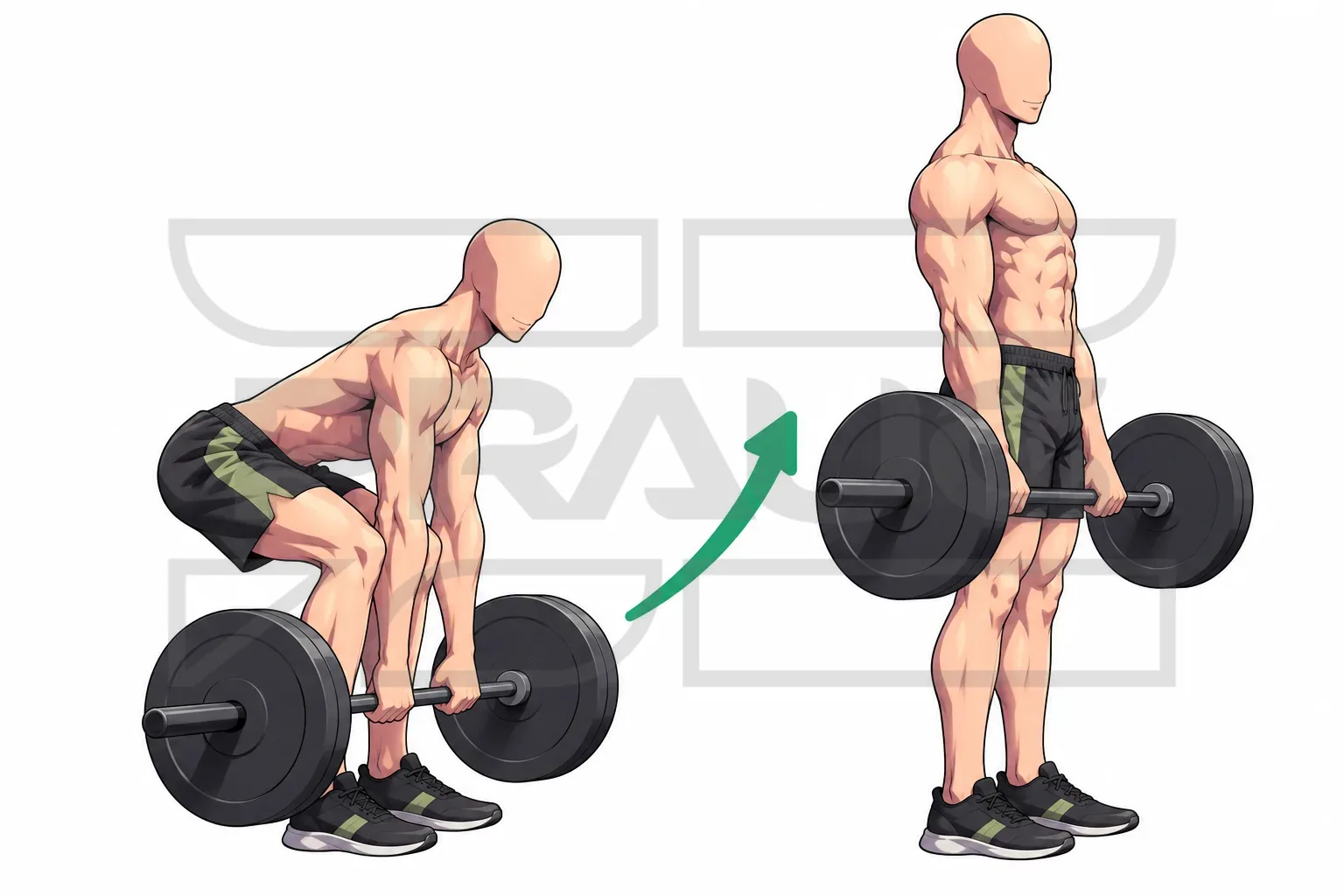
The essentials before you start.
- Start with the bar close to the middle of the foot and a stable stance you can repeat.
- Create tension before lifting; avoid jerking the bar from the floor.
- Keep the bar close and stand tall without leaning back at the top.
- Choose load and volume for your current control, experience and the rest of the programme.
Exercise facts
- Main muscles
- Gluteus maximus, Hamstrings, Spinal erectors
- Secondary muscles
- Quadriceps, Adductors, Trapezius, Latissimus dorsi, Forearms, Abdominals
- Equipment
- Barbell, Weight plates
What the conventional deadlift trains
The glutes and hamstrings contribute to hip extension, while the quadriceps help extend the knees. The spinal erectors and abdominal muscles help control the trunk. The upper back, lats and forearms help maintain the connection between the body and bar.
The cited studies compare electrical activity, joint demands or movement in particular deadlift variations. They show that stance and equipment change the task. They do not rank every version for long-term growth or establish injury risk for an individual lifter.
A conventional deadlift is a floor-start lift. A Romanian deadlift usually begins standing and lowers through a hip hinge with some knee bend. A stiff-leg version changes knee position; sumo uses a wider stance with the hands between the legs. These distinctions matter more than treating all variations as the same record.
Set up before the bar leaves the floor
Use a bar, plates, floor and clear space suitable for lifting. Full-diameter plates or stable raised supports can set a useful starting height; a small plate does not mean every beginner must reach a lower floor position.
- Stand with the bar close to the middle of the feet, using a comfortable stance around hip width.
- Hinge at the hips and take a full grip just outside the legs. Bend the knees enough to reach a controlled starting position without pushing the bar away.
- Find a trunk and head position you can maintain. The precise hip height depends on your proportions, stance and equipment.
- Brace the trunk and take up tension through the arms and bar before it leaves the floor. Do not bend the elbows to lift.
- Check that you can begin without losing balance, moving the bar away or rushing the setup.
Lift and lower with a repeatable bar path
Push against the floor and extend the knees and hips as the bar rises close to the legs. The coordination is continuous; it is not a requirement to finish all leg movement before using the hips.
Finish standing tall with the hips extended. Avoid adding a backward lean or shrug to prove that the lift is complete. Lower by moving the hips back and bending the knees as needed to keep the bar close, then reset on the floor rather than relying on a bounce.
Use a breathing and bracing approach suited to the load and your health. Do not treat a prolonged breath hold as mandatory for every reader. If you need a modified approach because of a health condition, discuss it with an appropriately qualified professional.
Grip, straps and a lifting belt
A double-overhand grip has both palms facing towards your body at the start. It is a useful default while you can hold the bar securely. A mixed grip turns one palm away; it changes the setup and requires keeping the elbows straight rather than trying to curl the load.
Straps can help when grip limits the intended work, but learn how to attach and release them with a light load first. They do not correct an unstable bar path. A belt provides something to brace against; it does not replace technique or guarantee protection from injury.
An acute change in abdominal muscle activity with a belt does not show that everyone needs one or that it prevents injury. Choose equipment for a clear purpose and learn its use.
Errors, volume and progression
If the bar drifts forwards, the hips rise while the bar stays on the floor, or the position changes abruptly as effort rises, reduce the demand and revisit the setup. End the set when you cannot reproduce the intended movement. Do not use one video frame alone to diagnose injury.
Coaching examples include 3–5 sets of 3–6 repetitions for a strength emphasis, or somewhat higher repetitions, as coaching examples. These ranges and one or two weekly exposures are not universal limits established by the cited studies. Start with work you can control and recover from alongside other hinge and leg training.
Record the bar type, start height, stance, load, repetitions and effort. Increase one demand at a time once the existing work is repeatable. An unfamiliar variation needs a new starting load rather than an automatic transfer of the previous best lift.
Sumo, Romanian, stiff-leg and trap-bar options
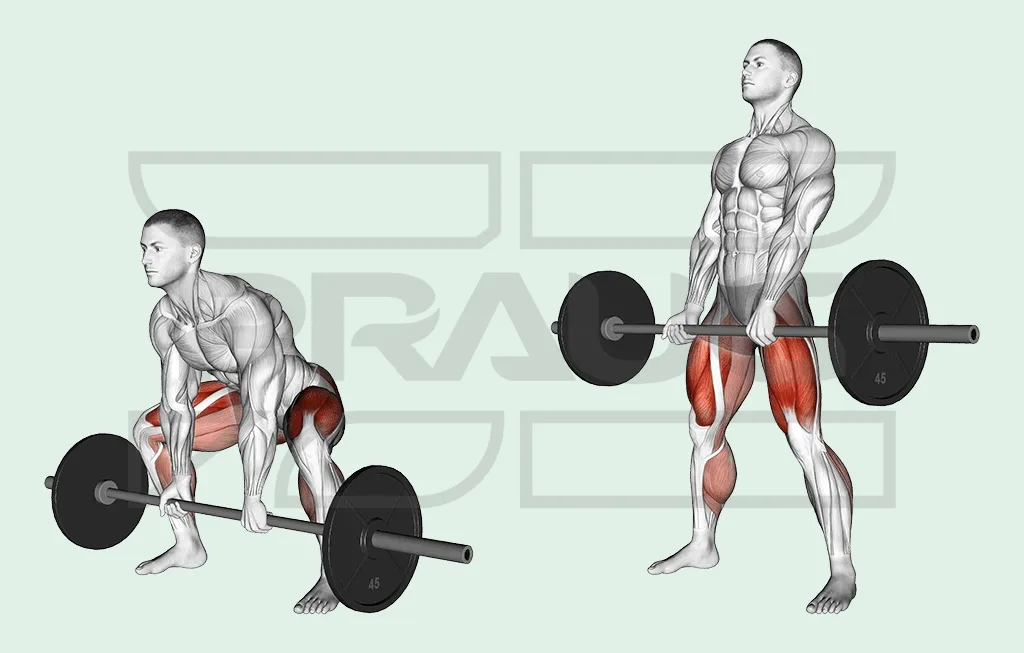
Sumo places the feet wider and the hands between the legs. A trap bar places the lifter inside the frame, with handles at the sides and sometimes different handle heights. Both alter the geometry and movement demands.
A Romanian deadlift starts from standing and emphasises a controlled hip hinge. A stiff-leg version changes knee position; the name does not require forcing the knees into a locked position. Choose a range you can control rather than reaching the floor at any cost.
No stance is automatically best for every body. Test manageable versions with appropriate support and coaching when needed. If pain is present, do not assume that switching stance provides a diagnosis or treatment.
Illustrated setup and variations
The illustrations show example setups and variations. Use a difficulty you can control; the drawings do not prescribe an individual load.
Starting position
Floor-start lift
Sumo variation
Frequently asked questions
Which muscles does a deadlift work?
Hip and knee extensors contribute to moving the load, while the trunk, back and grip help hold the position and bar path. The relative demands change with the setup.
Is a conventional deadlift the same as a Romanian deadlift?
No. The conventional lift starts from the floor and includes more of a floor-start knee-and-hip extension task. The Romanian version usually begins standing and lowers through a hip hinge before returning.
Is rounding the back proof of an injury?
A visible movement is not a diagnosis. For this guide, choose a load and range that let you maintain your intended position and stop when control is lost. Persistent or concerning pain needs individual assessment.
How often should I deadlift?
Choose frequency and volume in the context of your experience, recovery and other work. One or two weekly sessions are a source coaching example, not a requirement or an upper limit for everyone.
Should I choose sumo or conventional?
They are different setups. Use manageable loads to explore which task fits your goal and movement, and get technique help if needed. Small acute studies do not identify the best individual long-term choice.
Sources and limitations
Sources support the passages that cite them. Practical suggestions are coaching choices to adapt to your own situation.
- Neto et al. · 2020 · Systematic review of gluteus maximus electrical activity during loaded strength exercises. ↗
Electrical activity during exercise does not rank long-term muscle growth or establish injury risk.
- Escamilla et al. · 2002 · Electromyographic comparison of sumo and conventional deadlifts, with and without a belt. ↗
Small sample of male athletes and acute measurements. The study does not measure long-term growth, strength gains or injury prevention.
- Gundersen et al. · 2025 · Biomechanical comparison of conventional, sumo and trap-bar deadlifts in trained women. ↗
Very small sample and acute analysis. Joint demands and muscle activity do not identify the best individual long-term training variation.
This general information does not replace individual advice. Zepraug’s limitations.