Training· 4 min read
45-degree back extension: setup, technique and progression
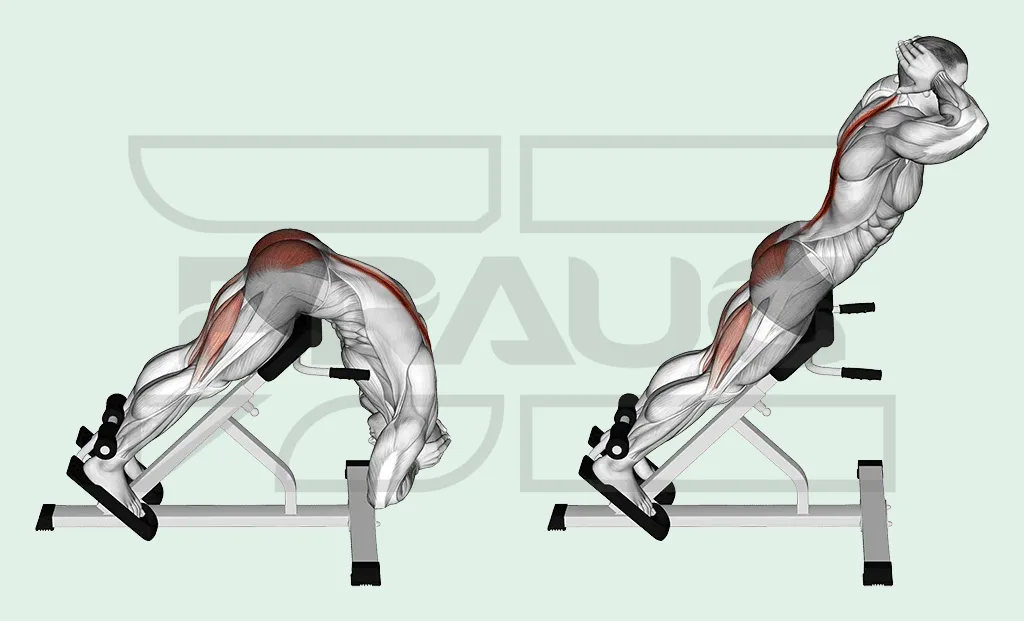
A 45-degree back extension supports the lower body on an inclined bench while the torso lowers and rises. This guide starts with a hip-hinge version: move mainly at the hips and return to a controlled body line. A version that deliberately moves the spine is a different task, not a compulsory progression or a treatment for back pain.

Certified fitness coach · CQP Instructeur Fitness
Published on
The essentials before you start.
- Use a secure setup and a load or assistance you can control.
- Keep the intended support, range and effort comparable between sessions.
- Variations change the task; acute activity does not rank long-term growth.
- Adapt the example workload to other training and recovery.
Exercise facts
- Main muscles
- Spinal erectors, Gluteus maximus, Hamstrings
- Secondary muscles
- Abdominals
- Equipment
- 45-degree back-extension bench
What the movement trains
The glutes and hamstrings contribute to hip extension, while the spinal erectors and abdominal muscles help control the trunk. The pad height, knee position and chosen movement change the demand. A hip hinge does not switch the back muscles off; deliberate trunk extension does not isolate one small lumbar region.
Set up and perform the movement
- Check the bench, foot platform and ankle restraints. Learn how to enter and leave it with no added weight.
- Set the upper pad near the hip crease so the intended hip movement is possible, following the model’s instructions. Keep the feet and ankles supported.
- Begin with the arms crossed over the chest and a trunk position you can maintain. Hands near the head lengthen the lever and must not pull on the neck.
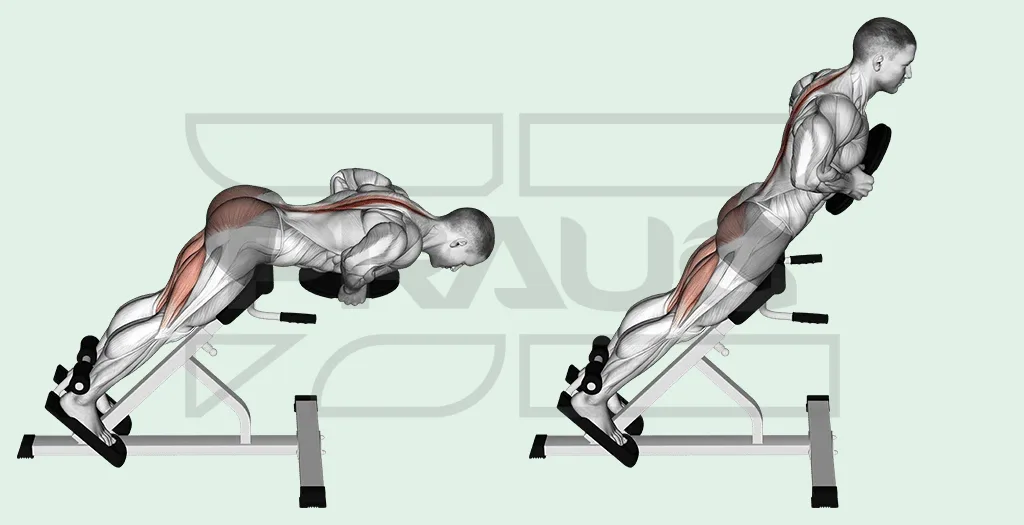
- Lower by bending at the hips through a range you can control. Do not chase the floor or an extreme hamstring stretch.
- Extend the hips smoothly to return towards alignment with the legs. Stop there rather than lifting into an exaggerated backward arch.
- Lower again under control and keep breathing. Finish using the planned dismount; add resistance only when you can hold and put it down securely.
What the cited research does and does not show
The women’s acute comparison used a 45-degree bench and particular loading. The hand-and-knee experiment did not compare straight-trunk and deliberately rounded-trunk techniques. Neither establishes later growth, an individual pain treatment or one universally safe spinal range.
Variations and alternatives
A plate held near the chest changes the loading. Moving the hands overhead changes the lever. Deliberate spinal flexion and extension needs a separately chosen range and load; moving the pad does not prove the lumbar muscles are isolated or that the version is appropriate for a painful back. A Romanian deadlift is a standing hinge with different support.
Sets, progression and tracking
An adjustable example is 2–3 sets of 10–15 controlled repetitions. Begin with fewer or shorter sets when learning. Account for other hinges and trunk work; the cited experiments did not establish this weekly dose. Record pad height, hand position, range and any external load.
When to reduce the demand or change the setup
A change in range, support, body angle or assistance changes the comparison. Reduce the demand or finish the set when you cannot retain the movement you intended. An equipment label or a beginner/advanced category does not establish individual suitability.
Stop for sharp pain and seek appropriate individual advice for persistent symptoms. A new handle, support or variation does not diagnose or treat the cause.
Browse the back collection for other pulling and trunk tasks, or the back programme to choose work within a whole week rather than adding every guide together.
Illustrated positions and options
These show example positions and equipment. An illustration is not a required range, individual loading instruction or validation of a particular support.
Illustrated option 1
Illustrated option 2
Frequently asked questions
Is a back extension only a lower-back exercise?
No. A hip-hinge version also uses hip extensors while the trunk holds position. Deliberate spinal movement is a different task.
Should I rise above the line of my legs?
The starting example finishes near a controlled body line. Extra backward arch is not required to complete it.
When should I progress?
When the chosen movement and effort are repeatable. Change one demand deliberately and log any setup change.
Can this treat back or shoulder pain?
The guide and its cited activity studies do not establish an individual treatment. Persistent symptoms need suitable assessment.
Sources and limitations
Sources support the passages that cite them. Practical suggestions are coaching choices to adapt to your own situation.
- Andersen and al. · 2021 · Acute comparison of three hip-extension exercises. ↗
Fifteen trained women; activity measurements do not establish growth or pain-treatment effects.
- Park and Yoo · 2014 · Roman-chair activity with different hand and knee positions. ↗
Eighteen asymptomatic men; not a comparison of deliberate spinal flexion and a hip hinge.
This general information does not replace individual advice. Zepraug’s limitations.