Training· 3 min read
Seated calf raise: setup, technique and progression
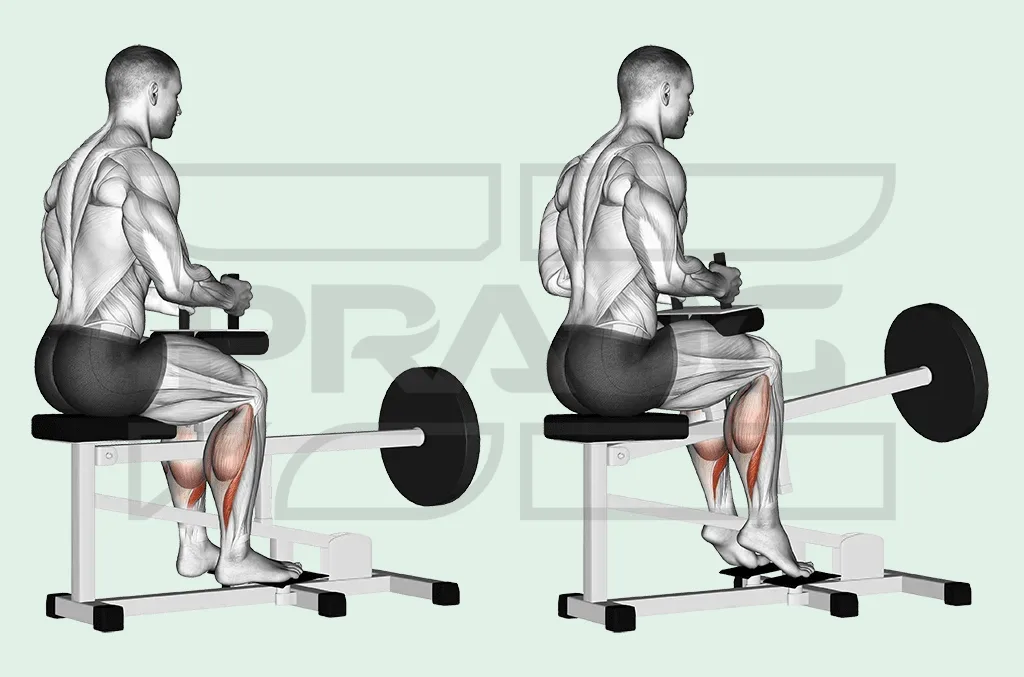
A seated calf raise plantarflexes the ankles with the knees bent and a suitable pad over the lower thighs. Knee flexion changes gastrocnemius length, but does not switch it off or completely isolate the soleus.

Certified fitness coach · CQP Instructeur Fitness
Published on
The essentials before you start.
- Practise the setup, support and return before adding demand.
- Keep the intended range and movement repeatable.
- The cited outcomes apply to particular tasks and populations.
- Choose the workload within the whole week.
Exercise facts
- Main muscles
- Soleus
- Secondary muscles
- Gastrocnemius, Tibialis posterior, Toe flexors
- Equipment
- Seated calf-raise machine
What the movement trains
The soleus and gastrocnemius contribute to ankle movement. The soleus does not cross the knee; the gastrocnemius does. That distinction helps describe the task without proving that seated work must always follow standing work.
Set up and perform the movement
- Check the seated calf machine and learn the release and return mechanism.
- Place the forefeet securely on the support with enough heel clearance for the intended range.
- Adjust the thigh pad above the kneecaps as instructed, with a manageable knee angle and supported torso.
- Release the load under control, lower the heels through a manageable range and raise smoothly.
- Avoid bouncing or using repeated knee movement to shift the pad.
- Engage the support securely before moving the legs or leaving the seat.
Range, support and control
Around ninety degrees at the knee is a setup reference, not a compulsory angle. A loose bar or dumbbell balanced on the knees is not an automatic equivalent to a secured machine pad. Use suitable support and controlled handling for any alternative.
What the cited research supports
In fourteen untrained adults, the twelve-week comparison favoured standing for gastrocnemius and total triceps-surae growth; soleus changes were similar between conditions. The acute knee-angle study showed modest activity differences, not complete muscle isolation. Neither proves that adding seated work after standing is a superior routine.
Variations and alternatives
A standing raise changes knee position and support. A one-leg seated version needs its own manageable load rather than half a bilateral stack by assumption.
Sets, progression and tracking
An example is 2–4 sets of 12–20 repetitions with enough rest to preserve ankle range. Log knee angle, pad, foot support, range and effort. Choose the amount rather than automatically adding it to every standing session.
Frequently asked questions
Does the gastrocnemius stop working when seated?
No. Knee position changes its length and demand. The cited studies do not establish a complete on/off switch or exclusive soleus isolation.
When should I add demand?
When the setup, range and effort are repeatable and the next change is manageable. Log changed support or assistance rather than comparing different tasks as if they were identical.
Sources and limitations
Sources support the passages that cite them. Practical suggestions are coaching choices to adapt to your own situation.
- Kinoshita et al. · 2023 · Twelve-week standing versus seated calf-raise trial in fourteen untrained adults, measured by MRI. ↗
Standing favoured gastrocnemius and total growth; soleus changes were similar. No required combined routine or universal dose tested.
- Hébert-Losier et al. · 2012 · Acute unilateral heel raises at two knee angles in forty-eight healthy adults. ↗
Modest activity differences, not complete muscle isolation, later growth or an individual rehabilitation outcome.
This general information does not replace individual advice. Zepraug’s limitations.