Training· 3 min read
Renegade row: setup, technique and progression
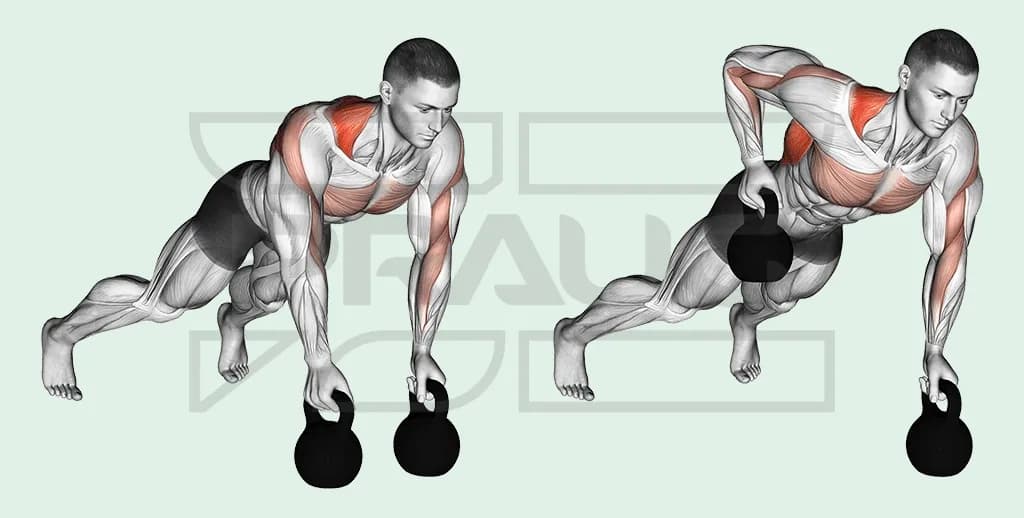
A renegade row combines a plank support position with alternating one-arm rows. The supporting hand must have a secure base designed for the load. A kettlebell handle is not automatically suitable for bearing bodyweight.

Certified fitness coach · CQP Instructeur Fitness
Published on
The essentials before you start.
- Use a level nonslip surface and implements expressly suitable for bodyweight support, checking stability under the intended direction of force. Do not use bells that can tip or roll.
- Practise the chosen movement and return before adding load, speed or repetitions.
- A practice example is 1–3 sets of 3–6 pulls per arm with adequate rest.
- Research on a related task does not establish the same outcomes for every version.
Exercise facts
- Main muscles
- Latissimus dorsi, Rhomboids, Middle trapezius, Abdominals and obliques
- Secondary muscles
- Biceps, Rear deltoids, Pectorals, Triceps, Spinal erectors, Gluteals
- Equipment
- Stable nonslip surface, Implements expressly suitable for bodyweight support, or a separate designed hand support
What the movement trains
The pulling arm uses the back and elbow flexors while the supporting arm, trunk and hips maintain the chosen position. Balance or grip can limit the set before the pulling muscles do.
Set up and perform the movement
- Use a level nonslip surface and implements expressly suitable for bodyweight support, checking stability under the intended direction of force. Do not use bells that can tip or roll.
- If support suitability is uncertain, keep the supporting hand on the floor or a designed support and choose a different one-arm-row setup.
- With suitable equipment, establish a manageable plank or knee-supported position and comfortable foot width.
- Shift support deliberately, then draw one bell towards the hip without throwing the pelvis into rotation.
- Lower and settle the bell before transferring support to the other side.
- End by regaining secure hand and knee or foot support before leaving the position or moving the equipment.
Range, grip and control
A hexagonal dumbbell may resist rolling but still needs adequate grip, stability and intended load capacity. Wider feet or knee support change demand; neither makes every setup suitable. Adding push-ups is optional.
What the cited research supports
The cited seven-man experiment tested inverted, bent-over and one-arm cable rows. It did not directly test a renegade row or establish its growth or rehabilitation effects.
Variations and alternatives
A supported kettlebell row separates rowing from plank balance. A front plank is another support task, not a compulsory timed entry test.
Practice, workload and tracking
A practice example is 1–3 sets of 3–6 pulls per arm with adequate rest. Six right plus six left is twelve individual pulls, or six pairs; log which convention you use. Three sets per arm gives each arm three sets.
Illustrated positions and options
These illustrations show particular versions. Match the setup, grip, support and return to the version being practised rather than copying a load or depth.
Illustrated option 1
Frequently asked questions
Can I use any flat-bottomed kettlebell as a handle?
No. A flat base alone does not establish stability under sideways force or suitability for supporting bodyweight. Use intended equipment or a different support setup.
When should I add demand?
When the chosen setup, path, grip and return are repeatable and the next change is manageable. More load, speed, range and repetitions need not increase together.
Sources and limitations
Sources support the passages that cite them. Practical suggestions are coaching choices to adapt to your own situation.
- Fenwick et al. · 2009 · Activity and estimated loading across three rows ↗
Seven men performed inverted, bent-over and one-arm cable rows; not a direct kettlebell or renegade-row trial, nor long-term growth.
This general information does not replace individual advice. Zepraug’s limitations.