Training· 3 min read
Preacher curl: setup, technique and progression
Other names: Dumbbell preacher curl
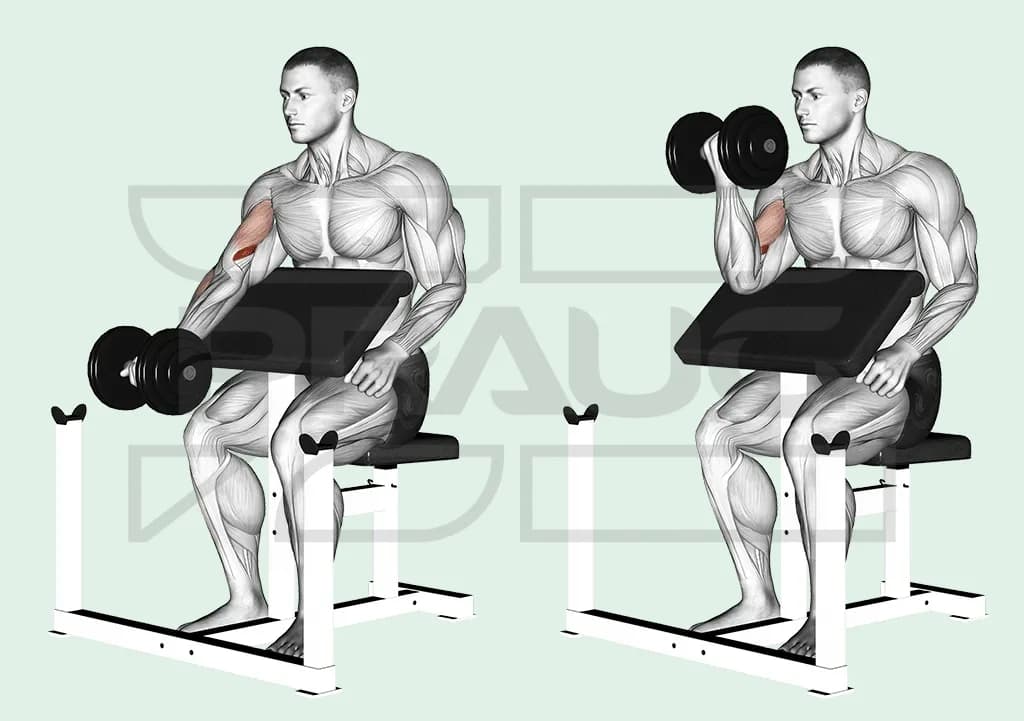
A preacher curl supports the upper arms on a pad in front of the torso while the elbows bend and straighten. A dumbbell, EZ bar or purpose-built machine can be used. Support changes the task but does not make an uncontrolled bottom position harmless.

Certified fitness coach · CQP Instructeur Fitness
Published on
The essentials before you start.
- Use secure support and practise the pickup and return.
- Keep the intended arm path and range repeatable.
- Research results apply to specific tasks and measured outcomes.
- Choose the workload within the whole week.
Exercise facts
- Main muscles
- Biceps brachii, Brachialis
- Secondary muscles
- Brachioradialis, Wrist flexors
- Equipment
- Preacher station, Dumbbell or EZ bar
What the movement trains
The biceps, brachialis and brachioradialis share elbow flexion. The shoulder is flexed and the resistance changes with the implement and pad geometry. A shoulder-forward position does not prove isolated short-head growth.
Set up and perform the movement
- Use a stable preacher station or a bench specifically suitable and secured for this supported task. Plan access to the weight and its return.
- Adjust the seat and pad so the upper arms are supported without hard pressure directly beneath the elbow joints.
- Take a secure grip with the shoulders comfortable and the torso steady. Start with a manageable load.
- Bend the elbows without lifting the upper arms away from the pad to finish.
- Lower smoothly to the elbow range you can retain. Do not bounce or let the weight fall into the long-lever bottom position.
- Return the implement securely before moving off the support.
Range, support and control
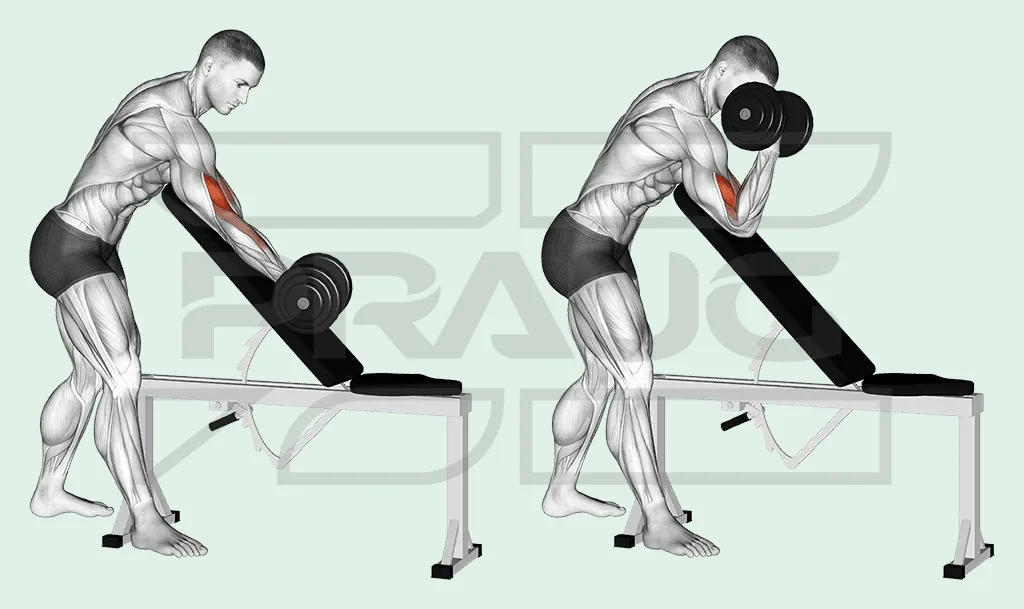
A pad supports the arms rather than locking the joints. Dumbbell, EZ-bar and machine versions have different resistance profiles; their load labels are not interchangeable. The illustrated bench adaptation requires suitable stable equipment, rather than any loose backrest.
What the cited research supports
The twelve-week comparison favoured preacher curls for brachialis and brachioradialis growth, and incline curls for biceps growth, without a clear total elbow-flexor difference or separate biceps-head measurements. In the nine-week study in thirty-eight women, a significant change at one preacher measurement site did not establish superiority between exercises. Acute activity patterns are a separate outcome.
Variations and alternatives
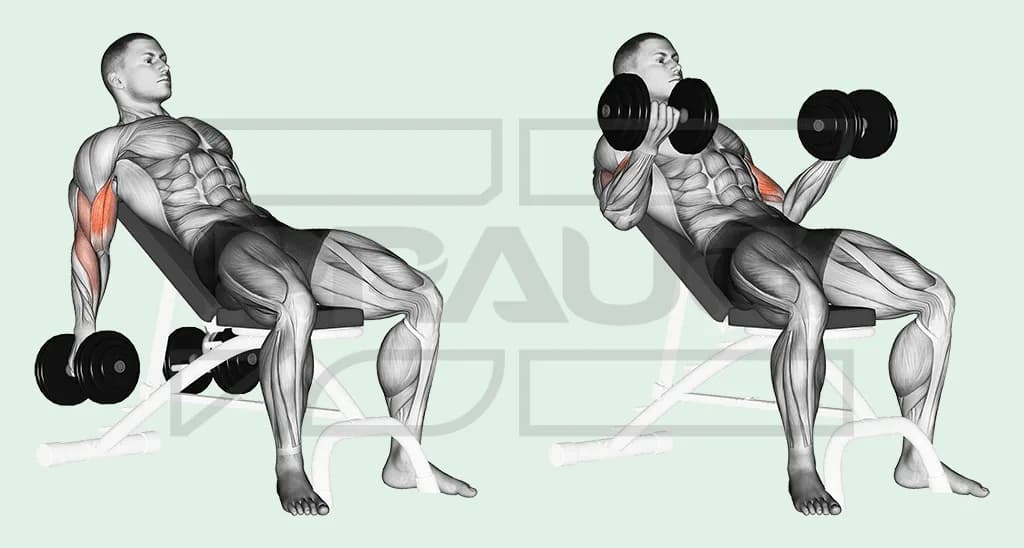
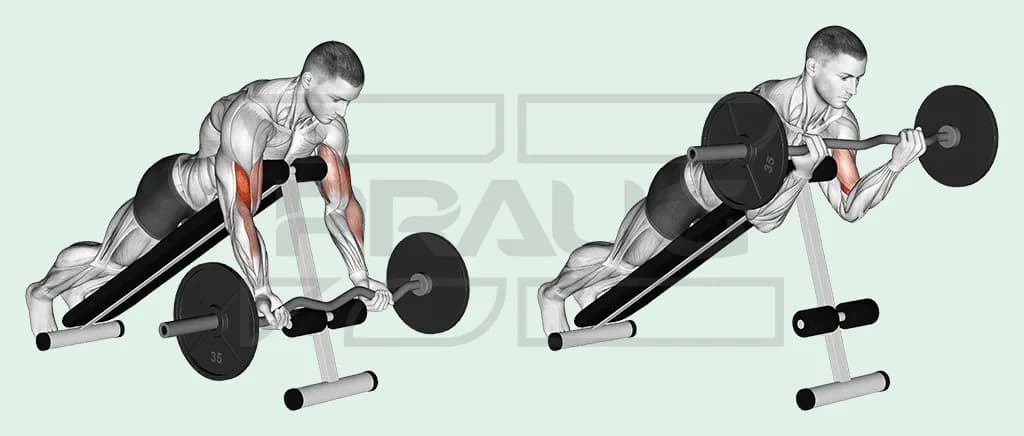
An incline curl changes shoulder position and loading. A concentration curl uses thigh support, and a spider curl supports the chest rather than the upper arms.
Sets, progression and tracking
One example is 2–3 sets of 8–15 repetitions with control still available. Record pad angle, implement, range and load. For one-arm work, record sets received by each side separately and account for other elbow-flexor work.
Illustrated positions and options
The images show example positions rather than individual range or load prescriptions. Bench adaptations require stable equipment intended for the task.
Illustrated option 1
Frequently asked questions
Does the study prove more growth near the elbow?
A change within one condition at one site is not automatically a difference between conditions. The cited findings do not establish a universal regional-growth advantage.
When should I add demand?
When the chosen setup, range and effort are repeatable and the next increment is manageable. Record changes rather than comparing different tasks as if they were identical.
Sources and limitations
Sources support the passages that cite them. Practical suggestions are coaching choices to adapt to your own situation.
- Kobayashi et al. · 2026 · Twelve-week incline versus preacher dumbbell-curl comparison with MRI in twenty-one untrained adults. ↗
Different individual muscle changes, without a clear total elbow-flexor difference; no separate biceps-head or spider-curl measurement.
- Oliveira et al. · 2009 · Acute long-head activity comparison of standing, incline and preacher dumbbell curls in twenty-two men. ↗
A single cycle at a submaximal load; not upright seated curls or later growth.
- Zabaleta-Korta et al. · 2023 · Nine-week incline versus preacher curl trial in thirty-eight women. ↗
Changes within a group at one measurement site do not establish a between-exercise regional-growth advantage.
This general information does not replace individual advice. Zepraug’s limitations.