Training· 3 min read
Russian twist: setup, technique and progression
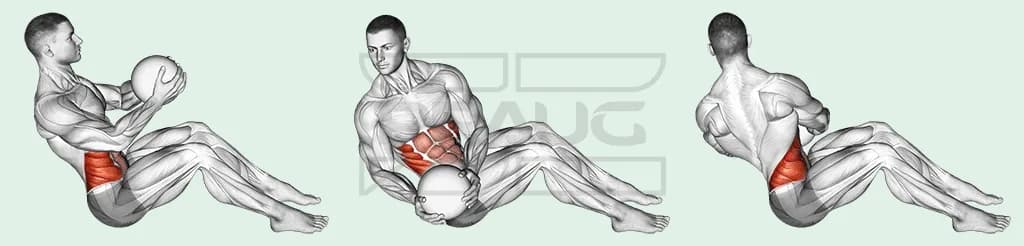
A Russian twist rotates the torso from a seated position with the knees bent. Keeping the feet on the floor is a usable option. Start with a small controlled turn rather than swinging a load between floor-touch targets.

Certified fitness coach · CQP Instructeur Fitness
Published on
The essentials before you start.
- Choose secure support and a manageable starting demand.
- Describe the intended trunk, hip and pelvic movement.
- Record lever, range and counting method consistently.
- Research measurements do not establish every variation or a local-fat-loss promise.
Exercise facts
- Main muscles
- External and internal obliques
- Secondary muscles
- Rectus abdominis, Transversus abdominis, Iliopsoas
- Equipment
- Bodyweight, Securely held medicine ball or plate, optional
What the movement trains
The obliques contribute to rotation while other trunk and hip muscles maintain the seated position. Turning only the hands is different from a deliberate torso turn; a larger lumbar twist is not automatically better.
Set up and perform the movement
- Sit on a comfortable surface with the feet supported and knees bent.
- Lean back only as far as the torso position remains manageable. Begin without an external load.
- Hold the hands in front of the chest and turn the torso through a small controlled range.
- Return through the centre and turn towards the other side without throwing the arms.
- Keep breathing and retain the chosen foot support and torso lean.
- Return upright and relax the legs when the set ends.
Range, support and control
Foot elevation and external load change balance and resistance. Do not force the hands to hit the floor or chase a maximal twist. A medicine ball or plate must stay securely held, rather than being dropped or caught near the feet.
What the cited research supports
The cited twenty-man pilot mapped activity during resisted isometric trunk tasks. It did not test dynamic Russian twists, later muscle growth or a fixed technique and dose. It cannot establish this exercise as a treatment or a universal rotation choice.
Variations and alternatives
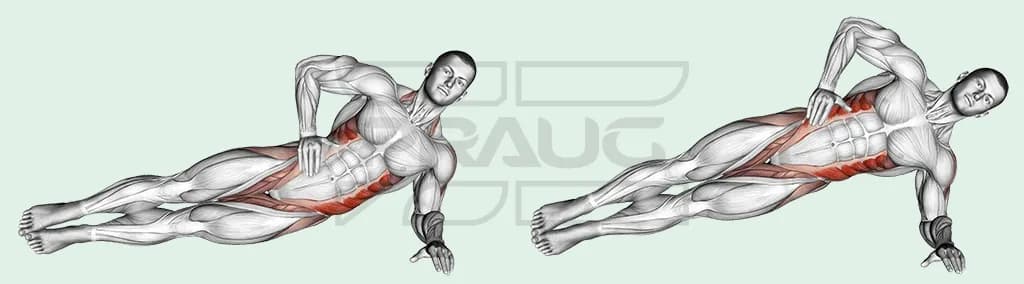
A Pallof press resists rotation rather than repeatedly producing it. A side plank changes the support and task.
Sets, progression and tracking
One option is 2–3 sets of 6–12 controlled turns per side with sufficient rest. Define one left turn and one right turn separately; do not silently change between per-side and total counts. Log lean, support, range and load.
Frequently asked questions
Must my heels be lifted?
No. Feet on the floor can help provide repeatable support. Raising them changes the task and is not a compulsory progression.
When should I add demand?
When the intended support, range and effort remain repeatable and the next change is manageable. Record changes rather than comparing different levers as if they were identical.
Sources and limitations
Sources support the passages that cite them. Practical suggestions are coaching choices to adapt to your own situation.
- Anders et al. · 2018 · Isometric trunk force-direction mapping in twenty healthy men. ↗
No dynamic Russian twist or bench side-bend training comparison; no later growth or individual treatment outcome.
This general information does not replace individual advice. Zepraug’s limitations.