Training· 3 min read
Single-arm cable lateral raise: setup, technique and progression
Other names: Low-cable lateral raise
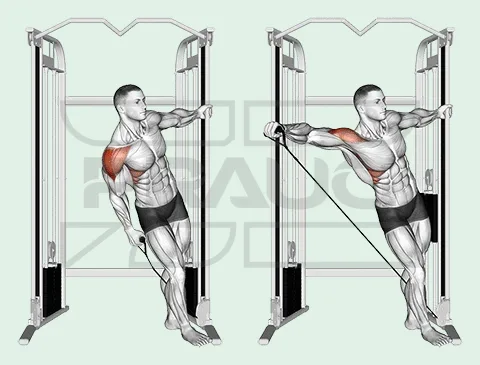
A single-arm cable lateral raise lifts the arm out to the side against a low pulley. The cable direction changes the shoulder’s resistance through the movement. A taut cable does not mean identical joint torque at every angle or guaranteed superiority to a dumbbell.

Certified fitness coach · CQP Instructeur Fitness
Published on
The essentials before you start.
- Use secure support and practise the pickup and return.
- Keep the intended arm path and range repeatable.
- Research results apply to specific tasks and measured outcomes.
- Choose the workload within the whole week.
Exercise facts
- Main muscles
- Lateral deltoid
- Secondary muscles
- Upper trapezius, Anterior deltoid, Supraspinatus, Forearm muscles
- Equipment
- Low cable pulley, Single handle
What the movement trains
The lateral deltoid contributes to raising the upper arm, with help from the rotator cuff and shoulder-blade muscles. The grip and trunk support the setup. Cable height, standing distance and arm path affect the task.
Set up and perform the movement
- Check the low pulley, secure single handle and clear cable path. Begin with a light load.
- Stand side-on and take the handle in the farther hand. Use suitable support with the free hand if helpful.
- Set a steady stance and a small comfortable elbow bend. A torso lean is optional rather than a required angle.
- Raise the upper arm outwards along a comfortable path, without driving the stack up with the hips.
- Use a controllable height, often around shoulder level, letting the shoulder blade move rather than pinning it down.
- Lower smoothly and settle the stack before changing hands or releasing the attachment.
Range, support and control
Passing the cable in front of or behind the legs changes clearance and direction. Use a path that cannot rub or catch and record it. The study did not establish a best leaning angle or fixed hand position.
What the cited research supports
Twenty-four trained adults completed eight weeks with one arm using cables and the other dumbbells, with matched range. Measured lateral-deltoid thickness increased similarly. The study did not compare every pulley position, torso lean or cable route, and does not establish identical outcomes for all setups.
Variations and alternatives
A dumbbell lateral raise changes the resistance profile. A machine or two-cable version changes support and handling. Re-establish a manageable load instead of comparing stack labels directly.
Sets, progression and tracking
An adjustable example is 2–4 sets of 10–20 repetitions per side. Three sets on each side gives each shoulder three sets. Rest enough to retain the stance and arm path; record pulley, cable route, range, load and effort.
Frequently asked questions
Does the cable always create more demand at the bottom?
The direction and moment arm determine shoulder torque. A loaded cable alone does not prove the same demand at every bottom position.
When should I add demand?
When the chosen setup, range and effort are repeatable and the next increment is manageable. Record changes rather than comparing different tasks as if they were identical.
Sources and limitations
Sources support the passages that cite them. Practical suggestions are coaching choices to adapt to your own situation.
- Larsen et al. · 2025 · Eight-week cable versus dumbbell lateral-raise trial in twenty-four trained adults. ↗
Matched range and similar measured lateral-deltoid thickness gains; no comparison of every torso lean, pulley position or cable route.
This general information does not replace individual advice. Zepraug’s limitations.