Training· 4 min read
Dumbbell front raise: setup, technique and progression
Other names: Front raise
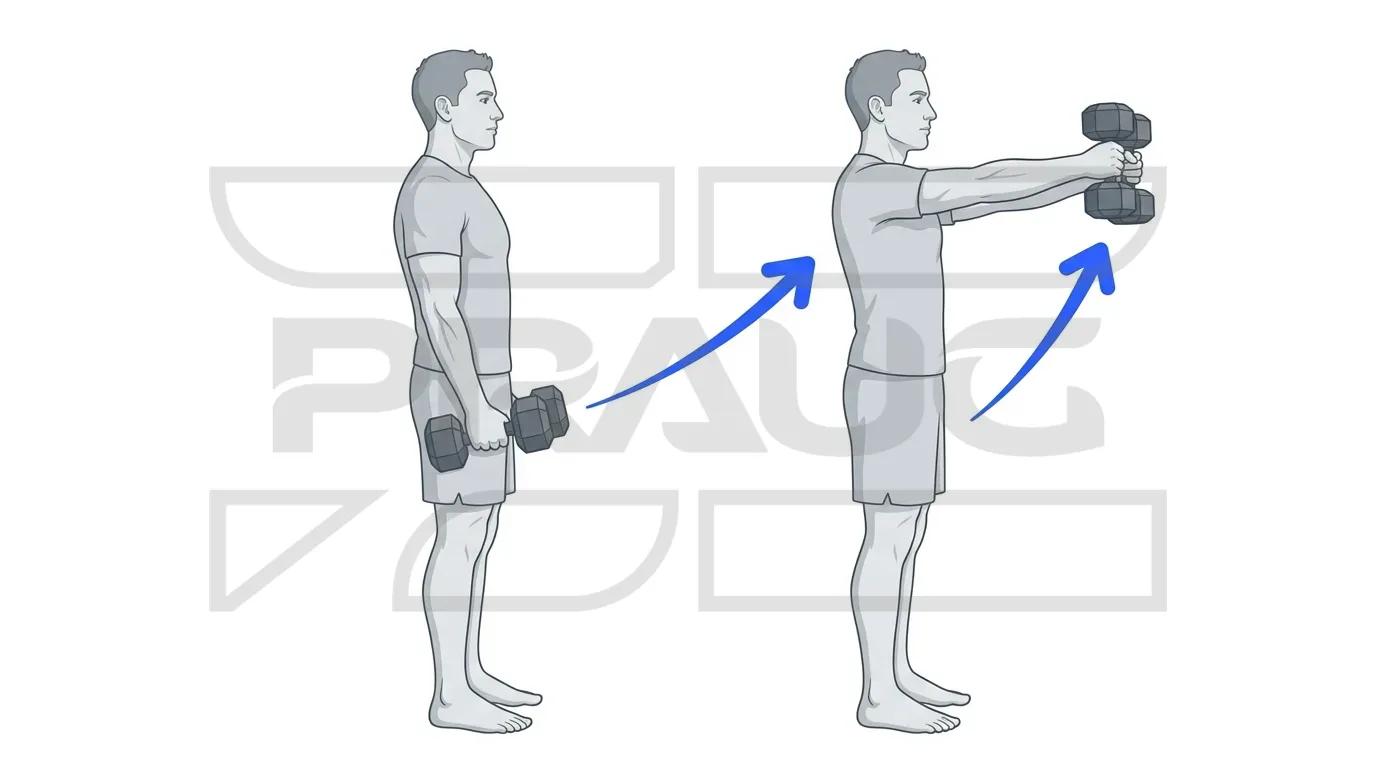
A dumbbell front raise lifts the upper arms in front of the body with a small elbow bend. Shoulder height can be a useful reference, rather than a compulsory endpoint. Choose a controllable path and count the front-shoulder work already provided by pressing.

Certified fitness coach · CQP Instructeur Fitness
Published on
The essentials before you start.
- Use secure support and practise the pickup and return.
- Keep the intended arm path and range repeatable.
- Research results apply to specific tasks and measured outcomes.
- Choose the workload within the whole week.
Exercise facts
- Main muscles
- Anterior deltoid
- Secondary muscles
- Pectoralis major, clavicular portion, Serratus anterior, Upper and middle trapezius, Biceps brachii
- Equipment
- Dumbbells
What the movement trains
The anterior deltoid contributes to shoulder flexion, with other shoulder and shoulder-blade muscles assisting. The movement does not isolate it completely, and allowing normal shoulder-blade motion is different from shrugging the weights up with momentum.
Set up and perform the movement
- Stand with stable feet and manageable dumbbells in front of or beside the thighs.
- Choose a secure palms-down or neutral grip and keep a small comfortable elbow bend.
- Raise the arms forwards without launching the weights with the hips or leaning backwards.
- Use a height that preserves control, often around shoulder level, without forcing a fixed endpoint.
- Lower smoothly through the same path rather than dropping the weights.
- Return the weights securely; alternating arms is an option if recorded clearly.
Range, support and control
An optional pause or two-to-three-second lowering phase can help practise control, but is not a growth requirement validated by the cited source. Do not force the shoulder blades to remain immobile. Going above shoulder height is a changed range, not automatically useless or a reason to force it.
What the cited research supports
The cited experiment compared presses, flyes and lateral raises in thirteen trained men. Front raises were not tested. Brief activity results do not establish this exercise’s later growth, ideal weekly dose or necessary placement at the end of a session.
Front and lateral raises describe different directions
The cited study did not test front raises. This comparison is a movement description, not a proven dose or growth ranking.
| Feature | Front raise | Lateral raise |
|---|---|---|
| Arm path | Upper arms move forwards | Upper arms move outwards, often slightly forwards of the torso |
| Main task | Shoulder flexion | Shoulder abduction |
| Appearance | No guaranteed shape change from this task alone | No guaranteed shoulder-width result from this task alone |
| Weekly amount | Choose alongside existing pressing | Choose alongside other shoulder work |
| Exercise order | By priority and ability to retain control | By priority and ability to retain control |
Variations and alternatives
A cable, plate or bar changes grip and resistance. A lateral raise moves in a different direction; one is not a mandatory companion to the other.
Sets, progression and tracking
One optional example is 2–3 sets of 10–15 repetitions. Less or no additional front-raise work may suit a week with substantial pressing. Log arm path, range, load and effort and use enough rest to keep the task repeatable.
Choose an option, reduce it or omit additional work where appropriate. These are adjustable examples, not compulsory finishers or doses established by the cited study.
| Possible option | Sets | Repetitions | Example rest |
|---|---|---|---|
| Moderate repeated work | 2–3 | 10–15 | 60–90 s or more as needed |
| Lighter repeated work | 2–3 | 15–20 | 45–60 s or more as needed |
| Optional longer set | 2 | 20–25 | 30–45 s or more as needed |
Frequently asked questions
Must every shoulder session include front raises?
No. The cited study did not establish that requirement. Choose the amount in the context of overhead and chest pressing.
When should I add demand?
When the chosen setup, range and effort are repeatable and the next increment is manageable. Record changes rather than comparing different tasks as if they were identical.
Sources and limitations
Sources support the passages that cite them. Practical suggestions are coaching choices to adapt to your own situation.
- Campos et al. · 2020 · Brief activity comparison of presses, flyes and lateral raises in thirteen trained men. ↗
Neither front raises nor pike push-ups were tested; not a long-term growth or workload trial.
This general information does not replace individual advice. Zepraug’s limitations.