Training· 4 min read
Barbell shrug: setup, technique and progression
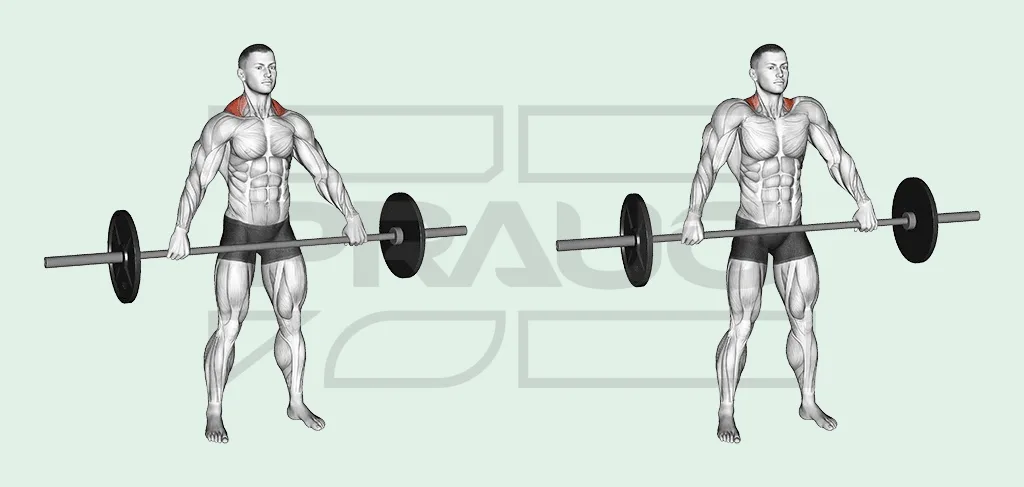
A barbell shrug raises and lowers the shoulders while the arms hold a bar in front of the thighs. It emphasises shoulder-blade elevation, with the upper trapezius contributing alongside other muscles. It is not a pull with the elbows and does not require circling the shoulders or moving the neck.

Certified fitness coach · CQP Instructeur Fitness
Published on
The essentials before you start.
- Use a secure setup and a load or assistance you can control.
- Keep the intended support, range and effort comparable between sessions.
- Variations change the task; acute activity does not rank long-term growth.
- Adapt the example workload to other training and recovery.
Exercise facts
- Main muscles
- Upper trapezius
- Secondary muscles
- Levator scapulae, Forearms, Abdominals, Spinal erectors
- Equipment
- Barbell, Rack
What the movement trains
The upper trapezius and levator scapulae contribute to elevation. The forearms hold the bar, while the trunk and hips help maintain the standing position. Feeling a neck-area muscle work is not evidence of postural correction, and a shrug does not train every trapezius task equally.
Set up and perform the movement
- Set the bar on appropriate rack supports around a manageable pickup height. Choose a load you can lift, hold and return securely.
- Take a secure overhand grip with the arms beside the body. Stand clear of the rack with stable feet and comfortable knees.
- Keep the head comfortable and the elbows long without forcing a rigid neck position.
- Raise the shoulders smoothly towards the ears through a controlled range. Avoid using the knees to launch the bar.
- Pause briefly if useful, then lower the shoulders under control rather than letting the load yank them down.
- Repeat the same range and return the bar to its supports. Stop before grip or body control prevents a secure finish.
What the cited research does and does not show
The acute shoulder study tested a unilateral shrug, not this bilateral barbell setup. Its activity finding cannot rank barbell versus dumbbell growth or establish a universal need for heavy shrugging. Do not turn an activity comparison into a treatment claim for neck symptoms.
Variations and alternatives
Dumbbells change hand position and clearance. A Smith machine guides the path and requires its own safety setup. A behind-the-back bar changes shoulder position and is not a necessary progression. Straps require a learned attachment and release method; they do not make any load suitable.
Sets, progression and tracking
One adjustable example is 2–4 sets of 10–15 repetitions. Use a load that preserves the chosen shoulder motion and finish method. Count other upper-back work when choosing volume and record grip, support, range and load; a heavier bar moved through a shorter range is a different comparison.
When to reduce the demand or change the setup
A change in range, support, body angle or assistance changes the comparison. Reduce the demand or finish the set when you cannot retain the movement you intended. An equipment label or a beginner/advanced category does not establish individual suitability.
Stop for sharp pain and seek appropriate individual advice for persistent symptoms. A new handle, support or variation does not diagnose or treat the cause.
Browse the back collection for other pulling and trunk tasks, or the back programme to choose work within a whole week rather than adding every guide together.
Frequently asked questions
Should I roll the shoulders?
This example uses controlled elevation and lowering, without a deliberate circular shoulder motion or elbow pull.
Does the cited study prove barbell shrugs build the most upper trapezius?
No. It tested acute activity including a unilateral shrug, not long-term barbell-versus-dumbbell growth.
When should I progress?
When the chosen movement and effort are repeatable. Change one demand deliberately and log any setup change.
Can this treat back or shoulder pain?
The guide and its cited activity studies do not establish an individual treatment. Persistent symptoms need suitable assessment.
Sources and limitations
Sources support the passages that cite them. Practical suggestions are coaching choices to adapt to your own situation.
- Ekstrom and al. · 2003 · Acute shoulder-exercise activity comparison including a shrug. ↗
A unilateral shrug was tested, not bilateral barbell versus dumbbell growth.
This general information does not replace individual advice. Zepraug’s limitations.