Training· 3 min read
Abdominal drawing-in exercise: setup, technique and progression
Other names: Stomach vacuum, Abdominal hollowing
An abdominal drawing-in exercise gently draws the lower abdominal wall in while breathing. It is often called a stomach vacuum, but the low-load version here does not require maximal exhalation, breath holding or a bodybuilding pose.

Certified fitness coach · CQP Instructeur Fitness
Published on
The essentials before you start.
- Choose secure support and a manageable starting demand.
- Describe the intended trunk, hip and pelvic movement.
- Record lever, range and counting method consistently.
- Research measurements do not establish every variation or a local-fat-loss promise.
Exercise facts
- Main muscles
- Transversus abdominis
- Secondary muscles
- Internal obliques, Diaphragm
- Equipment
- Bodyweight
What the movement trains
The transverse abdominis and other abdominal muscles participate in controlling the abdominal wall. Drawing in and bracing the whole abdominal wall are different strategies. Neither is a promise of a smaller waist, fat loss or a treatment.
Set up and perform the movement
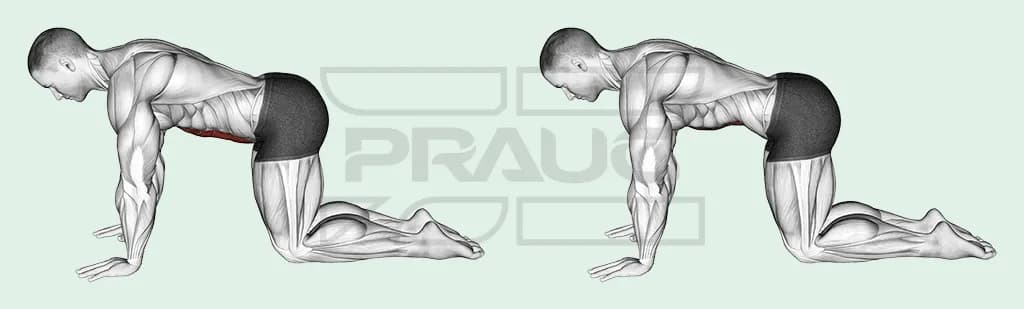
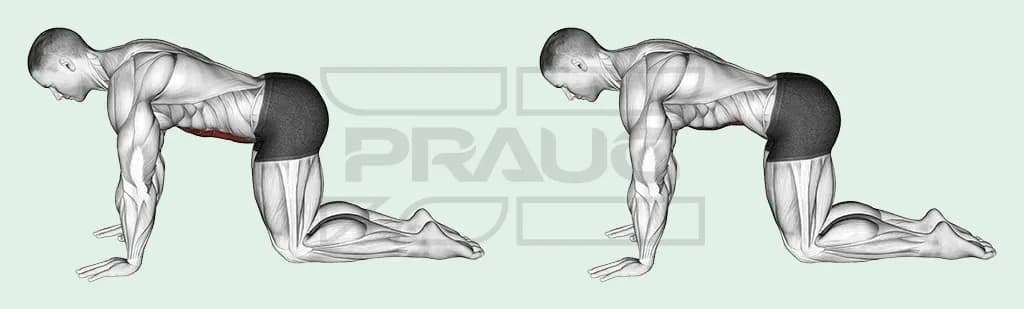
- Choose a comfortable lying position with knees bent, or hands and knees with secure support.
- Let the abdomen relax during a normal breath rather than taking repeated maximal breaths.
- Breathe out gently and draw the lower abdominal wall in a little without a large spinal or pelvic movement.
- Maintain light breathing while holding briefly. Reduce the effort if breathing becomes strained.
- Release fully and take normal breaths before repeating.
- Stop if dizzy or uncomfortable rather than extending a breath hold.
Range, support and control
On hands and knees, keep a manageable back position and avoid sucking in as hard as possible. In lying, keep the feet supported without forcing the low back flat. Seated and standing versions change position; they are not automatically advanced or better. This exercise is not a cue to keep the abdomen drawn in throughout heavy lifting.
What the cited research supports
The pilot study measured acute muscle recruitment during several voluntary tasks, including drawing the lower abdominal wall in while lying. It did not measure waist reduction or later symptoms. The eight-man hollowing-versus-bracing experiment modelled spinal stability under hand-held loads; it did not validate a breath-held vacuum routine or long-term treatment.
Variations and alternatives
A gentle seated version can practise the same abdominal-wall action with a different support. A front plank is a different whole-body support task, not an equivalent vacuum hold.
Sets, progression and tracking
An optional practice example is 3–5 brief holds of about 5–10 seconds with normal breaths between them, using less if needed. These are coaching examples rather than a dose established by the cited studies. Log position, breathing and control rather than maximum suction or waist change.
Illustrated positions and options
The images show example positions rather than an individual range, loading or breathing prescription. Use suitable equipment and a controlled return.
Illustrated option 1
Frequently asked questions
Must I empty my lungs and hold my breath?
No. The version described here uses a gentle drawing-in action with continued breathing. The cited experiments do not establish a maximal breath-held vacuum prescription.
When should I add demand?
When the intended support, range and effort remain repeatable and the next change is manageable. Record changes rather than comparing different levers as if they were identical.
Sources and limitations
Sources support the passages that cite them. Practical suggestions are coaching choices to adapt to your own situation.
- Urquhart et al. · 2005 · Pilot activity comparison of voluntary abdominal-wall drawing-in, bracing and pelvic tasks. ↗
Particular acute positions, including lying drawing-in; no waist-size, fat-loss or later symptom outcome.
- Grenier and McGill · 2007 · Hollowing versus bracing under hand-held loads in eight healthy men, with mechanical modelling. ↗
Estimated stability and compression, not a breath-held vacuum routine, waist reduction or long-term treatment.
This general information does not replace individual advice. Zepraug’s limitations.