Training· 3 min read
Ab wheel rollout: setup, technique and progression
Other names: Ab roller, Kneeling rollout
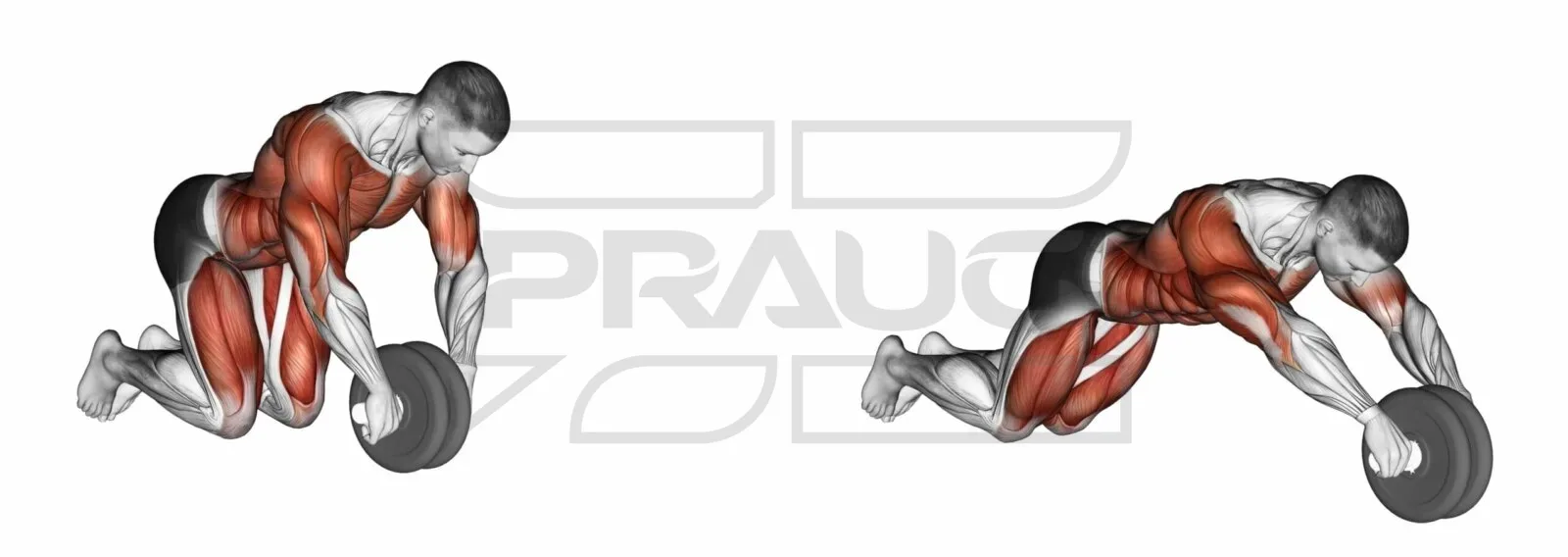
An ab wheel rollout moves a wheel away from the knees and back while the trunk resists unwanted extension. Choose a distance you can return from under control. A full kneeling or standing rollout is an optional task, not a required milestone.

Certified fitness coach · CQP Instructeur Fitness
Published on
The essentials before you start.
- Choose secure support and a manageable starting demand.
- Describe the intended trunk, hip and pelvic movement.
- Record lever, range and counting method consistently.
- Research measurements do not establish every variation or a local-fat-loss promise.
Exercise facts
- Main muscles
- Rectus abdominis, Transversus abdominis, Internal and external obliques
- Secondary muscles
- Latissimus dorsi, Deltoids, Triceps, Spinal erectors, Hip flexors
- Equipment
- Suitable ab wheel, Exercise mat
What the movement trains
The abdominal wall helps resist extension while the shoulders, arms and latissimus dorsi help control the wheel. The demand changes with reach and body position; it is not determined by distance alone.
Set up and perform the movement
- Inspect a suitable wheel and handles, clear the floor and use a non-slip surface with comfortable knee padding.
- Start on the knees with the wheel near the shoulders and a secure grip. Practise a short return first.
- Set the trunk and pelvis without forcing a maximal back flattening or holding the breath.
- Roll forwards slowly, opening the hips and shoulders only as far as the trunk position can be retained.
- Return smoothly before the low back sags or the wheel runs beyond a controllable distance.
- Finish on secure support. End the set before an unsuccessful return becomes a fall.
Range, support and control
A wall can limit travel if it is a suitable clear stop, but it does not make an uncontrolled approach safe. There is no required thirty-centimetre start, weekly step backwards or ten-repetition threshold for standing work. Diagonal, standing, barbell and suspension versions change the task and handling.
What the cited research supports
The twenty-one-person comparison included particular Power Wheel tasks and measured acute activity, not later growth. The plank comparison used isometric stable and suspended positions rather than a wheel. Neither validates every wheel, a fixed progression ladder or injury prevention. The six-week abdominal-exercise trial did not show a reduction in measured abdominal fat.
Variations and alternatives
A front plank or dead bug provides a different support and lever. Suspension rollouts require appropriate equipment and their own practice rather than an assumed equivalent load.
Sets, progression and tracking
One optional example is 2–3 short sets of 4–10 controlled repetitions at a manageable reach. Rest enough to retain the return. Log wheel, knee support, distance, range and effort before extending the lever or adding work.
Frequently asked questions
Must I progress to standing rollouts?
No. The cited studies do not establish that requirement or a universal repetition threshold. A shorter repeatable kneeling task remains a valid choice.
When should I add demand?
When the intended support, range and effort remain repeatable and the next change is manageable. Record changes rather than comparing different levers as if they were identical.
Sources and limitations
Sources support the passages that cite them. Practical suggestions are coaching choices to adapt to your own situation.
- Escamilla et al. · 2006 · Acute activity comparison of traditional and device-based abdominal tasks in twenty-one adults. ↗
Specific Power Wheel, strapped knee-up, inclined reverse-crunch and floor tasks; not every commercial device, later growth or injury outcomes.
- Calatayud et al. · 2017 · Activity during eight stable and suspended isometric plank variations in twenty students. ↗
No wheel rollout training intervention or modelled spinal loading; not a validated progression ladder.
- Vispute et al. · 2011 · Six-week abdominal-exercise trial in twenty-four sedentary adults. ↗
Curl-up endurance improved without significant changes in the measured abdominal-fat outcomes; not every exercise or combined lifestyle intervention.
This general information does not replace individual advice. Zepraug’s limitations.