Training· 5 min read
45-degree leg press: setup, range and foot position
Other names: Inclined leg press, Sled leg press
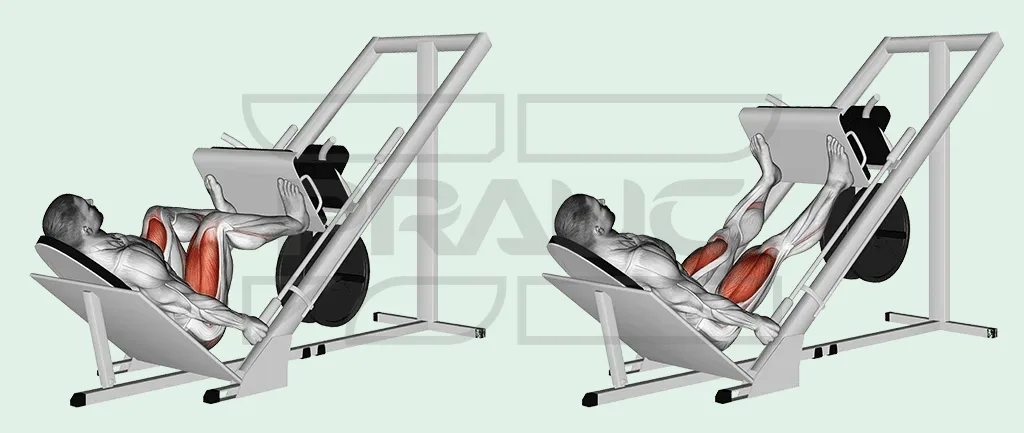
A 45-degree leg press moves a loaded sled along inclined rails while your back and pelvis are supported. The knees and hips bend on the return and extend as you press. Set the stops and practise the release and re-racking method before adding a demanding load.

Certified fitness coach · CQP Instructeur Fitness
Published on
The essentials before you start.
- Follow the instructions for the model and test the stops and exit method.
- Keep the pelvis and back supported through a range you can control.
- Do not compare plate totals directly with squats or a different leg-press machine.
- A backrest changes support; it does not eliminate all spinal loading or make failed repetitions harmless.
Exercise facts
- Main muscles
- Quadriceps
- Secondary muscles
- Gluteus maximus, Adductors, Hamstrings
- Equipment
- Inclined sled leg-press machine
What the leg press trains
The quadriceps contribute to knee extension while the glutes and adductors contribute at the hips. Hamstrings and other muscles can assist, but the movement does not replace a seated knee curl or every hip-hinge task.
Two small studies cited here measured acute muscle activity and knee mechanics during squats, leg presses and other knee exercises. They do not identify the machine angle or foot placement that produces the most long-term growth.
The supported position changes the balance and loading arrangement compared with a barbell squat. It does not remove every demand on the back or prove that a person with back pain should use this machine.
How to use the sled with control
Machines differ in backrest angle, platform, catches and stops. Follow that model’s instructions and establish a safe return method with a light load.
- Adjust the backrest and stops for a range you can control, and check how to secure the sled again.
- Sit with the pelvis and back supported. Place the feet around hip to shoulder width near the middle of the platform as a starting position.
- Press enough to release the catches using the intended handles. Keep a firm foot position and control of the sled.
- Bend the knees and hips smoothly, allowing the knees to move broadly with the feet.
- Stop before depth requires an uncontrolled pelvic roll or loss of support. Thigh-to-chest contact is not a compulsory target.
- Press smoothly to the intended finish without snapping into hyperextension or resting heavily on the end position.
- Fully engage the catches and check the sled is supported before leaving the machine.
High, low, wide or narrow feet?
Moving the feet changes the available knee and hip motion, but it does not neatly switch one muscle on and another off. The tested foot-angle changes did not produce a universal muscle-activity advantage.
Use a placement that keeps the whole foot securely on the platform and allows a repeatable range. Do not put the feet so low that they slip off or choose an extreme width just to chase a claimed muscle-isolation effect.
Record the position, backrest and machine model when comparing sessions. A higher-foot setup is not automatically a treatment for knee pain, and stack or plate totals depend on the equipment mechanics.
Common errors and other uses
An uncontrolled deep return, lifting the pelvis, pushing the knees with the hands or adding plates while progressively shortening the range changes the task. Reduce the demand and restore the intended movement rather than pursuing a large plate total.
A straightened knee is not the same as an uncontrolled snap into hyperextension. Choose a stable finish suited to your range, without using the joints as a sudden stop. Use breathing you can sustain rather than a prolonged strained breath-hold.
One-leg pressing is an option only on equipment designed for it, with suitable load and pelvic control. A horizontal leg press has different mechanics and settings. Calf work on a leg press is a separate task with its own foot security and stop requirements; do not improvise it at the edge of a heavily loaded platform.
Sets, repetitions and place in a session
A coaching example is 3–4 sets of 8–15 repetitions with enough rest to repeat the movement, often around two minutes for demanding work. Adapt it to current capacity and the rest of the week. A supported setup does not make fatigue purely local or justify unlimited drop sets.
It can be the main knee-and-hip extension task or additional work after another movement. You do not need to add it after every squat. Compare quadriceps exercises according to support, equipment and goals.
Track the model, backrest, foot position, stop setting, depth, load and repetitions. Progress within a stable setup, and seek individual advice for persistent or concerning pain rather than assuming the machine removes the cause.
Frequently asked questions
Does the leg press spare my spine completely?
No. The support changes the task but does not eliminate spinal loading or establish suitability for a particular back condition.
How far should the sled come down?
Use a controlled range that retains the intended back and pelvic support. Do not force the thighs against the chest.
Can foot height isolate the glutes or quadriceps?
It changes the mechanics, but the cited acute studies do not establish a precise long-term isolation effect.
Why is the plate total much higher than my squat?
Sled angle, friction, counterbalancing and support differ. The displayed loads are not interchangeable measures of leg strength.
Sources and limitations
Sources support the passages that cite them. Practical suggestions are coaching choices to adapt to your own situation.
- Escamilla et al. · 2001 · Knee mechanics and muscle activity under squat and leg-press technique variations. ↗
Ten trained men and acute measurements; no long-term growth, injury follow-up or comparison of every machine angle.
- Escamilla et al. · 1998 · Acute knee mechanics during squats, leg presses and knee extensions. ↗
Ten men, a few repetitions and modelled internal forces. It does not identify the best long-term growth or injury-prevention exercise.
This general information does not replace individual advice. Zepraug’s limitations.