Training· 3 min read
Kneeling cable crunch: setup, technique and progression
Other names: High-cable crunch
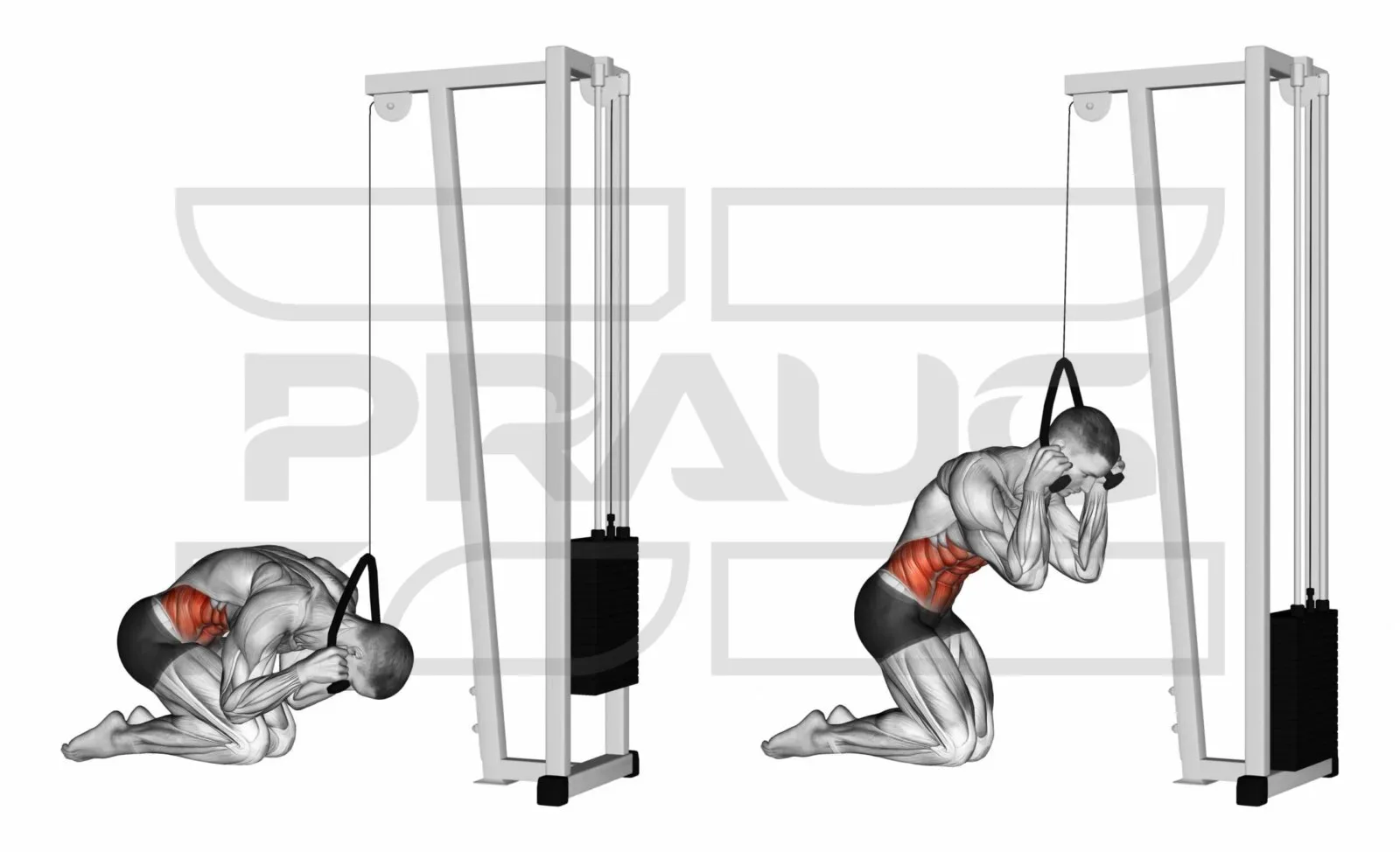
A kneeling cable crunch curls the trunk against a high cable while the hands hold an attachment near the head. The load should be controlled through a repeatable trunk movement, rather than pulled down by the arms or moved by sitting onto the heels.

Certified fitness coach · CQP Instructeur Fitness
Published on
The essentials before you start.
- Choose secure support and a manageable starting demand.
- Describe the intended trunk, hip and pelvic movement.
- Record lever, range and counting method consistently.
- Research measurements do not establish every variation or a local-fat-loss promise.
Exercise facts
- Main muscles
- Rectus abdominis
- Secondary muscles
- External and internal obliques, Transversus abdominis
- Equipment
- High cable pulley, Rope attachment
What the movement trains
The abdominal wall contributes to trunk flexion. The hips and arms support the setup. Stack labels, pulley ratios, attachment position and trunk path all affect the task; the listed kilograms are not a direct measure of abdominal force.
Set up and perform the movement
- Check the high pulley, rope or suitable attachment and secure connection. Begin light.
- Kneel on suitable padding at a distance that leaves a clear cable path and a stable starting position.
- Bring the handle near the sides of the head without pulling on the neck. Keep the grip secure.
- Curl the upper torso towards the pelvis while keeping the hip position reasonably repeatable.
- Use a range that you can control; elbow contact with the thighs is not required. Return smoothly without the stack jerking the torso upwards.
- Settle the stack securely before releasing the attachment or standing.
Range, support and control
An intentional hip hinge is a different movement from the intended crunch. Do not force the neck down or use a heavier stack merely because the hands can pull it. Kneeling distance and elbow position are adjustable references.
What the cited research supports
The loaded-crunch study compared a Swiss ball with elastic resistance and a seated machine, not cable crunches. The other studies examined isometric activity patterns and a short abdominal-training intervention. They do not establish this pulley task as the best growth option or a way to selectively remove abdominal fat.
Variations and alternatives
A floor crunch changes external resistance and support. Standing, low-cable or oblique versions need a new setup; the cited trials do not rank those options.
Sets, progression and tracking
One adjustable example is 2–4 sets of 8–15 repetitions. Rest enough to retain the trunk path and controlled return. Record station, pulley height, attachment, stance, range and effort, alongside other direct abdominal work.
Movement video
The demonstration shows one setup, rather than an individual range or loading prescription.
Kneeling cable crunch movement demonstration
Frequently asked questions
Must my elbows touch my thighs?
No. That contact depends on proportions and setup. Use a repeatable trunk range without turning the task into an arm pull or a hip hinge.
When should I add demand?
When the intended support, range and effort remain repeatable and the next change is manageable. Record changes rather than comparing different levers as if they were identical.
Sources and limitations
Sources support the passages that cite them. Practical suggestions are coaching choices to adapt to your own situation.
- Sundstrup et al. · 2012 · Loaded Swiss-ball-with-elastic versus seated-machine crunch activity in forty-two adults. ↗
Three repetitions at a ten-repetition-maximum load; no cable crunch, later growth or treatment outcome.
- Lehman and McGill · 2001 · Regional rectus-abdominis activity during controlled isometric tasks in eleven selected participants. ↗
No clear upper-versus-lower activity difference in those tasks; no dynamic-variation ranking or regional-growth measurement.
- Vispute et al. · 2011 · Six-week abdominal-exercise trial in twenty-four sedentary adults. ↗
Curl-up endurance improved without significant changes in the measured abdominal-fat outcomes; not every exercise or combined lifestyle intervention.
This general information does not replace individual advice. Zepraug’s limitations.