



training2 min read
Do you need to train to failure on every set?
A set can be demanding without ending in an impossible repetition. Training to failure is a tool to consider alongside exercise choice, intended effort and session fatigue.

Certified fitness coach · CQP Instructeur Fitness
Published on

The essentials before you start.
- Getting close to failure differs from reaching it on every set.
- Define range of motion and technique before judging effort.
- Fatigue should fit the sets and sessions that follow.
Define failure using movement criteria
Momentary muscular failure means being unable to complete a repetition under the movement criteria. Deteriorating technique is already a cue to stop.
Guidelines do not make failure on every set essential. Getting close to failure and reaching it on every set are different strategies.
The cited meta-regressions associated closer-to-failure sets with greater hypertrophy, using estimated repetitions in reserve. They do not show that every set must reach failure or establish one exact stopping point for everyone.
Reference: ACSM ↗Robinson ZP et al. · 2024 ↗

Load, technique and repetitions in reserve
Increasing cheating just to finish does not automatically improve a set. Fatigue cost and safety conditions matter too.
- Controlled load
- Defined technique
- Repetitions still possible
Fit demanding sets into the training week
Depending on experience, a stable exercise that is easy to stop may suit very hard effort better. Plan appropriate safeties and assistance.
- Quality of later sets
- Next-session performance
- Fatigue you can manage across the week
A practical way to use this
Before a set, define the range of motion, technique and effort you want to reproduce. Continuing when movement deteriorates does not make comparisons more useful. Record your estimate of repetitions remaining alongside performance. Estimation takes practice; it does not require deliberately failing in every session.
Context and limits
Train with real effort without making constant failure a badge of commitment. Adjust for the exercise and your recovery.
Evidence does not establish an exact ideal number of repetitions in reserve for every exercise and person. These cues do not replace technique coaching.
Reference: ACSM ↗Robinson ZP et al. · 2024 ↗
From the post to your practice
Explore the carousel.
Explore the visual version of this topic on @zepraug.
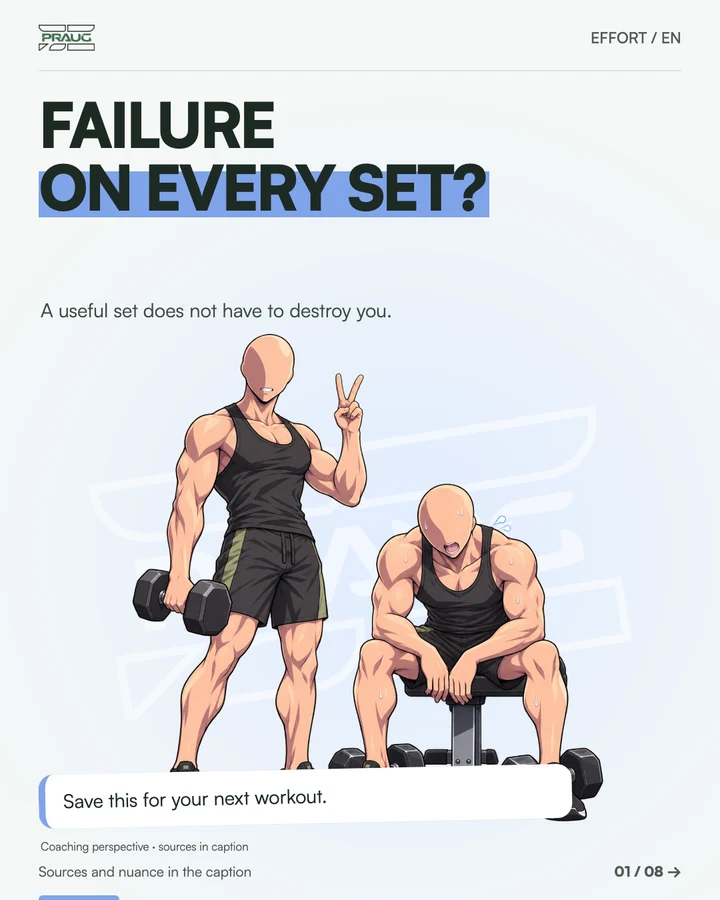
Do you need to train to failure on every set?
The carousel is coming to Instagram. Scheduled for 11 November 2026.
Sources and limitations
Sources support the passages that cite them. Practical suggestions are coaching choices to adapt to your own situation.
- ACSM · Updated resistance training guidelines, 2026 ↗
ACSM official summary of its 2026 Position Stand for healthy adults. Failure on every set is not generally essential; it is not an individual coaching or rehabilitation prescription.
- Robinson ZP et al. · 2024 · Exploring the Dose-Response Relationship Between Estimated Resistance Training Proximity to Failure, Strength Gain, and Muscle Hypertrophy: A Series of Meta-Regressions. ↗
Exploratory meta-regressions using estimated repetitions in reserve. Closer-to-failure sets were associated with greater hypertrophy, but the exact relationship and ideal individual stopping point remain uncertain.
This general information does not replace individual advice. Zepraug’s limitations.